Introduction
Most businesses settle for template websites that look identical to competitors, limit functionality, and can't scale—creating a credibility and capability gap in a market where digital first impressions determine trust. Research from Stanford University reveals that 46.1% of users assess a website's credibility based purely on its visual design, and the Nielsen Norman Group found these aesthetic judgments form in just 50 milliseconds. When your site looks like thousands of others using the same WordPress theme or Squarespace template, you're actively undermining the trust you need to convert visitors into customers.
Bespoke development is how businesses close that gap. This article covers what it is, why it outperforms off-the-shelf solutions, how the process works, who benefits most, and what to look for in a development partner—whether you're a startup building a differentiated product or an enterprise that's outgrown what generic software can deliver.
What is Bespoke Web Development?
Bespoke web development is the process of building a website or web application entirely from scratch, custom-coded to match a business's specific goals, brand identity, workflows, and user needs—as opposed to configuring a pre-built theme or template.
In bespoke development, every feature, UI element, and integration is purpose-built for your business. Nothing is inherited from a generic template designed for mass-market use.
Your checkout flow, user dashboard, navigation structure, and data integrations are all designed around how your customers behave and how your business operates.
TLDR: Key Takeaways
- Custom code built for your needs — not configured around a template's limitations
- Delivers better performance, tighter security, and a distinct brand identity
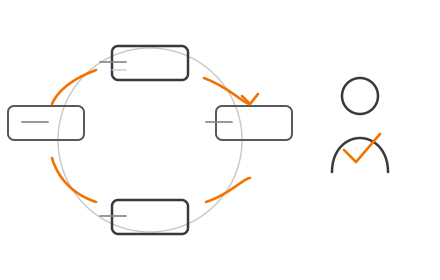
- Follows structured phases: discovery, design, development, testing, and post-launch support
- Best fit for startups, SMEs with specialized workflows, and enterprises needing differentiation
- Choose a partner with end-to-end capabilities, industry experience, and AI readiness
Bespoke vs. Off-the-Shelf: Why Templates Fall Short
Templates appeal for obvious reasons: quick setup and low upfront cost. For very basic use cases—a simple brochure site with minimal functionality—they can work. But they break down quickly when businesses need unique functionality, high performance, or the ability to scale.
The Hidden Costs of Template Platforms
Off-the-shelf platforms carry significant technical debt:
- Constrained by what the theme developer built, not what your business actually needs
- Redundant code from unused features slows page speed—Google reports that 53% of mobile visits are abandoned if a page takes longer than three seconds to load
- Bloated themes make passing Core Web Vitals difficult, directly impacting search rankings
- Adding new features often requires expensive workarounds or complete rebuilds
Those scalability limits don't just stall growth—they push businesses toward a pattern that compounds costs further.
The Workaround Trap
Businesses using WordPress, Shopify, or similar platforms often spend significant time and money adding plugins, patching limitations, and building integrations that a bespoke solution would have natively. Patchstack reported 5,948 new WordPress vulnerabilities in 2023 (a 24% year-over-year increase), with 97% originating from third-party plugins. Every plugin added to patch a template gap introduces new security exposure. The maintenance burden accumulates until the "affordable" template is costing more than a custom build would have.

The Baymard Institute tracks a 70.19% average global cart abandonment rate, with standardized checkout flows frequently the sole cause. When your conversion path is dictated by a template rather than designed around your customers' actual journey, you're leaving revenue on the table.
Key Benefits of Bespoke Web Development
Tailored Functionality and Workflows
Bespoke solutions are designed around how your business actually operates. This enables:
- Unique user flows that match customer behavior patterns
- Custom dashboards displaying the exact metrics your team needs
- Role-based access controls tailored to your organizational structure
- Specialized modules that no template can replicate out of the box
For businesses in sectors like investment management or private lending, where workflows are highly specialized, this customization is essential. Codiot has hands-on experience building bespoke solutions for clients in investment and finance sectors, creating client portals and custom platforms that off-the-shelf tools simply cannot accommodate.
Superior Scalability
Unlike templates that buckle under new feature requirements, bespoke applications are architected for growth from day one. Modular codebases allow teams to:
- Add capabilities without expensive rewrites
- Handle increased user loads with proper infrastructure planning
- Integrate new systems as business needs evolve
- Avoid the technical debt that accumulates from forced customizations
Grand View Research projects the global custom software development market will grow from $43.16 billion in 2024 to $146.18 billion by 2030, representing a 22.6% CAGR. That growth rate signals a clear shift: enterprises are increasingly finding that packaged platforms cannot sustain long-term product differentiation.
Enhanced Security
Scalability and security are closely linked — growth attracts risk, and off-the-shelf platforms magnify it. Custom-built systems allow developers to implement security controls specific to your business's risk profile and regulatory environment, which matters especially in finance, investment, and private lending where a single breach carries serious legal and reputational consequences.
Sucuri's 2023 report revealed that WordPress accounted for 95.5% of infected CMS platforms in their remediation dataset, with 39.1% of compromised sites running outdated software at the time of infection. Bespoke architectures eliminate reliance on vulnerable third-party plugin ecosystems that act as significant attack vectors.
Brand Differentiation and UX Control
A bespoke website reflects your company's identity with precision:
- Unique visual language that reinforces brand trust
- Interaction design tailored to your audience's expectations
- Content flows optimized for your specific conversion goals
- Zero risk of looking identical to competitors using the same template
Users form credibility judgments in 50 milliseconds based on visual design alone. A generic template hands that judgment — and that first impression — to the template vendor, not your brand.
Long-Term Cost Efficiency
While upfront investment is higher, bespoke development removes recurring costs and technical friction:
- Zero per-seat licensing fees that scale with growth
- Reduced plugin dependency and associated maintenance overhead
- Elimination of costly workarounds and forced customizations
- IDC research shows custom web applications deliver 32% higher ROI over five years compared to off-the-shelf alternatives
Gartner's "Buy, Build, Blend" framework recommends building custom software for the 10–15% of capabilities that truly differentiate a business, avoiding long-term customization debt and integration friction.
The Bespoke Web Development Process Step by Step
Discovery and Requirements Gathering
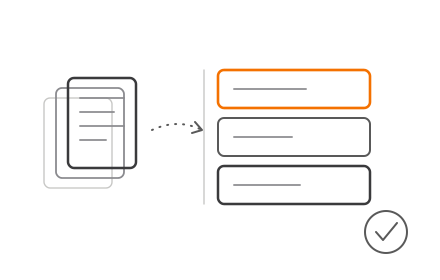
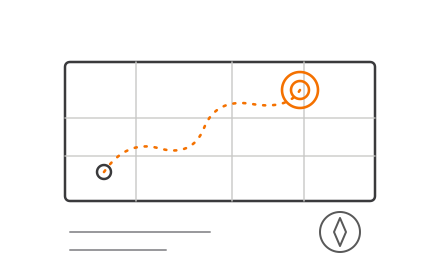
The project begins with deep consultation between the client and development team to define business objectives, user needs, technical requirements, and success metrics. Misalignment at this stage is a leading cause of project failure, so thorough documentation is essential.
Key activities include:
- Stakeholder interviews to understand business goals
- User research to identify pain points and workflows
- Technical requirements definition
- Success metrics and KPI establishment
- Competitive analysis and market positioning review

Design, Prototyping, and Architecture
UI/UX Design Phase
Designers create wireframes and interactive prototypes that define the visual experience and user journeys before a single line of code is written. This phase ensures the end product serves real users effectively and allows for low-cost adjustments.
The design process includes:
- Low-fidelity wireframes for structure and flow
- High-fidelity prototypes for visual design and interactions
- User testing to validate assumptions
- Design system creation for consistency
- Responsive design planning for all devices
Technical Architecture Planning
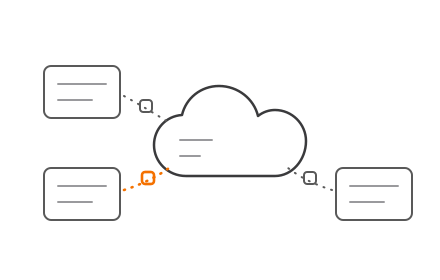
The development team selects the appropriate tech stack, defines the system architecture, and plans integrations with third-party APIs, CRMs, ERPs, or data platforms. These decisions shape the application's long-term scalability, performance, and how easily it can be maintained or extended.
Architecture considerations include:
- Frontend and backend technology selection
- Database architecture and data modeling
- API design and third-party integration planning
- Security framework implementation
- Performance optimization strategy
Development, Testing, and Launch
Custom Development and Integration
Front-end and back-end development proceeds in sprints, with continuous integration of features, third-party APIs, and data systems. Regular check-ins with the client ensure the build stays aligned with requirements.
QA, Testing, and Deployment
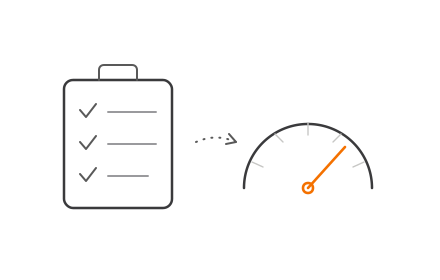
The application undergoes rigorous functional, performance, security, and usability testing before going live. Finding bugs pre-launch is dramatically cheaper than fixing them post-release — QA is as much a budget protection measure as a quality one.
A Deloitte Digital study found that a 0.1-second improvement in mobile site speed increased retail conversions by 8.4% and average order value by 9.2%. Performance testing ensures your bespoke build meets these benchmarks.
Post-Launch Support and Evolution
Ongoing maintenance, security patching, performance monitoring, and iterative feature development protect the investment and keep the application competitive as user needs evolve.
Who Should Invest in Bespoke Web Development?
Startups Building a Differentiated Digital Product
For founders with a unique product concept, a bespoke application is the only way to bring that vision to life. Generic templates can't accommodate novel workflows or provide the branded, conversion-optimized experience early users expect.
SMEs with Specialized Operational Needs
Businesses in industries with unique workflows—such as investment management, private lending, or financial services—benefit from custom-built portals, client dashboards, and automated workflows that off-the-shelf tools can't replicate. Codiot has direct experience building these solutions for investment and finance clients, where regulatory nuance and process complexity make generic platforms a poor fit.
Enterprises Seeking a Competitive Edge
Large organizations use bespoke tools to create proprietary capabilities that competitors using generic software cannot match. Custom analytics, AI-powered features, and deep system integrations become unique strategic assets.
McKinsey reports that AI "high performers" already attribute more than 10% of EBIT to their use of Generative AI. These capabilities require bespoke integration that off-the-shelf platforms cannot provide.
Any Business Where the Website Is a Revenue-Critical Channel
If your website directly drives leads, sales, or client onboarding—rather than just serving as a digital brochure—template limitations translate into real revenue loss. Signs you've outgrown an off-the-shelf solution:
- Conversion rates plateau despite ongoing content or ad spend improvements
- The site can't support custom onboarding flows, pricing logic, or integrations
- Brand credibility suffers because the design looks like everyone else's template
- Performance bottlenecks appear as traffic or transaction volume grows

In these situations, the cost of staying generic typically exceeds the cost of building right.
What to Look for in a Bespoke Web Development Partner
Technical Breadth and Full-Spectrum Delivery
Look for a partner capable of handling every layer—from UI/UX design to front-end and back-end development, API integrations, and post-launch support—so there's no handoff friction between agencies or freelancers.
Codiot, for example, covers design, development, data engineering, and AI integration under one roof, which means a single team owns the outcome from kickoff to go-live.
Industry Experience and a Proven Process
Ask prospective partners for case studies in your sector and evidence of a structured discovery and QA process. Vague workflows and thin portfolios are red flags. Transparent timelines and clear IP ownership terms are non-negotiable.
Key questions to ask:
- Can you share case studies from my industry?
- What does your discovery and requirements process involve?
- How do you handle QA and testing before launch?
- What are your standard IP ownership terms?
- What does post-launch support look like?
AI Readiness and Long-Term Scalability
Beyond credentials and process, check whether a prospective partner builds with AI in mind from day one. Bespoke solutions now routinely incorporate AI capabilities: intelligent search, personalization engines, automated workflows, and real-time data analysis. Gartner predicts that by 2026, more than 80% of enterprises will have used GenAI APIs or deployed GenAI-enabled applications.
The financial case is hard to ignore. IDC's 2024 study found that for every $1 invested in generative AI, the average ROI is $3.7x — with top performers hitting $10.3x. Capturing those returns requires deep, architecture-level integration, not a bolted-on feature. That's exactly where bespoke development earns its place.
Frequently Asked Questions
What is bespoke website development?
Bespoke website development is building a site entirely from scratch to match specific business requirements, rather than configuring a pre-built template. Every feature, design element, and integration is custom-coded for your unique needs.
How much does bespoke web development cost?
Costs depend on complexity, features, and integrations — typically ranging from ₹5 lakh for simpler builds to ₹50 lakh or more for enterprise platforms. The higher upfront investment usually pays off through better performance, avoided licensing fees, and long-term scalability.
How long does bespoke web development typically take?
Most projects run 10–20 weeks end to end — discovery and design typically take 2–4 weeks, with core development spanning 8–16 weeks depending on scope and integrations.
Is bespoke web development better than WordPress or Squarespace?
WordPress and Squarespace suit basic needs, but bespoke is the better choice when a business needs unique functionality, high performance, custom integrations, or advanced security that pre-built platforms cannot deliver. If your roadmap includes custom workflows, third-party API integrations, or rapid scaling, bespoke development is the right direction.
Who owns the code in a bespoke web development project?
The client typically owns the full source code and usage rights. Always confirm this in the contract before the project starts — it protects your digital assets and avoids disputes down the line.