Business Intelligence Consultants

Introduction

Organizations today face a paradox: more data than ever before, yet 87% still operate at low BI and analytics maturity. The gap isn't technological—it's operational. Companies collect millions of data points across CRM systems, ERPs, and financial platforms, but most leadership teams still make critical decisions based on outdated spreadsheets or intuition.

This disconnect costs real money. Poor data quality alone drains $12.9 million annually from the average organization, while 68% cite data silos as their primary challenge. Most organizations have the data. What they lack is a framework to turn it into decisions.

Business intelligence consultants bridge this gap. Unlike data analysts who pull reports, BI consultants assess your entire data ecosystem, recommend infrastructure improvements, build governance frameworks, and translate findings into business recommendations.This article covers what BI consultants actually do, clear signs your organization needs one, and how AI is reshaping the discipline.


TLDR

  • BI consultants transform fragmented data into strategic assets by building governance frameworks, not just dashboards
  • Poor data quality costs ₹107 crore annually; 68% of organizations struggle with siloed data across departments
  • Essential skills include SQL/data modeling, BI platform proficiency across Power BI, Tableau, and Looker, plus business acumen
  • AI integration—predictive analytics, natural language querying, automated anomaly detection—has become a baseline expectation, not a differentiator
  • Choose partners who handle the full stack—data engineering, modeling, visualization, and change management

What Is Business Intelligence Consulting?

Business intelligence consulting helps organizations collect, analyze, and act on data to improve decision-making, operational efficiency, and competitive positioning. Unlike IT consulting (infrastructure focus) or data science (algorithmic modeling), BI consulting spans strategy, technology selection, data architecture, and ongoing insights delivery.

The discipline is defined by rigorous frameworks. The DAMA Data Management Body of Knowledge (DMBOK) outlines 11 core knowledge areas—data governance, architecture, modeling, integration, and quality management—that form the foundation of professional BI consulting. Similarly, TDWI's Certified Business Intelligence Professional framework covers planning, development, delivery, and management of BI solutions.

BI consulting differs fundamentally from general data analysis:

  • Data analysts pull reports and answer specific questions using existing systems
  • BI consultants assess the entire data ecosystem, recommend tools, build processes, establish governance, and translate findings into strategic recommendations

The market reflects this distinction. The global BI Consulting Services market reached $415 billion in 2025 and is projected to grow at 12% CAGR through 2033, driven by cloud adoption and the urgent need for advanced analytics capabilities.

That growth spans every sector and business size. Startups building their first data stack, mid-market companies standardizing reporting across teams, and enterprises replacing legacy systems are all drawing on BI consultants for the same reason: they need structure around their data before they can act on it reliably.


What Does a Business Intelligence Consultant Actually Do?

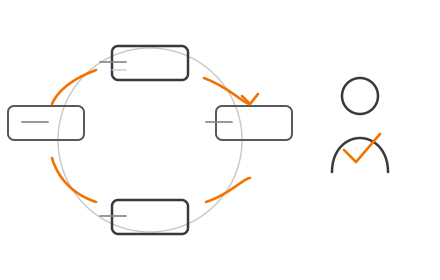
BI consultants turn fragmented, siloed data into a reliable foundation for decision-making. Their work follows structured phases — each building toward measurable business outcomes.

Discovery and Needs Assessment

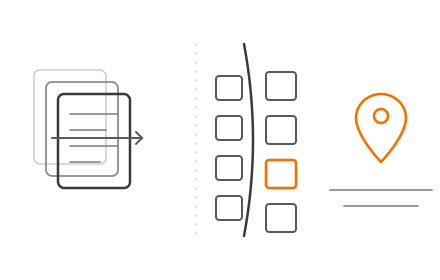
Consultants begin by working with stakeholders to understand pain points, business objectives, and the current state of data infrastructure. This phase maps existing data sources, identifies gaps, and establishes success metrics before recommending any technology solution.

Data Architecture and Governance

The foundation of effective BI is solid data infrastructure:

  • Data pipeline design - Setting up or auditing ETL (Extract, Transform, Load) processes that move data from source systems into centralized warehouses
  • Data governance frameworks - Defining collection policies, access controls, and quality standards to ensure consistency across sources
  • Semantic modeling - Creating a universal business language so "revenue" means the same thing to Sales, Marketing, and Finance

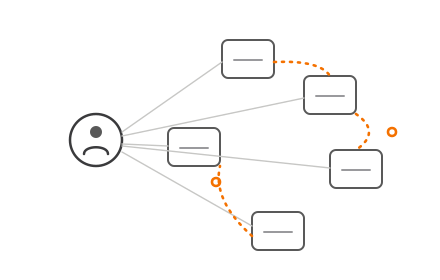
This work addresses the 68% of organizations struggling with data silos and establishes the single source of truth that makes downstream analysis reliable.

Analysis and Visualization Layer

Consultants use platforms to build dashboards and reports that surface KPIs, trends, and anomalies in formats non-technical leaders can act on:

Leading BI Platforms (2025 Gartner Leaders):

  • Microsoft Power BI - Dominant market presence with deep Microsoft Fabric integration and Copilot for natural language insights
  • Salesforce Tableau - Gold standard for visual-based exploration, transitioning to open lakehouse architectures
  • Google Looker - Code-first semantic layer (LookML) with strong governance controls and API integration
  • Qlik - Associative engine for non-linear data exploration and unstructured data insights
  • IBM Cognos - Enterprise-grade governance for regulated industries with flexible hybrid deployment

Top 5 BI platforms 2025 Gartner Leaders comparison features overview infographic

Strategic Recommendations and Implementation

After analysis, consultants propose concrete next steps and stay engaged to see them through:

  • Recommending process changes, new technologies, or organizational restructuring
  • Overseeing implementation to keep projects on track
  • Providing change management support so tools get used, not shelved

Ongoing Optimization

BI consulting rarely ends at delivery. Most engagements include ongoing performance reviews, strategy refinements, and updates as data sources or business conditions shift. 60% of BI initiatives fail to deliver business value when treated as software purchases rather than continuous organizational investments — which is why sustained engagement matters.


Key Signs Your Business Needs a BI Consultant

Decisions Based on Gut Feeling or Outdated Reports

If leadership relies on end-of-month spreadsheets or intuition rather than real-time data, there's a foundational BI gap. The result: slower responses to market shifts, missed opportunities, and strategies built on last month's numbers. A consultant builds systems that surface the right data at the right moment — before decisions are already made.

Data Exists But Is Siloed Across Departments

When CRM, ERP, and finance tools operate independently, no one has a unified view of performance. Sales reports one revenue figure, Finance reports another, and Operations uses different numbers entirely. The result is decision-making based on whoever's spreadsheet wins the argument. A BI consultant maps these disconnected sources and integrates them into a single, reliable view of performance.

Scaling Business But Static Data Processes

Growth exposes weak infrastructure. What worked for a 10-person team breaks at 100. Manual processes that were manageable become bottlenecks. A BI consultant builds systems that scale: automated pipelines, self-service dashboards, and governance frameworks that support expansion without adding headcount to manage it.

Reporting Takes Too Long or Produces Inconsistent Numbers

If different teams pull different figures for the same metric, it's a data governance problem. Inconsistent metric definitions, manual entry errors, and no standardization erode trust in the data — fast. Once teams stop believing the numbers, they stop using them. A consultant establishes clear definitions, automated validation, and reporting standards everyone actually follows.

Invested in BI Tools But Not Seeing ROI

Purchasing Power BI or Tableau licenses doesn't automatically generate insights. 85% of big data projects fail to move past preliminary stages, often because organizations treat BI as a software purchase rather than a business transformation. A consultant closes that gap — ensuring tools are configured correctly, adopted by the people who need them, and tied to the business outcomes that justified the investment.


Essential Skills and Tools to Look For in a BI Consultant

Technical Proficiency

Foundation skills determine whether a consultant can work with your existing infrastructure:

  • SQLThe most sought-after data skill, essential for querying databases and building data models
  • Data modeling — Creating semantic layers that translate technical data structures into business concepts
  • ETL processes — Designing pipelines that extract, transform, and load data efficiently
  • Data warehousing — Architecting centralized repositories that support enterprise-scale analytics

Core BI consultant technical skills SQL data modeling ETL warehousing breakdown

BI Platform Expertise

Identify which tools your business uses or plans to use, then confirm the consultant has genuine hands-on experience with them:

  • Power BI — Microsoft ecosystem integration, DAX calculations, Copilot AI features
  • Tableau — Visual-based exploration, open lakehouse architectures, Einstein Trust Layer
  • Looker — LookML semantic modeling, API integration, code-first approach
  • Qlik — Associative engine, unstructured data insights, non-linear exploration
  • IBM Cognos — Enterprise governance, hybrid deployment, regulated industry compliance

Business Acumen and Domain Knowledge

The best BI consultants understand the industry context behind the data — not just how to query it. Look for:

  • Fluency with relevant KPIs: CAC, LTV, default rates, portfolio performance
  • Familiarity with compliance requirements around data privacy and regulatory reporting
  • Experience navigating industry-specific data sources and integration challenges
  • A track record of translating business questions into analytical frameworks

Communication and Visualization Skills

A consultant who uncovers insights but can't explain them to non-technical stakeholders adds limited value. Assess their ability to:

  • Present findings clearly through dashboards, reports, and executive summaries
  • Translate technical concepts into business language
  • Design visualizations that highlight actionable insights, not just data

Project Management and Stakeholder Alignment

BI projects span multiple teams and timelines — and scope creep is a common failure point. When evaluating candidates or firms, look for:

  • A structured delivery methodology with clear phases, milestones, and deliverables
  • A track record of managing cross-functional implementations
  • A documented approach to scope management and change control
  • References or case studies that reflect delivery discipline, not just technical skill

How AI Is Transforming Business Intelligence Consulting

From Descriptive to Predictive and Prescriptive BI

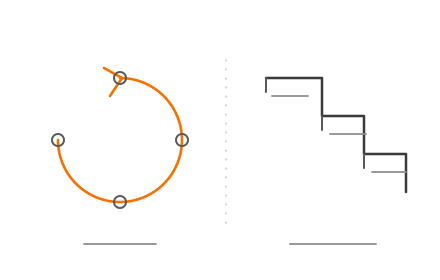
Traditional BI told businesses what happened. AI-integrated BI now predicts what will happen and recommends actions. This shift moves organizations through the four pillars of analytics:

  1. Descriptive - What happened? (Traditional dashboards)
  2. Diagnostic - Why did it happen? (Root-cause analysis)
  3. Predictive - What will happen? (Forecasting and ML models)
  4. Prescriptive - What should we do? (Optimization and recommendations)

Four pillars of analytics progression from descriptive to prescriptive AI-driven decisions

Gartner predicts that by 2027, 50% of business decisions will be augmented or automated by AI agents, fundamentally changing how BI consultants design and deliver solutions.

Embedded AI Capabilities in Modern BI

BI consultants now implement advanced features across leading platforms:

Microsoft Power BI:

  • Copilot generates DAX calculations, summarizes reports, and creates visuals through natural language prompts
  • Requires consultants to structure semantic models for AI consumption and train users on prompt engineering

Tableau:

  • Tableau Agent supports viz authoring, data exploration, and calculated field creation through conversational input
  • Requires implementation of Einstein Trust Layer to ensure data privacy and security

IBM Cognos:

  • The watsonx-powered AI Assistant accepts text-based queries and surfaces quick insights without requiring SQL or DAX knowledge
  • Consultants focus on grounding AI in governed semantic layers to ensure traceability

AI Integration as a Differentiator

When choosing a BI consulting partner, AI integration capability is now a baseline requirement, not a premium add-on. Firms that combine data engineering with AI-driven analytics can build BI systems that move beyond historical reporting — using the kind of predictive and prescriptive intelligence that Gartner projects will drive half of all business decisions within two years. Codiot works across this full stack, from data engineering to analytics delivery, which means BI implementations are designed for AI augmentation from the ground up.


How to Choose the Right BI Consulting Partner

Evaluate Engagement Model and Flexibility

Consider whether you need a one-time BI strategy overhaul or an ongoing partner:

  • Project-based - Defined scope, fixed timeline, specific deliverables (best for initial implementations)
  • Retainer model - Ongoing support, continuous optimization, evolving strategy (best for mature BI programs)
  • Hybrid approach - Initial project followed by maintenance retainer

Assess Breadth of Capability

A strong BI consulting partner should cover the full stack rather than specializing in just one layer:

  • Data engineering - Pipeline architecture, ETL processes, data quality frameworks
  • Semantic modeling - Business logic layer, consistent definitions, governance
  • Visualization - Dashboard design, self-service analytics, executive reporting
  • Change management - User training, adoption support, stakeholder alignment

Full-stack BI consulting capability four-layer framework from data engineering to change management

Ask how they handle data quality issues, tool implementation, and organizational resistance. Firms that only build dashboards without addressing underlying data infrastructure deliver limited long-term value.

Look for Cultural Fit and Communication Style

BI consulting involves close collaboration with internal teams. Evaluate:

  • How clearly the firm explains its methodology before engagement
  • Whether they ask thoughtful questions about your business, not just technical requirements
  • Reviews and case studies demonstrating successful implementations in your industry

For data-intensive industries like investment, finance, and private lending, domain experience matters as much as technical skill. Codiot's work across these sectors—spanning data engineering, AI integration, and analytics delivery—reflects the kind of cross-functional depth worth looking for when evaluating partners.

Avoid Common Failure Modes

Gartner warns that 80% of data and analytics governance initiatives will fail by 2027 if they take rigid, IT-centric approaches rather than targeting tangible business outcomes. Separately, 77% of businesses report that user adoption remains a massive challenge, leaving expensive software unused.

Choose partners who prioritize governance frameworks, semantic modeling, and change management—not just dashboard aesthetics.


Frequently Asked Questions

What does a business intelligence consultant do?

A BI consultant helps organizations collect, analyze, and act on data. This includes assessing data infrastructure, building pipelines, designing dashboards, and making strategic recommendations that align analytics to business goals.

How much does a Power BI consultant cost?

Power BI consultant rates vary based on geography, engagement type, and expertise level. In India, junior consultants charge ₹2,000-4,000/hour, mid-level consultants ₹4,000-8,000/hour, and senior architects ₹8,000-25,000+/hour for enterprise implementations requiring complex DAX, governance, and performance optimization.

What is BI in analytics?

BI (business intelligence) refers to the processes, tools, and strategies used to collect, analyze, and visualize business data. It forms the foundation on which analytics insights are built, covering data warehousing, semantic modeling, dashboards, and reporting.

What are the top 5 BI tools?

The 2025 Gartner Leaders in Analytics and BI Platforms are Microsoft Power BI, Salesforce Tableau, Google Looker, Qlik Sense, and IBM Cognos. The right tool depends on your business size, data complexity, and whether you need cloud-native, hybrid, or on-premises deployment.

What is a BI center of excellence?

A BI Center of Excellence (CoE) is an internal governance body that standardizes BI practices, manages tool adoption, and drives data quality across the organization. Central governance sets the rules; individual departments retain flexibility in how they apply them.

What are the 4 pillars of business analytics?

The four pillars are descriptive analytics (what happened), diagnostic analytics (why it happened), predictive analytics (what will happen), and prescriptive analytics (what should be done). BI consulting often spans all four, with AI integration accelerating the shift from descriptive to prescriptive capabilities.