AI-Powered Data Analytics Services

Introduction

Modern businesses face a frustrating paradox: they're drowning in data but starving for actionable insights. Finance teams wait days for reports on portfolio risk. Marketing managers can't identify which campaigns drive revenue. Operations leaders spot problems only after they've escalated.

The bottleneck isn't data volume—it's the time required to transform raw information into decisions. Analysts spend 80% of their time preparing data and only 20% analyzing it, meaning insights arrive too late to influence outcomes. Meanwhile, 60% of enterprise data sits unused—unanalyzed and generating zero business value.

AI-powered data analytics eliminates this lag. It automates the tedious work of pattern recognition, surfaces opportunities buried in unstructured data, and puts decision-ready intelligence in front of business users—not just the data science team. What follows covers how it works, where it delivers the clearest ROI, and what separates a successful implementation from an expensive experiment.

TLDR:

  • AI analytics automates data prep, pattern detection, and forecasting—reducing insight cycles from weeks to minutes
  • Covers all four analytics types (descriptive through prescriptive)—traditional BI stops at the first two
  • Finance, retail, healthcare, and manufacturing see the highest ROI from real-time monitoring and demand forecasting
  • Successful deployment requires AI-ready data: governed, consistent, and validated before model training begins
  • Custom service implementations outperform off-the-shelf tools for complex data environments or compliance-heavy industries

What Is AI-Powered Data Analytics?

AI-powered data analytics applies machine learning (ML), natural language processing (NLP), large language models (LLMs), and automation to process large datasets, identify patterns, and generate insights— without requiring users to write queries or master complex statistical models.

The Four Types of Analytics and How AI Elevates Them

Traditional business intelligence excels at two types of analysis:

  • Descriptive analytics answers "What happened?" through dashboards and historical reports
  • Diagnostic analytics drills down to explain "Why did it happen?" through segmentation and root-cause analysis

AI extends capabilities to forward-looking intelligence:

  • Predictive analytics forecasts "What will happen?" using probability models trained on historical patterns
  • Prescriptive analytics recommends "What should we do?" by simulating outcomes and optimizing decisions

The global augmented analytics market reached $15.26 billion in 2025 and is projected to hit $113.43 billion by 2034—a 24.20% compound annual growth rate driven by demand for predictive and prescriptive capabilities that traditional BI can't deliver at scale.

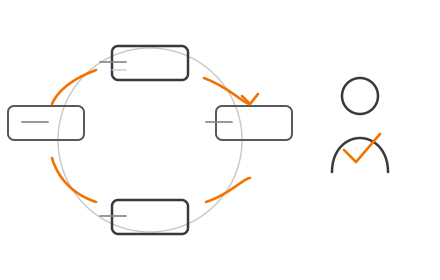
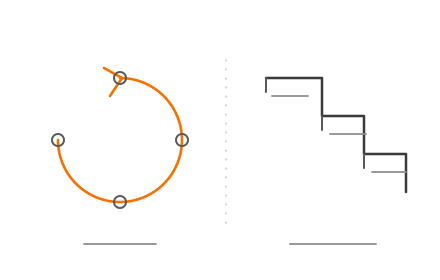
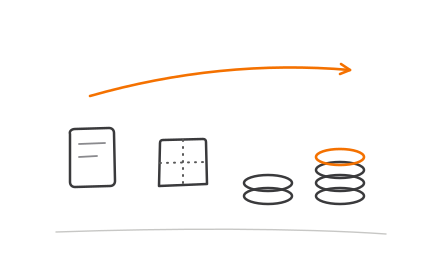
Four analytics types progression from descriptive to prescriptive AI-powered intelligence

How AI Puts Analytics in Every Business User's Hands

AI analytics removes the bottleneck of expert dependency. Instead of waiting for an analyst to build a report, business users — marketers, sales leaders, finance managers — ask questions in plain language and get instant answers.

Natural language processing translates conversational questions into analytical queries, allowing users to type "Which customers are most likely to churn this quarter?" and receive prioritized lists with confidence scores, with no SQL knowledge required.

Service-Based vs. Off-the-Shelf Platforms

That capability only reaches its potential when the implementation fits your actual data environment. Off-the-shelf platforms offer quick deployment but assume generic data structures. Service-based implementations, where a technology partner like Codiot builds custom AI analytics solutions, deliver better ROI for organizations with:

  • Unique data environments (proprietary systems, legacy infrastructure)
  • Industry-specific requirements (regulatory compliance, specialized metrics)
  • Complex integration needs (multiple data sources, real-time pipelines)

What "AI-Ready Data" Means

AI is only as reliable as the data feeding it. AI-ready data is validated, governed, and consistently defined—meaning the same metric (e.g., "customer lifetime value") is calculated the same way across all systems.

Without this foundation, AI models produce misleading outputs. Gartner predicts that through 2026, organizations will abandon 60% of AI projects unsupported by AI-ready data.


How AI Analytics Differs from Traditional Business Intelligence

Workflow Comparison

Traditional BIAI Analytics
Pre-built dashboards requiring analyst supportNatural language querying—no technical skills needed
Days or weeks to build custom reportsMinutes to receive answers to new questions
Historical data onlyReal-time monitoring with automated alerts
Manual anomaly detectionContinuous automated pattern recognition
Answers questions you askSurfaces insights before you think to ask

Traditional BI workflows require days or weeks to iterate through model design, dashboard creation, and review cycles, while AI-augmented analytics compresses this to minutes.

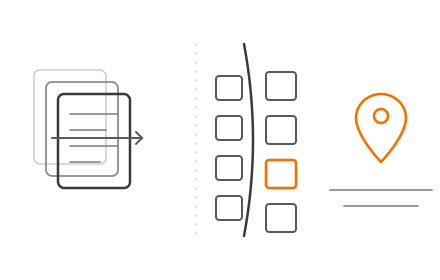
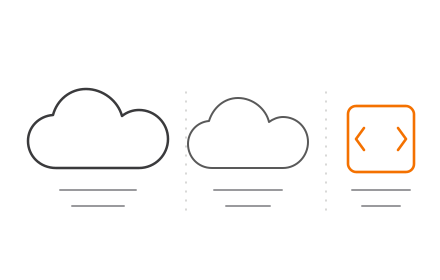
Traditional BI versus AI analytics side-by-side workflow comparison infographic

From Reactive to Proactive Intelligence

Traditional BI is inherently reactive—it reports what already happened. AI analytics continuously monitors data streams and surfaces findings proactively.

Example in finance: Rather than discovering portfolio risk exposure in a weekly report, AI alerts investment managers the moment market signals indicate increased volatility—allowing same-day rebalancing instead of week-late corrections.

That shift from reactive to proactive also changes what analysts spend their time on.

AI Augments Analysts, Doesn't Replace Them

AI handles the repetitive workload — data cleaning, report generation, and anomaly flagging — so analysts can focus where their judgment actually matters: strategic interpretation, model validation, and advising on decisions.

Organizations using AI analytics platforms improved technical team productivity by up to 35% by eliminating undifferentiated tasks. Skilled professionals spend less time pulling reports and more time acting on them.


The Core Technologies Behind AI Data Analytics

Natural Language Processing (NLP)

NLP enables systems to understand unstructured data—customer feedback, emails, social media posts—and allows users to query databases using conversational language.

  • Sentiment analysis of customer support tickets to identify product issues
  • Text summarization of legal documents or research reports
  • Conversational queries: "Show me Q1 revenue by region where growth exceeded 15%"

Machine Learning and Predictive Modeling

ML algorithms train on historical data to identify patterns, forecast outcomes, and generate probability-weighted recommendations.

  • Demand forecasting to optimize inventory levels
  • Churn prediction to prioritize retention efforts
  • Risk scoring for credit applications or fraud detection

Machine learning fraud detection models achieve 96% accuracy compared to 88% for traditional logistic regression, catching fraud patterns earlier and reducing false positives by up to 50%.

Generative AI and Large Language Models (LLMs)

LLMs power conversational analytics interfaces, automated report generation, and plain-language explanations of complex model outputs—making insights accessible to non-technical stakeholders.

Microsoft's Copilot for Power BI lets business users chat with their data directly. It automatically generates summaries and ad-hoc analyses without requiring users to learn dashboard design.

Neural Networks and Deep Learning

Where LLMs handle language, neural networks and deep learning tackle volume and complexity — recognizing patterns across large, multi-dimensional datasets. They're particularly valuable for:

  • Image analysis in quality control
  • Fraud detection in high-volume transaction data
  • Anomaly identification across thousands of variables simultaneously

Automated Data Preparation and Anomaly Detection

Data preparation consumes 60-70% of total analytics workflow time. AI automates cleaning, transformation, deduplication, and outlier flagging—ensuring the insights layer is built on reliable data from the start.

Automated anomaly detection continuously monitors metrics and alerts teams when values fall outside expected ranges, catching issues hours or days earlier than manual review cycles.

Real-World Use Cases: Industry Applications

AI analytics delivers measurable results across industries — from cutting fraud losses in finance to preventing equipment failures on factory floors. Here's how different sectors are putting it to work.

Financial Services and Investment

Finance teams deal with high-stakes decisions at speed. AI analytics sharpens both:

Retail and E-Commerce

For retailers, margins are thin and customer expectations are high — AI analytics helps on both fronts:

Healthcare and Life Sciences

Hospitals and life sciences teams use AI analytics to act earlier — on readmissions, resource shortages, and trial timelines:

Sales and Marketing Operations

Revenue teams that run on gut feel leave money on the table. AI analytics changes that:

  • Lead scoring: Companies implementing ML lead scoring report 75% higher conversion rates compared to traditional methods
  • Pipeline velocity analysis: Identify stalled deals and rep performance gaps weeks earlier
  • Campaign attribution: Track multi-touch journeys and allocate budget to highest-performing channels
  • Customer lifetime value modeling: Prioritize high-value accounts for retention and upsell efforts

Manufacturing and Supply Chain

Unplanned downtime and supply disruptions are expensive. AI analytics shifts operations from reactive to predictive:


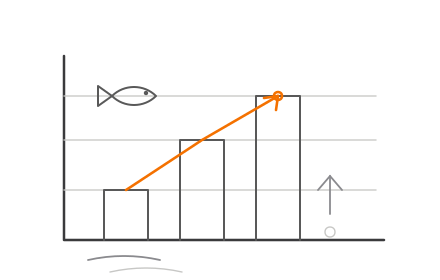
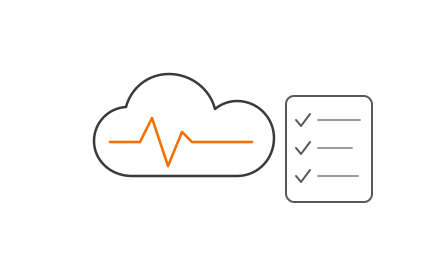
AI analytics industry use cases across finance retail healthcare and manufacturing sectors

Business Benefits of AI-Powered Data Analytics

Speed and Scalability

AI compresses analytics cycles from days or weeks to minutes. Forrester found that deploying Sigma Computing's analytics platform saved 49,400 end-user hours over three years by shifting work from stretched data teams to self-service users.

Automated pipelines scale with data volume without requiring additional headcount—a critical advantage as datasets grow exponentially.

Competitive Advantage Through Real-Time Decision-Making

Organizations with mature AI analytics respond to market changes, customer signals, and operational anomalies faster than competitors relying on traditional BI.

This is especially critical in finance and investment sectors where timing directly affects outcomes. Detecting portfolio risk exposure hours earlier can prevent significant losses during volatile markets.

Cost Efficiency and Reduced Analyst Dependency

AI reduces reliance on large analytics teams for routine reporting, reallocating skilled professionals toward strategic work.

Optimizely One customers achieved 446% three-year ROI with payback in under six months, generating $337 million in incremental revenue through AI-powered experimentation and personalization.

This matters for SMEs and startups too. Without needing large data science teams, smaller organizations can access the same analytical capabilities that were once reserved for enterprise budgets—closing the gap with larger competitors on speed and insight quality.


Challenges and Considerations Before Implementing AI Analytics

Data Quality and Governance

AI is only as reliable as the data feeding it. Inconsistent metric definitions, stale data, and ungoverned schemas produce misleading outputs.

Poor data quality costs organizations at least ₹107 crore annually due to operational inefficiencies and flawed decision-making.

Critical foundation requirements:

  • Consistent metric definitions across all systems
  • Regular data validation and cleansing processes
  • Clear data ownership and accountability structures
  • Documented lineage showing where data originates and how it transforms

Establish a governed data foundation before deploying AI models—not afterward.

Bias, Hallucinations, and Explainability

Three risks surface repeatedly in production AI analytics deployments:

  • Biased training data produces biased outputs. If historical hiring data overrepresents one demographic, AI hiring tools will perpetuate that bias.
  • AI hallucinations — models generating plausible but incorrect outputs — are more common than most teams expect. Even specialized legal AI tools hallucinate between 17% and 34% of the time.
  • Models that cannot explain their reasoning are unsuitable for regulated industries requiring clear audit trails.

Mitigation strategies:

  • Human-in-the-loop oversight for critical decisions
  • Deterministic query layers that validate AI-generated insights against source data
  • Partnering with responsible AI practitioners who prioritize explainability
  • Regular bias audits and model retraining

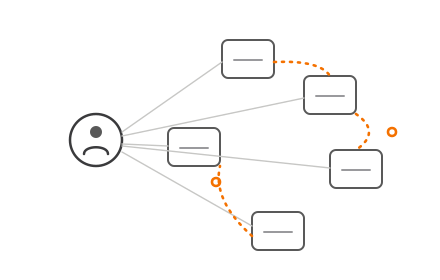
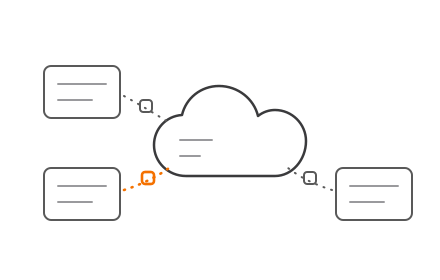
Four AI analytics risk mitigation strategies for bias hallucination and explainability issues

Choosing Between Platforms and Custom Implementations

Evaluate your organization's needs before selecting an approach:

Off-the-shelf platforms work best when:

  • Data structures are standard and simple
  • Technical maturity is high (teams can self-configure)
  • Compliance requirements are minimal
  • Speed to initial insights is the priority

Custom implementations deliver better ROI when:

  • Data environments are unique or complex
  • Industry-specific metrics require specialized models
  • Regulatory compliance demands governed pipelines
  • Integration with legacy systems is required

For regulated industries — finance, lending, healthcare — the decision usually comes down to compliance depth and data complexity. Off-the-shelf tools are built for the median use case; when your data environment or regulatory requirements fall outside that range, a custom implementation is the more defensible choice.


Frequently Asked Questions

Can data analytics be done by AI?

Yes, AI can automate many core analytics tasks including data preparation, pattern recognition, anomaly detection, and insight generation. However, human oversight remains essential for strategic interpretation, model validation, and ensuring outputs align with business context.

What is the difference between AI analytics and traditional business intelligence?

Traditional BI primarily reports on what happened using pre-built dashboards and historical data. AI analytics goes further by predicting future outcomes, diagnosing root causes automatically, and surfacing insights proactively without users needing to ask specific questions.

What industries benefit most from AI-powered data analytics?

Every data-rich industry benefits, but financial services, healthcare, retail, manufacturing, and professional services see the highest impact. These sectors handle large transaction volumes where delays in insight delivery directly affect risk management and business outcomes.

How long does it take to implement AI data analytics for a business?

Timelines depend on data readiness and complexity. Self-service platforms can surface initial insights within days; custom enterprise implementations with governed data pipelines typically take several weeks to a few months based on integration scope and data quality.

What data do you need to get started with AI analytics?

Any structured business data works as a starting point—CRM records, sales transactions, financial data, operational logs. The more consistent, complete, and historically rich the data, the more reliable the insights. Clean, governed data matters more than volume.

Is AI analytics only suitable for large enterprises?

No—AI analytics is accessible for startups and SMEs through service-based implementations that remove the need for large in-house data teams. The right approach matches your organization's size, data maturity, and budget.


Ready to transform your data into competitive intelligence? Contact Codiot to discuss how custom AI analytics solutions can deliver the insights your business needs—built around your data environment, not a generic template.