Introduction
eCommerce competition is accelerating, and a well-designed Shopify store is no longer enough to stand out. According to McKinsey's 2025 State of AI report, 78% of organizations now use AI in at least one business function — and 84% of eCommerce businesses rank it as their top strategic priority.
AI has moved from experimental technology to operational necessity.
The question is no longer whether to integrate AI into your Shopify store — it's how to do it strategically. Hyper-personalization alone can lift revenue by 10-15%, while predictive inventory management cuts stock levels by up to 30%.
This guide covers the core technologies driving AI-powered Shopify development, the highest-impact use cases, the ROI businesses are seeing, and how to approach implementation with measurable outcomes in mind.
TL;DR
- AI-powered Shopify development uses ML, NLP, and Computer Vision to automate workflows and deliver personalized customer experiences
- Product recommendation engines alone can lift AOV by up to 26%; AI chatbots hit 90%+ satisfaction rates when implemented correctly
- McKinsey research shows that personalization drives a 10-15% revenue lift, while AI-driven inventory forecasting can reduce stock levels by 20-30%
- Implementation ranges from free native tools like Shopify Magic to fully custom ML models built on proprietary merchant data for competitive differentiation
- The right development partner brings AI expertise, eCommerce domain knowledge, and a clear focus on conversion outcomes
What Is AI-Powered Shopify Development?
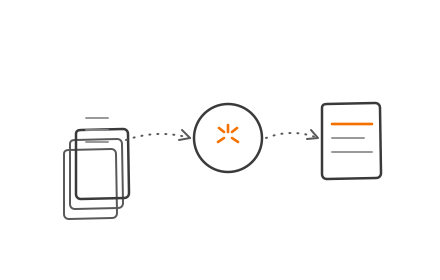
AI-powered Shopify development is the practice of weaving artificial intelligence directly into your store's architecture to automate workflows, personalize customer experiences, and surface data-driven insights. It transforms your store from a static product catalogue into a dynamic, intelligent sales system that adapts to each visitor's behavior, predicts future demand, and optimizes operations in real time.
This is fundamentally different from simply installing a Shopify plugin. Out-of-the-box tools like Shopify Magic provide instant content generation and basic AI features available to all merchants. Custom AI development, by contrast, involves building machine learning models trained on your own store data: your customer behavior patterns, purchase history, seasonal trends, and store logic. The result is a store that behaves in ways a competitor running generic tools simply cannot match.
The Three Core Technologies Transforming eCommerce
Machine Learning (ML) serves as the predictive engine that analyzes purchase history, browsing behavior, and seasonal patterns to forecast demand and power personalized recommendations. ML algorithms learn from historical data to make increasingly accurate predictions about what products a customer wants, when inventory should be restocked, and which price points maximize conversion.
Natural Language Processing (NLP) enables intelligent search and conversational commerce. Rather than matching keywords, NLP-powered systems understand customer intent—the difference between a search for "running shoes for marathon training" versus "casual running shoes for everyday wear." This same technology powers chatbots that can handle nuanced customer queries, process returns, and provide product guidance in natural language.
Computer Vision powers visual search capabilities, allowing shoppers to upload an image and find matching or similar products in your catalogue. For fashion and home goods merchants especially, this captures purchase intent that traditional text search completely misses.

Why Implementation Urgency Matters Now
These technologies are no longer experimental. McKinsey's data shows that over 80% of retail and consumer packaged goods companies are either using or actively piloting generative AI. For Shopify merchants, that creates a narrow window: early adopters can establish market position and capture customer loyalty before AI personalization becomes the baseline expectation.
Implementation exists on a spectrum. Some merchants start with Shopify Magic for content generation, email subject lines, and semantic search—all free and native to the platform. Others build custom ML models for dynamic pricing, demand forecasting, or personalized storefronts that adapt product ordering and promotional offers based on individual visitor signals. This isn't a binary choice between simple and complex—it's a strategic journey where capabilities scale as your data and business needs grow.
Key AI Use Cases That Transform Your Shopify Store
AI is reshaping Shopify stores across five high-impact areas — each backed by measurable outcomes and real adoption data.
Hyper-Personalized Shopping Experiences
Machine learning algorithms analyze each visitor's browsing history, past purchases, cart behavior, and time-on-page signals to dynamically tailor the storefront. This goes far beyond showing a customer's name — it means reordering product grids, adjusting homepage hero content, and surfacing promotional offers that align with predicted purchase intent.
According to BCG's 2025 Personalization Index, businesses that lead in personalization achieve compound annual growth rates 10 percentage points higher than laggards. McKinsey's foundational research establishes that personalization most often drives a 10-15% revenue lift, while also reducing marketing and sales costs by 10-20%.
Critical consideration: Gartner's 2025 survey revealed that personalization can backfire — 53% of customers reported negative experiences when tactics felt overwhelming or rushed, making them 44% less likely to purchase again. The lesson: personalization must feel helpful, not invasive.
AI-Powered Product Recommendations
Recommendation engines use collaborative filtering and intent modeling to suggest products based on what similar customers purchased, items frequently bought together, and contextual signals like season or browsing session — a significant step up from basic "you might also like" suggestions.
Older benchmarks (Barilliance 2014, McKinsey 2013) put recommendations at 31-35% of eCommerce revenue. More recent Salesforce data shows shoppers who engage with AI recommendations have a 26% higher average order value — and Barilliance data suggests AOV can climb up to 369% in highly engaged sessions.
Implementation insight: Rather than relying on vendor-supplied benchmarks, establish your own baseline metrics and run rigorous A/B tests to measure actual impact on your store's conversion rate and AOV.
Intelligent Chatbots and Customer Support
NLP-powered chatbots handle order tracking, return queries, size recommendations, and product guidance 24/7. Shopify Inbox integrates with Shopify Magic to generate contextually relevant responses that help turn conversations into conversions.
The trajectory is notable: Forrester predicts that by end of 2026, one in four brands will see a 10% increase in successful self-service interactions. Gartner goes further, forecasting that by 2029, agentic AI will autonomously resolve 80% of common customer service issues — cutting operational costs by 30%.
The critical caveat: COPC's 2026 research found that while 74% of customers report satisfaction with AI interactions, Net Promoter Scores can plunge by up to 70 points when a bot fails to resolve the issue and the handoff to a human agent is clumsy or nonexistent. The fix: always build strict escalation workflows so the transition to a human agent is seamless, not an afterthought.
Predictive Analytics and Inventory Management
AI analyzes historical sales data, seasonality, promotional calendars, and external market signals to forecast demand with high accuracy. This prevents both stockouts that cost revenue and overstock scenarios that tie up working capital.
The business case is straightforward: inventory distortion costs retailers $1.77 trillion annually. McKinsey reports that AI-driven inventory operations can reduce stock levels by 20-30%, cut logistics costs by 5-20%, and lower forecasting errors by 20-50%.

Shopify Magic includes predictive AI for inventory insights, forecasting demand, and recommending optimal restock levels — making this capability accessible even to smaller merchants without custom data science teams.
AI-Enhanced Marketing and Visual Search
AI handles audience segmentation and campaign personalization across channels, automating tasks that previously required dedicated teams:
- Writes and tests email copy based on customer behavior segments
- Schedules ad placements triggered by browsing and purchase signals
- Personalizes landing page content by traffic source and intent
- Identifies high-value audience clusters for retargeting
Visual search represents an emerging differentiator. Shoppers upload an image of a product they like, and computer vision algorithms match it against matching or similar items in your catalogue. For fashion, home décor, and furniture merchants, this captures purchase intent from customers who lack the vocabulary to describe what they want through text search.
The Business Case: What ROI Does AI Actually Deliver?
AI's value proposition centers on three core eCommerce metrics: conversion rate, average order value (AOV), and customer lifetime value (LTV). Here's how AI directly moves each lever.
- Conversion rates rise when personalization makes shopping feel relevant — McKinsey research points to a 10-15% sales-conversion lift alongside lower acquisition costs
- AOV climbs when AI surfaces the right upsells at the right moment — Salesforce data shows a 26% higher AOV for shoppers engaging with AI recommendations
- LTV grows as faster, more relevant experiences — semantic search, chatbots, personalized product grids — bring customers back rather than losing them to competitors
Validated ROI Case Studies
Enterprise-grade implementations demonstrate substantial returns:
| Platform | ROI | Payback Period | Key Outcomes |
|---|---|---|---|
| Optimizely One | 446% | < 6 months | $40.3M incremental revenue over 3 years; 5% increase in digital visits; 8% conversion lift |
| Bloomreach Engagement | 251% | N/A | $3.74M incremental email profit; 83% clickthrough increase; 27% web conversion increase |
| Salesforce Composable Storefront | 271% | 6 months | $7.09M improved conversion profit; 5 basis point conversion increase |

The platform powering most of these implementations tells its own story. Shopify's Q4 2025 financials reported 31% revenue growth and a 19% free cash flow margin — with management noting that orders from AI-powered search increased 15x since January 2025.
Addressing the Low-Data Misconception
A common concern is that AI requires massive datasets to deliver value. In reality, businesses can start with the data they already have—purchase history, browsing sessions, email engagement—and scale as data accumulates. Data quality matters more than volume at the outset. Starting with focused implementations like a recommendation engine or chatbot allows merchants to prove ROI before expanding to more complex use cases.
How to Implement AI in Your Shopify Store
Successful implementation follows a three-phase approach that prioritizes business outcomes over technical complexity.
Phase 1: Define Goals and Assess Data Readiness
Vague goals like "use AI" fail. Effective implementations start with specific objectives tied to measurable KPIs:
- Increase AOV by 15% through intelligent product recommendations
- Reduce customer support costs by 25% via AI chatbots
- Cut inventory carrying costs by 20% with predictive forecasting
Data readiness is the prerequisite. AI models require clean, organized data. Audit your current data infrastructure:
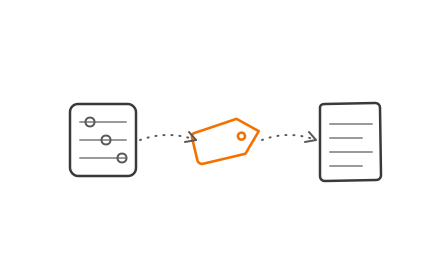
- Do you have consistent product tagging and categorization?
- Is customer behavioral data being captured and stored?
- Are purchase histories and browsing sessions accessible?
If data is scattered or inconsistent, data engineering work—building pipelines, establishing governance, and ensuring quality—must come first.
Phase 2: Choose the Right Tool Path
Off-the-shelf Shopify apps and APIs offer faster, lower-cost starts for standard use cases:
- Shopify Magic for content generation, semantic search, and chatbot responses
- Third-party recommendation engines like LimeSpot or Wiser
- Pre-built chatbot platforms like Tidio or Gorgias
Custom-built AI models make sense for businesses with unique requirements and competitive differentiation needs:
- Proprietary pricing logic that responds to competitor moves and inventory levels
- Demand forecasting models trained on your specific seasonality and promotional calendar
- Personalization engines that integrate CRM data, loyalty program signals, and offline purchase history
If off-the-shelf tools can deliver what you need, start there. Custom builds are worth the investment only when your competitive edge depends on capabilities no existing tool offers.
Phase 3: Develop, Test, and Continuously Optimize
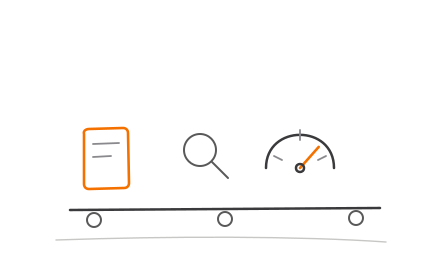
AI models improve over time as they accumulate more data. That means the work doesn't stop at launch — models need real-world feedback to improve. Establish baseline metrics before launch, run A/B tests to validate impact, and refine algorithms based on real-world performance.
Integration methods vary by use case:
- AI APIs and plugins for standard recommendation engines, chatbots, and analytics dashboards
- Custom machine learning models for proprietary pricing, demand forecasting, and deep personalization
- Workflow automations that connect Shopify with external CRM, ERP, and marketing platforms to unify data and trigger AI-powered actions

Data Privacy and Trust Considerations
Native tools like Shopify Magic operate within Shopify's own privacy architecture. Shopify doesn't use one merchant's store-level data to train models for other merchants. However, enabling "Shopify Network Intelligence" for advanced features like Shopify Audiences pools anonymized customer data across the network, requiring updated privacy policies and cookie consent banners.
For third-party AI integrations, vet how customer and store data is handled. This is especially critical for merchants in regulated industries or serving customers in GDPR/CCPA jurisdictions. Non-compliance carries both legal and reputational risk.
Choosing the Right AI Shopify Development Partner
The right partner combines proven AI/ML expertise with real eCommerce domain knowledge. You need strategists who understand how to map AI capabilities to conversion goals, AOV improvement, and customer retention metrics—not just developers who can write code.
Key Evaluation Criteria
- Portfolio with measurable outcomes: Look for case studies showing conversion lifts, AOV improvements, and cost reductions—not vague claims about innovation.
- Off-the-shelf vs. custom judgment: The best partners know when a Shopify app is enough and when custom development creates real differentiated value—and can explain the cost-benefit tradeoff clearly.
- Business-outcome focus: Technical deliverables aren't the goal. Revenue growth, cost reduction, and customer satisfaction are. Your partner should speak in business impact terms, not just model accuracy or API latency.
- Ongoing refinement capability: AI implementations need continuous tuning as data accumulates and customer behavior shifts. Confirm your partner offers monitoring and iterative improvement, not just a one-time handoff.
Codiot's Comprehensive AI-Driven Approach
Codiot covers the full development stack—UI/UX design, web and mobile development, data engineering, and AI integration—so AI-powered Shopify features connect to the broader digital experience rather than operating as isolated add-ons.
Their work spans startups through enterprises, with specific depth in:
- Building data pipelines that feed recommendation and personalization models
- Predictive analytics infrastructure for inventory and demand forecasting
- Connecting AI models directly to customer-facing Shopify experiences
For merchants who want AI to move conversion and retention metrics, that end-to-end capability matters. A partner who handles only the ML layer can't optimize how the output surfaces in your storefront.
Frequently Asked Questions
What is AI-powered Shopify development?
AI-powered Shopify development integrates technologies like Machine Learning, Natural Language Processing, and Computer Vision into Shopify stores to automate workflows, personalize customer experiences, and generate data-driven insights. It goes beyond basic plugin installations to include custom models trained on merchant-specific data.
What are the most impactful AI use cases for a Shopify store?
The highest-impact use cases include:
- Hyper-personalized shopping experiences that adapt to each visitor
- AI product recommendation engines that increase average order value
- Intelligent chatbots for 24/7 customer support
- Predictive inventory management that cuts stock costs by 20-30%
- AI-driven marketing automation for segmentation and campaign personalization
Do I need a large amount of customer data to start using AI on Shopify?
No. You can start with data you already have—purchase history, browsing sessions, email engagement. Data quality matters more than volume. AI capabilities scale as your data grows, making focused starting points like recommendations or chatbots a practical way to prove ROI early.
What is the difference between Shopify Magic and custom AI development?
Shopify Magic is a free, built-in AI tool for content generation, semantic search, chatbot responses, and basic inventory insights. Custom AI development involves building machine learning models trained on your specific data for complex use cases like dynamic pricing, proprietary demand forecasting, or deeply personalized storefronts that create competitive differentiation.
How much does it cost to implement AI in a Shopify store?
Costs range from free (Shopify Magic) to monthly app subscriptions (₹2,000-₹20,000 depending on features) to larger custom development investments (₹5,00,000+ for proprietary models). The right approach depends on your business goals, budget, and how differentiated your solution needs to be to gain competitive advantage.
How do I choose the right AI Shopify development partner?
Prioritize partners with measurable case studies in AI and eCommerce, hands-on experience with both off-the-shelf and custom solutions, and a clear focus on business outcomes—conversions, AOV, cost savings—rather than technical complexity. Ongoing support for model monitoring and optimization is equally important.