Introduction
The global eCommerce market is projected to reach $6.419 trillion in 2025, representing 20.5% of total retail sales worldwide. Yet for many businesses, off-the-shelf platforms struggle to keep pace with unique workflows, scaling demands, and rising customer experience expectations.
Generic tools force businesses to bend their processes to fit rigid templates — limiting agility and competitive edge over time. This guide covers the what, why, and how of custom eCommerce software development, so you can make informed decisions for your business.
TLDR
- eCommerce software development builds the custom digital systems behind your storefront, transactions, and backend operations
- Core advantages include unrestricted scalability, full brand control, native tool integrations, and purpose-built security
- Must-have features: mobile-first UI/UX, secure payment gateways, real-time inventory management, and analytics dashboards
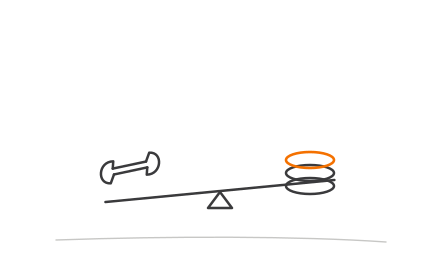
- Custom builds deliver long-term ROI and flexibility — off-the-shelf platforms work best for faster, budget-constrained launches
What Is eCommerce Software Development?
eCommerce software development is the creation, customization, and maintenance of digital tools and applications that enable businesses to sell products or services online. It encompasses everything from storefront interfaces and checkout systems to order management, inventory tracking, and customer data handling.
What separates eCommerce software development from simply adopting a platform is the depth of customization involved. Development means building or tailoring systems to match specific business logic, workflows, and customer journeys—rather than fitting a business into a rigid template with limited flexibility.
What Does an eCommerce Developer Do?
An eCommerce developer designs and builds both the front-end (what customers see and interact with) and back-end (servers, databases, APIs) of an online store. Key responsibilities include:
- Writing and maintaining clean, scalable code for storefront and checkout flows
- Integrating third-party services like payment processors, shipping APIs, and CRM systems
- Optimizing site performance to reduce load times and improve conversion rates
- Ensuring security compliance with standards like PCI-DSS and implementing SSL encryption
- Building responsive designs that work seamlessly across desktop, mobile, and tablet devices
What Are eCommerce Software Solutions?
eCommerce software solutions refer to the full range of systems used to operate an online business. These include:
- Custom-built platforms designed around unique business requirements and workflows
- SaaS solutions like Shopify or WooCommerce with standardized, ready-to-deploy features
- Hybrid approaches that extend existing platforms with custom functionality
- Headless commerce architectures that decouple the front-end presentation layer from the back-end
- Specialized tools covering inventory management, order processing, analytics, and CRM
The right choice depends on where your business sits today—and where it needs to go. A startup launching its first store has very different needs than an enterprise managing thousands of SKUs across multiple regions.
Key Benefits of eCommerce Software Development
Scalability on Demand
Purpose-built eCommerce software can be architected to scale horizontally or vertically as traffic, product catalogs, and transaction volumes grow. Unlike rigid off-the-shelf platforms that impose performance bottlenecks, custom solutions let you add server capacity, optimize database queries, and refactor code to handle increased demand without platform-imposed constraints.
Full Ownership of Brand Experience
With custom development, you control every layer — UX, design, user flows, and checkout logic. Research shows the average large eCommerce site can gain a 35% increase in conversion rate by fixing checkout UX flaws alone. Owning the full experience, from product discovery to post-purchase confirmation, means every touchpoint can be optimized for your brand and your revenue goals.
Native Integration with Business Tools
eCommerce software built specifically for your stack connects directly to your CRMs, ERPs, accounting tools, and logistics platforms. The result:
- No data silos between departments
- Less manual data entry and reconciliation
- A single view of customers, inventory, and financials
Enhanced Data Security and Compliance
Rather than relying on a platform vendor's blanket security, a custom build lets you design protocols around your actual risk profile. That means SSL/TLS encryption, PCI-DSS compliance, data tokenization, access controls, and vulnerability audits shaped specifically for your business model and customer data sensitivity.
Better Performance Equals Better Revenue
Page load speed and checkout efficiency directly affect bounce rates and sales. Sites loading in 1 second have conversion rates 2.5x higher than sites loading in 5 seconds. A custom-developed platform can be performance-optimized at both the code and infrastructure level, ensuring Core Web Vitals targets are met and slow load times don't cost you revenue.

Must-Have Features of eCommerce Software
User Interface and Mobile Responsiveness
An intuitive, clean UI with fast load times and mobile-first design is non-negotiable. Mobile devices account for 69.9% of retail eCommerce sales, making mobile optimization the default priority rather than an afterthought. Key UX elements include:
- Clear product categorization and intuitive navigation
- Streamlined checkout process with minimal form fields
- Fast-loading images optimized for mobile bandwidth
- Touch-friendly buttons and interactive elements
- Responsive layouts that adapt seamlessly to all screen sizes
Secure Payment Gateway Integration
Payment gateway integration enables support for multiple payment methods—credit cards, digital wallets like Apple Pay and Google Pay, and buy-now-pay-later options. Well-built integration handles encryption and tokenization behind the scenes while ensuring compliance with PCI-DSS standards. Seamless, trusted checkout reduces cart abandonment; 19% of users abandon carts because they don't trust the site with their payment information.
Inventory and Order Management
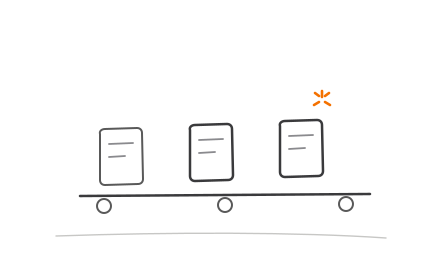
Real-time inventory tracking, automated stock alerts, and order lifecycle management (from placement to delivery) are essential for operational efficiency. Advanced systems integrate AI-powered demand forecasting to prevent stockouts and overstock scenarios. Gartner predicts that 70% of large organizations will adopt AI-based supply chain forecasting by 2030, making early adoption a practical edge—not just a future consideration.
Analytics and Reporting Dashboard
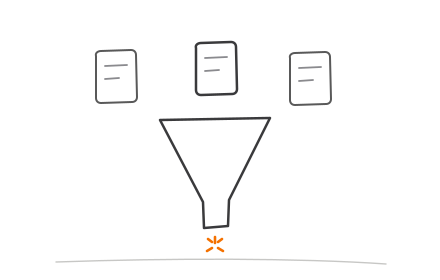
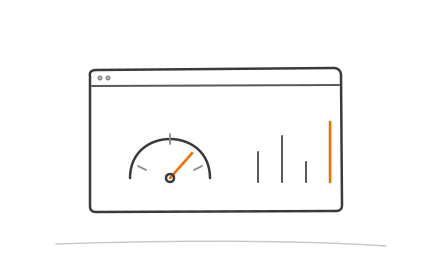
Inventory and order data only tell half the story—analytics close the loop. Built-in dashboards track user behavior, sales performance, customer lifetime value, and campaign ROI. Surfacing metrics like conversion funnel drop-off points, average order value trends, and product performance lets teams act on what's actually happening rather than guessing.
Custom vs. Ready-Made eCommerce Solutions
Custom eCommerce Software
Custom-built solutions offer full flexibility, unique feature sets, and the ability to scale without platform-imposed constraints. They're ideal for businesses with complex workflows, high transaction volumes, or a need for deep third-party integrations. Codiot, for instance, builds custom eCommerce platforms for startups, SMEs, and enterprises — covering everything from initial planning through post-launch optimization.
Custom development typically requires:
- Longer initial build time (2-12+ months depending on complexity)
- Higher upfront investment
- Dedicated development and maintenance resources
- Complete ownership of code, data, and infrastructure
Ready-Made Platforms (SaaS)
Platforms like Shopify, Magento, or WooCommerce offer faster time-to-market, lower upfront cost, and built-in maintenance. They're best suited for businesses in early stages or with straightforward selling needs. The trade-off is real, though: limited customization, potential vendor lock-in, and escalating costs as you grow. Heavily customized SaaS deployments can exceed the total cost of ownership of a purpose-built custom solution by 150% over five years.
How to Decide
Use this decision framework:
Choose custom development if:
- Your business has unique workflows that don't fit standard templates
- You're planning aggressive growth and need unlimited scalability
- Deep integrations with ERP, CRM, or proprietary systems are required
- You need full control over data, security, and user experience
Choose a ready-made platform if:
- Speed-to-market is the primary concern
- Budget constraints limit initial investment
- Your product catalog and workflows are straightforward
- You prefer vendor-managed infrastructure and security updates
A hybrid approach (starting with a SaaS platform and layering in custom extensions) works well for businesses testing market fit before committing to a full custom build.

eCommerce Software Development Process and Best Practices
Planning and Discovery
Successful eCommerce development begins with a thorough discovery phase: defining business goals, mapping customer journeys, conducting competitive analysis, and documenting functional requirements. Skipping this phase is the leading cause of scope creep and budget overruns. During discovery, teams should:
- Interview stakeholders to understand business objectives and success metrics
- Map user personas and their typical purchase journeys
- Analyze competitor platforms to identify gaps and opportunities
- Document functional requirements, technical constraints, and integration needs
- Establish clear project milestones and acceptance criteria
Design and Development Best Practices
Adopt modern architectural patterns and development standards:
- API-first or headless architecture for flexibility and long-term scalability
- Mobile-first design given that mobile drives the majority of traffic and sales
- Component-based front-end development for code reusability and faster iteration
- Code review and documentation standards to maintain quality and knowledge transfer
- AI-assisted development tools to accelerate build cycles and reduce repetitive coding tasks
Testing Before Launch
Multi-layered testing prevents costly post-deployment fixes and protects brand reputation:
- Functional testing ensures all features work as specified
- Performance testing validates the platform can handle expected traffic loads
- Security testing includes vulnerability scans and penetration testing
- User acceptance testing (UAT) confirms the platform meets real-world user needs
- Cross-browser and device testing ensures consistent experience across environments
Security as a Development Pillar
Security must be built into every layer of development—not bolted on at the end. The global average cost of a data breach reached $4.44 million in 2025, making security a business-critical priority. Essential security measures include:
- SSL/TLS encryption for all data in transit
- Secure API authentication using OAuth 2.0 or JWT tokens
- PCI-DSS compliance for payment data handling
- Regular security audits and vulnerability scanning
- Access controls and role-based permissions to limit data exposure
- Protection against common threats like SQL injection, cross-site scripting (XSS), and DDoS attacks

Post-Launch Optimization and Ongoing Maintenance
Launch is a milestone, not a finish line. Ongoing iteration keeps your platform competitive as user behavior and market conditions shift. Key post-launch activities include:
- Performance monitoring to catch bottlenecks before they affect conversions
- A/B testing to continuously refine UX and checkout flows
- Analytics review to identify drop-off points and personalization opportunities
- Feature iteration based on real user feedback and business data
- Inventory and demand forecasting using behavioral patterns over time
Codiot supports eCommerce teams through this entire lifecycle — from initial architecture to post-launch maintenance — ensuring the platform keeps delivering measurable returns.
Frequently Asked Questions
What is ecommerce software development?
eCommerce software development is the process of designing, building, and maintaining digital systems that enable businesses to sell online. It covers storefronts, payment processing, order management, inventory tracking, and customer experience tools tailored to specific business requirements.
What does an ecommerce developer do?
An eCommerce developer builds and maintains both the front-end (customer-facing UI) and back-end (databases, APIs, server logic) of an online store. They integrate third-party services like payment gateways and shipping APIs while ensuring performance, security, and scalability standards are met.
What are e-commerce software solutions?
eCommerce software solutions are the systems used to operate an online store—from SaaS platforms like Shopify to fully custom-built applications. They cover storefront design, checkout flows, inventory management, CRM integration, and analytics.
What is the difference between custom and off-the-shelf eCommerce software?
Custom software is built to a business's exact specifications, offering full flexibility, scalability, and ownership. Off-the-shelf platforms are pre-built with standardized features that are faster to deploy but limited in customization and may impose vendor lock-in as your business grows.
How long does eCommerce software development take?
Development timelines vary based on scope. A basic custom storefront may take 2–4 months, while a complex enterprise-grade platform with integrations and AI features can take 6–12+ months.
What are the key security considerations in eCommerce development?
Key security measures include SSL/TLS encryption, PCI-DSS compliance for payment data, secure API authentication, regular vulnerability audits, and protection against SQL injection and DDoS attacks. These should be built into every stage of development, not retrofitted at the end.