Top E-Commerce Development Agencies — 2026

Introduction

E-commerce has evolved from a convenience into a competitive battleground. The global B2C e-commerce market is projected to reach $3.87 trillion in 2026, growing at 6.62% annually through 2030.

At that scale, choosing the right development partner carries real business consequences — not just technical ones.

In 2026, the most competitive e-commerce experiences are built on personalization engines, headless architecture, and mobile-first design. Mobile commerce now accounts for 69.9% of total retail e-commerce sales, and businesses using AI-driven personalization generate 40% more revenue than competitors who don't. Building these capabilities takes more than a generalist dev shop.

This article covers a ranked list of the top e-commerce development agencies in 2026, the criteria used to evaluate them, and a practical framework for choosing the right partner for your business.

TL;DR

  • E-commerce development in 2026 demands agencies with AI integration capabilities, platform expertise, and end-to-end execution
  • Top agencies specialize differently—some excel at B2B/enterprise, others at DTC or platform-specific builds (Shopify, Magento, BigCommerce)
  • Key selection criteria: technical stack, client portfolio, post-launch support, and scalability
  • Pricing ranges from $2,000–$25,000 for basic builds to $135,000+ annually for enterprise solutions
  • Codiot covers design, development, data engineering, and AI integration for startups, SMEs, and enterprises

What Is E-Commerce Development — and Why It Matters in 2026

E-commerce development encompasses far more than building an online store. It includes UX design, backend architecture, payment integration, performance optimization, and scalability planning. The goal is creating digital experiences that convert browsers into buyers and support business growth over time.

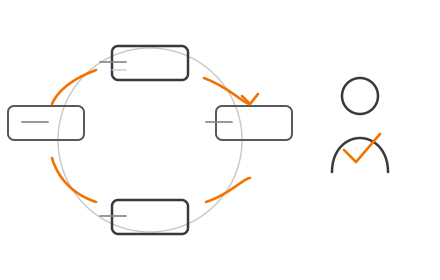
2026 marks a turning point. AI-driven features—product recommendations, dynamic pricing, chatbots—are now baseline expectations. By 2027, 60% of new B2C and B2B cloud-based digital commerce solutions will align with MACH architecture principles (Microservices, API-first, Cloud-native, Headless). Mobile-first buying behavior dominates, and composable commerce architectures are reshaping what "great" looks like.

Key shifts defining modern e-commerce development:

  • AI-first features — recommendations, dynamic pricing, and chatbots are table stakes, not differentiators
  • MACH architecture — modular, API-driven stacks replacing monolithic platforms
  • Mobile-native UX — designed for thumb-first interaction, not adapted from desktop

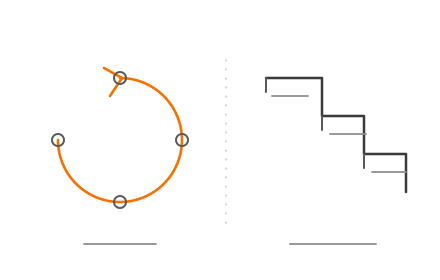
Three key modern e-commerce development trends for 2026 infographic

The numbers back this up. With the global e-commerce market projected to reach $5.00 trillion by 2030, choosing the right development partner directly affects conversion rates, customer retention, and time-to-market — not just the quality of the storefront.

Top E-Commerce Development Agencies in 2026

These agencies were selected based on technical depth, client impact, service range, and platform expertise. Each one has a demonstrated track record of driving measurable results for their clients.

Codiot

Codiot is an AI-native technology company offering end-to-end digital solutions—from UI/UX design and custom web development to mobile apps, data engineering, and Salesforce development. Serving startups, SMEs, and enterprises across industries including finance, investment, and private lending, Codiot stands out for its deep integration of AI across every service offering.

Codiot builds e-commerce experiences that are personalized, data-driven, and optimized for growth from day one. Clients get a single partner covering design, development, analytics, and ongoing optimization—no vendor handoffs, no gaps in accountability.

AspectDetails
Key ServicesCustom web development, mobile app development, UI/UX design, data engineering, Salesforce development, AI-powered digital solutions
Best Suited ForStartups and SMEs seeking end-to-end digital transformation; enterprises needing AI-integrated e-commerce and custom software
DifferentiatorAI-first approach embedded across all development services, not added as an afterthought

Innowise

Innowise is a global technology company with deep expertise in custom e-commerce development, mobile applications, and UX/UI design. With over 3,500 IT specialists and 1,600+ successful projects across 40+ countries, they serve clients across multiple industries with end-to-end solutions.

They build conversion-optimized shopping experiences grounded in scalable architecture and user-centric design. Innowise's 4.9/5 Clutch rating (72 reviews) reflects consistent delivery quality across geographies and industries.

AspectDetails
Key ServicesCustom e-commerce development, mobile app development, UX/UI design
Best Suited ForMid-to-large businesses needing custom, scalable e-commerce platforms
DifferentiatorEnd-to-end engagement model that covers strategy through post-launch optimization

Elogic Commerce

Elogic Commerce is a specialist e-commerce development agency known for Magento/Adobe Commerce expertise and a strong track record in B2B e-commerce. With 500+ projects delivered since 2009 and a perfect 5.0/5 Clutch rating (44 reviews), they excel at complex, enterprise-scale builds.

Their expertise includes multi-catalog pricing, approval workflows, and ERP integrations—making them a go-to partner for manufacturers, wholesalers, and distributors digitizing their sales channels. Elogic's verified Net Promoter Score (NPS) of 70 demonstrates exceptional client loyalty and satisfaction.

AspectDetails
Key ServicesMagento/Adobe Commerce development, e-commerce strategy, performance optimization, B2B e-commerce
Best Suited ForB2B enterprises, manufacturers, and distributors requiring complex custom platforms
DifferentiatorDeep Magento ecosystem expertise combined with pre-development business analysis to align technical builds with business goals

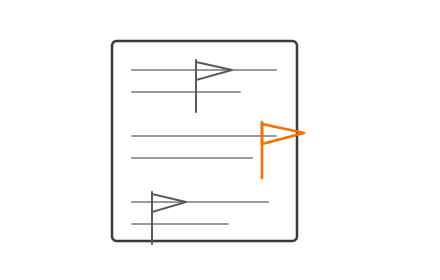
Top five e-commerce development agencies 2026 comparison overview infographic

Amasty

Amasty is a well-established e-commerce firm with a strong reputation in Magento development. In addition to agency services, they maintain a library of 270 Magento 2 extensions—covering custom solutions, performance optimization, and ongoing technical support.

This dual positioning as both a development agency and a product company gives clients access to an integrated Magento ecosystem. Case studies report impressive results—35% discoverability growth, load times under 1 second, and 30% conversion rate increases following speed optimization.

AspectDetails
Key ServicesMagento development, custom solutions, performance optimization, Shopify services, mobile app development
Best Suited ForMedium-to-large businesses on Magento/Adobe Commerce seeking custom builds and long-term optimization
DifferentiatorDual strength as both a development agency and a product company (extensions), offering clients an integrated Magento ecosystem

WebFX

WebFX is a US-based digital agency specializing in e-commerce development combined with SEO, web design, and digital marketing. With 750+ experts on staff, they take a unified approach—building stores with search visibility baked in, not bolted on afterward.

That model pays off: WebFX claims $10 billion in client revenue driven over the past five years, with individual case studies showing 348% conversion volume increases and 260% organic revenue growth.

AspectDetails
Key ServicesE-commerce development, SEO, web design, PPC, digital marketing
Best Suited ForBrands seeking combined development and digital marketing expertise under one roof
DifferentiatorRare ability to align technical store development with a full-funnel digital marketing strategy from day one

How We Chose the Best E-Commerce Development Agencies

Not every agency that builds e-commerce sites is equipped to grow one. Each agency on this list was evaluated across five core dimensions:

  • Technical capability and platform expertise
  • Client testimonials and verifiable case studies
  • Post-launch support practices
  • Breadth of platform knowledge (Shopify, Magento, custom builds)
  • Ability to deliver measurable business outcomes

Common Selection Mistakes to Avoid

Businesses often make critical errors when selecting an agency:

  • Choose based on fit, not price — the cheapest option rarely delivers long-term value
  • Match agency specialization to your model — B2B e-commerce demands different expertise than DTC
  • Confirm post-launch support commitments before signing — many agencies go quiet after launch
  • Test for scalability thinking — your platform needs to grow as your business does

These mistakes narrow your shortlist quickly. Once you know what to avoid, the next question is what 2026-specific capability to actively seek out.

AI Integration as a 2026-Specific Criterion

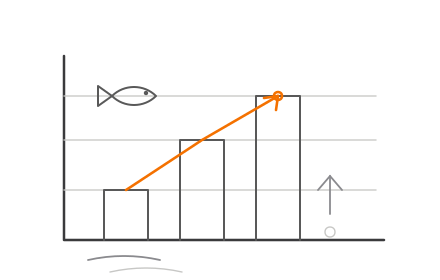
AI integration is now a critical evaluation criterion. Companies leveraging AI-driven personalization generate 40% more revenue than average players, and product recommendations alone drive up to 31% of e-commerce revenues.

According to Adobe's 2026 AI and Digital Trends report, roughly half of organizations consider the ability for AI agents to interact seamlessly with other agents a crucial factor in vendor selection. Agencies that embed AI into their workflows and deliverables—personalization engines, predictive analytics, intelligent automation—give clients a measurable edge over competitors.

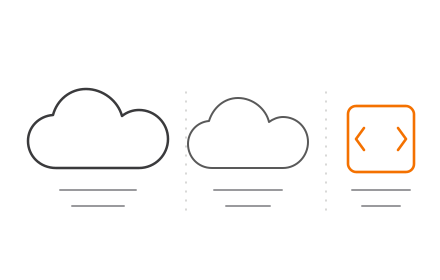
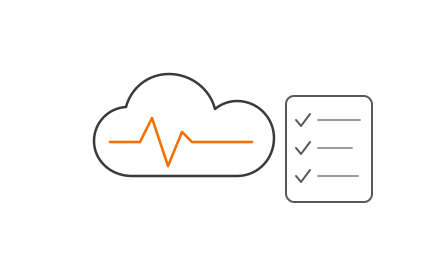
AI integration impact on e-commerce revenue personalization and vendor selection statistics

Conclusion

The right e-commerce development agency is a long-term strategic partner, not just a vendor. Your decision should be based on alignment with your business goals, platform needs, and growth roadmap—not just brand name or lowest quote.

Prioritize scalability, post-launch support quality, and AI readiness before signing on with any agency. The agencies that help you grow after launch are just as important as the ones that build well.

For businesses seeking a partner that combines AI-driven development with full-spectrum digital services—from UI/UX and web development to data engineering—Codiot works with startups, SMEs, and enterprises to deliver e-commerce solutions built for measurable growth.

Frequently Asked Questions

What is e-commerce development?

E-commerce development is the process of designing, building, and optimizing online shopping platforms. It encompasses everything from storefront UX and backend architecture to payment gateways, integrations, and performance at scale.

What are the 4 types of e-commerce?

There are four primary e-commerce models:

  • B2C (business to consumer) — retailers selling directly to individuals
  • B2B (business to business) — wholesale or supplier transactions
  • C2C (consumer to consumer) — peer-to-peer marketplaces
  • D2C (direct to consumer) — brands selling directly, bypassing intermediaries

How much does e-commerce development cost in 2026?

Costs vary widely by scope and complexity. Basic template builds range from $2,000 to $25,000 USD, while enterprise custom solutions exceed $135,000 USD annually. Ongoing maintenance ($1,000–$6,000 monthly) and integrations add to total cost of ownership.

How long does it take to build an e-commerce website?

Timelines depend on project complexity. SaaS platform builds (Shopify, BigCommerce) typically take 4–12 weeks, mid-market custom or headless builds require 12–24 weeks, and enterprise implementations span 3–9 months.

What should I look for when hiring an e-commerce development agency?

Look for agencies that demonstrate:

  • Platform expertise matched to your stack
  • A portfolio with relevant industry experience
  • A defined post-launch support model
  • Strong client references
  • A clear approach to scalability and AI integration

The best agencies tie their work to measurable business outcomes, not just technical deliverables.

What is the difference between custom and platform-based e-commerce development?

Custom development is built from scratch, offering maximum flexibility at higher cost and longer timelines. Platform-based development (Shopify, Magento, BigCommerce) launches faster and costs less upfront, with trade-offs in how far you can deviate from the platform's structure.