Flutter vs native development: an honest comparison
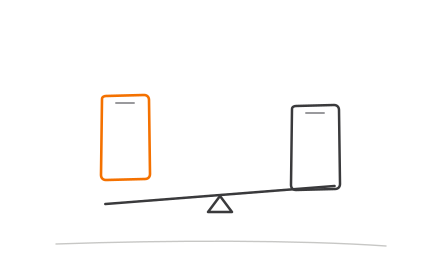
Native development means writing separate apps in Swift (or Objective-C) for iOS and Kotlin (or Java) for Android, each using the platform vendor's own tools and APIs directly. Flutter, by contrast, uses one Dart codebase and its own rendering engine to produce both apps at once. The honest tradeoff is this: native gives you the fastest possible access to every platform capability and the highest performance ceiling, while Flutter gives you roughly half the codebase to build and maintain in exchange for a small, usually invisible amount of that ceiling.
What "native" actually means
When people say "native," they mean code written directly against Apple's and Google's own SDKs: SwiftUI or UIKit for iOS, Jetpack Compose or the older View system for Android. These are the same tools Apple and Google's own engineers use, so native apps get access to every new OS feature on day one, the smallest possible app size for a given feature set, and the deepest possible integration with hardware like cameras, sensors, and background processing. The cost is that you're building and maintaining two separate apps in two separate languages, often with two separate teams who don't share much code or knowledge day to day.
What you gain and lose with Flutter
Flutter gives you one codebase, one team, and (usually) one release cycle for both platforms, which cuts development time and long-term maintenance substantially. It ships with a large widget library that covers most common UI patterns out of the box and increasingly strong plugins for camera, location, notifications, and payments. What you give up is a small amount of raw performance headroom, slightly larger app binary sizes than an equivalent native app, and a short lag (typically weeks, not months) before Flutter fully supports a brand-new OS feature after Apple or Google announces it, since Google's Flutter team has to build a bridge to it first.
Cost and timeline implications
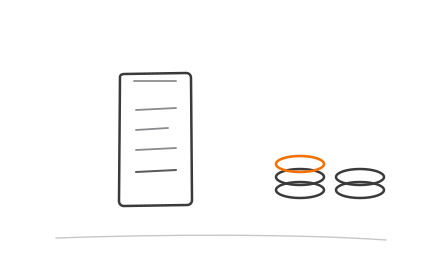
Building natively for both platforms roughly doubles the design, development, QA, and bug-fixing work compared to a single Flutter codebase, though not exactly double since some design and backend work is shared regardless of approach. A straightforward app might take a Flutter team 3-5 months versus 5-8 months for two parallel native teams working the same feature list; costs typically land 40-80% higher for the native-twice approach, with the multiplier growing as the feature list grows since every feature has to be built and tested twice.
Decision framework
| Choose Flutter when | Choose native when |
|---|---|
| Budget or timeline is a hard constraint | Budget supports two specialized teams |
| The app is CRUD-heavy, content-driven, or a standard business tool | The app leans on cutting-edge OS features (AR, ML on-device, new sensors) |
| One team needs to maintain both platforms long-term | You need the absolute smallest app size or fastest possible load |
| You want feature parity across iOS and Android by default | iOS and Android are meant to diverge significantly in design or feature set |
| You're validating a product and need to move fast | You're building for a narrow, performance-critical niche (games, pro audio/video tools) |
For most companies building a first product, an internal tool, or a standard consumer app, Flutter's savings in time and cost outweigh a performance gap most users will never notice. Native still earns its cost premium for apps where hardware access, raw performance, or day-one support for new OS features is the actual product, not a nice-to-have.
That calculation shifted slightly once Apple shipped a foldable iPhone, because what the iPhone Duo asks of your layouts lands on native and cross-platform teams at the same time.
If you're not sure which side of that line your project falls on, it's worth a conversation before committing a budget either way. Codiot's mobile app development team builds both native and cross-platform apps and can walk through your specific feature list; you can also see our take on the framework itself on the Flutter page.