How much does a web application cost to build?
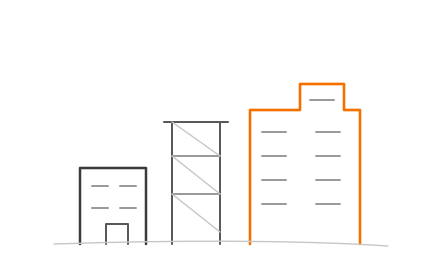
A simple marketing website is a small build, a web app with user accounts and a database is a middle tier, and a complex multi-tenant platform with integrations and custom workflows is the largest. The gap between them comes down to backend complexity, not visual design, which is why two projects that "look similar" can cost several times apart.
Most cost guides for web development either give a single vague range so wide it is useless, or a fake-precise number that pretends to certainty it cannot have. What actually moves the price is a short list of specific factors, and once you know them, you can place your own project on the scale before you ever talk to a vendor.
What actually drives the cost
Backend and database complexity. A site that just displays content needs little more than a content management system. An app that stores user data, handles permissions, and runs business logic needs a real backend, a database schema, and API design. This is usually the single biggest cost driver, more than the frontend.
Authentication and user roles. Basic email/password login is cheap. Multi-role permissions (admin, manager, end user), single sign-on, or enterprise identity providers (SAML, Okta) add real engineering time, often 1-3 weeks depending on how many roles and edge cases you need.
Third-party integrations. Payments (Stripe), email (SendGrid), SMS, CRM sync, accounting software, or a legacy internal system each typically add anywhere from a few days to a few weeks of work, depending on how clean the third-party API is and whether it needs custom error handling and retries.
Multi-tenancy. If your app serves multiple customers or organizations from one codebase, with data isolation between them, that's a meaningfully harder architecture than a single-tenant app and usually adds 20-40% to backend cost.
Design complexity. Custom illustration, animation, and highly tailored UI cost more than using a clean, consistent design system across screens. This affects cost less than backend complexity but is not free.
Cost breakdown by project type
| Project type | Relative cost | What's included |
|---|---|---|
| Marketing website | Lowest | CMS-driven pages, contact forms, basic SEO, no user accounts |
| Web app with auth + database | Mid-range | User accounts, core CRUD features, one or two integrations, admin panel |
| Complex multi-tenant platform | Highest | Multiple user roles, multi-tenancy, several integrations, custom workflows, reporting |
These ranges assume a single web app built by an experienced team. Adding native mobile apps, AI features, or a from-scratch design system on top will move you toward the higher end or beyond it.
What most estimates leave out
Three things get left off quotes more often than they should:
- Ongoing hosting and infrastructure. A production web app with a database, background jobs, and file storage carries a recurring monthly bill that grows with traffic and provider, before you factor in scaling costs.
- Third-party service fees. Payment processing, transactional email, and SMS providers charge per-use or per-seat, and these add up separately from your build cost.
- Maintenance and bug fixes. Software needs patching for security updates, dependency upgrades, and the inevitable edge cases users find that QA didn't catch. Budgeting nothing for the first 3-6 months after launch is a common and costly mistake.
Getting an estimate that holds up
The estimates that turn out to be accurate are the ones built from a real feature list and a real integration list, not a page count. Before you ask for a quote, write down: who your users are, what they need to do in the app, which systems it needs to talk to, and whether you need it to support multiple organizations or just one. That list will get you a far tighter estimate than "how much for a web app like X."
If you're scoping a build and want a range based on your actual requirements rather than a generic bracket, our web development team can walk through feature and integration tradeoffs before you commit to a number. For teams standardizing on a component-heavy frontend, it's also worth understanding framework choice early, since it affects both build speed and long-term maintenance cost; see our Angular technology page for how that fits into a larger platform decision.
The software project scoping checklist
The questions that actually decide a project's cost and timeline, so you can scope yours properly before you ever talk to a vendor.
One email, the resource, and nothing else. No list, no drip.