What is an AI factory? A plain-language guide
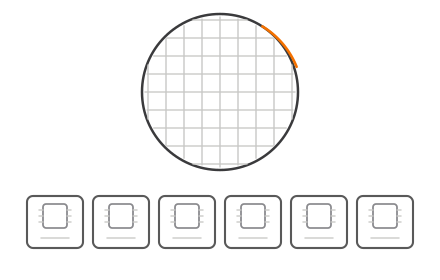
An AI factory is the repeatable infrastructure, team, and process that a company uses to turn AI use cases into shipped, working software one after another, instead of treating each idea as a one-off project that starts from zero. It bundles shared data access, a standard way to test and evaluate model output, and a proven deployment path, so that once the first use case ships, the second one takes a fraction of the time.
Why "factory" is the right word
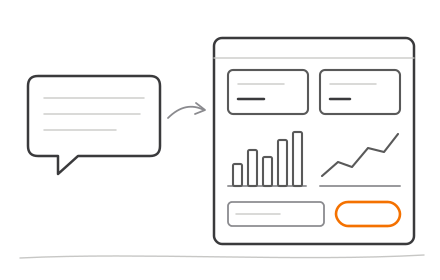
A factory does not build one car and shut down. It builds a line: the same tooling, the same quality checks, the same shift of workers, applied to product after product. An AI factory works the same way. The first AI feature a company ships, say, an internal support assistant, forces the team to solve a set of problems that have nothing to do with the assistant itself: how do we connect securely to our data, how do we know if a model's answer is actually good, how do we roll back a bad deployment, who signs off before it goes live.
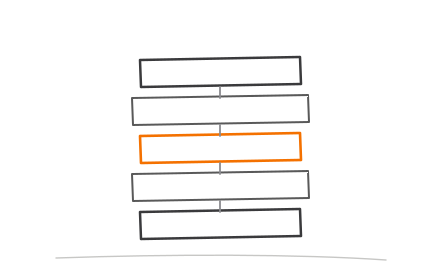
Solve those once, and every AI use case after the first one skips straight to the interesting part. That is the factory. It is not a tool you buy. It is the combination of a data layer, an evaluation harness, a deployment pipeline, and a team that knows how to run all three, kept alive between projects rather than rebuilt each time.
Why companies are building them now
Most companies discover the need for an AI factory the hard way. They run a successful pilot: a chatbot, a document summarizer, a classification model. It works. Then a business unit asks for a second use case, and the team realizes they are rebuilding the retrieval pipeline, re-writing evaluation scripts, and re-litigating governance approvals almost from scratch. Each project costs roughly the same as the last one instead of getting cheaper.
An AI factory exists to break that pattern. Instead of three teams independently wiring up connections to the same customer database, one shared pipeline serves all three. Instead of every project inventing its own way to check if the model's answers are accurate, one evaluation framework applies everywhere with small adjustments. The economics flip: use case one is expensive, use case five is comparatively cheap, because most of the hard infrastructure work is already paid for.
AI factory vs. a single AI project
| Single AI project | AI factory | |
|---|---|---|
| Data connections | Built per project | Built once, reused |
| Evaluation method | Improvised, often manual | Standardized framework |
| Deployment | Custom each time | Repeatable pipeline |
| Cost of the 2nd use case | Nearly same as the 1st | A fraction of the 1st |
| Governance and safety checks | Reviewed per project | Applied consistently across all use cases |
The practical difference shows up in timelines. A one-off AI project might take three to six months from idea to production, largely because of plumbing work that has nothing to do with the actual business problem. In an established AI factory, the fifth or sixth use case can often ship in a matter of weeks, because the plumbing is already there and the team is applying a known process to a new problem rather than inventing one.
What it takes to run one
An AI factory needs three things working together: infrastructure that persists across projects (data pipelines, retrieval systems, model access), a process that is documented and repeatable (how you scope a use case, how you evaluate it, how you ship it), and a team that has done this enough times to know where the sharp edges are. Miss any one of the three and you end up with expensive infrastructure nobody uses consistently, or a fast process running on infrastructure that breaks under real load.
Once agents enter the picture, the factory also has to decide who runs them, which we cover in the three-layer agent stack. One of the first economics questions a factory has to answer is which steps deserve your most expensive model, which is the subject of our piece on why an agent should not use a frontier model for every step. This is also why companies increasingly look outside for help setting one up rather than building it cold. Codiot's AI development team works with clients to scope the first one or two use cases correctly so the underlying factory gets built right, and our AI factory offering is built specifically around standing up that repeatable infrastructure and process rather than shipping a single isolated feature. If you are looking at a roadmap with more than a couple of AI features on it, the factory model is usually the cheaper path by the second or third one.