Can AI underwrite a property without local knowledge?
Private real-estate lending depends on a kind of intelligence that is hard to put in a spreadsheet. An experienced underwriter knows two streets in one ZIP code have very different buyer demand, that a proposed renovation is too ambitious for the block, or that a capable sponsor will solve a problem that would sink a weaker one.
AI processes more data than any individual. It reads documents, compares properties, detects inconsistencies, and runs scenarios in seconds. The question is whether it can underwrite the deal without flattening the local context that makes private lending work.
The useful answer is not "AI or human." It is a deliberate division of labour.
What AI does well
A loan file holds information in many shapes: application fields, bank statements, entity documents, appraisals, leases, construction budgets, photos, and email. Much of an underwriter's day goes on finding facts and checking whether they agree.
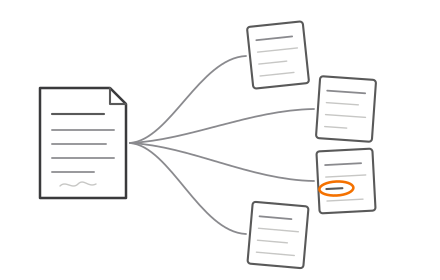
Document intelligence extracts names, dates, balances, and property details, then compares them across sources. It flags that the borrower name differs between an operating agreement and a bank statement, that a renovation budget omits a major trade, or that the square footage in a valuation disagrees with public records.
It also supports scenario work. Rather than one base case, the underwriter can test slower absorption, higher carrying costs, or a lower exit. The effect is better questions asked earlier.
What local expertise sees that data misses
Real estate is physical, local, and path-dependent. A database identifies comparable sales without understanding why one side of a main road trades differently. It sees that permits exist without knowing how long that jurisdiction actually takes. It recognises a contractor's name without knowing whether they can manage this scope.
Execution risk is equally contextual. Two sponsors with similar balance sheets diverge because one has completed this project type in this market several times. Experience with local trades, permitting, buyer expectations, and exit liquidity often decides whether a plan is realistic.
Local knowledge is not an argument against technology. It is information that should be captured in the decision. The system should let an expert record why a comparable is misleading, why an exception is acceptable, or why a project needs a larger contingency.
A workable operating model
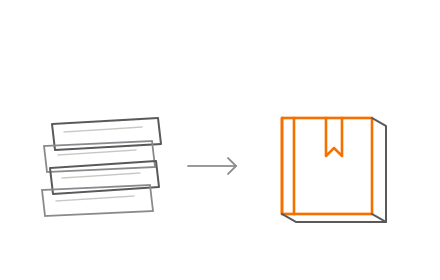
Four layers keep speed without confusing a model output with a lending decision.
- Assemble the facts. Software gathers data from the application, documents, and external sources, standardises addresses and entity names, identifies what is missing, and preserves the source of each field.
- Test for inconsistency. Rules and models compare values, detect anomalies, and route exceptions: unusual price movement, duplicated photos, budget gaps, undisclosed liens, or a mismatch between stated and observed experience.
- Add expert context. An underwriter assesses property, sponsor, and business plan. Local sales, neighbourhood dynamics, project complexity, and exit assumptions get explicit consideration. The expert may override the recommendation, and the reason is recorded.
- Decide and monitor. The authorised credit professional approves, declines, or modifies. After funding, real performance feeds back: draw timing, budget changes, repayment, exit results.
Why explanation matters operationally
A tool that says "high risk" without saying why is close to useless. The underwriter needs to know whether the concern is property condition, market liquidity, sponsor leverage, or a document inconsistency. Borrowers and brokers benefit too, from clearer conditions and fewer vague requests.
Explainability is not only a compliance talking point. When a team understands why a model produced an output, it can correct bad data, spot drift, and judge when to intervene. NIST's AI Risk Management Framework emphasises validity, transparency, explainability, privacy, and ongoing risk management for exactly this reason.
Measure against the human baseline
The right question is not whether the AI is perfect. It is whether the combined process beats the current one. Measure turnaround, rework, exception rates, post-close defects, early delinquencies, and consistency across similar decisions.
Then look at where it fails. Does performance degrade in thinly traded markets? Are ground-up projects treated like stabilised homes? Are inputs current enough for a fast-moving neighbourhood? Uncertainty should be visible rather than rounded away, which is the same discipline covered in how to evaluate LLM outputs.
Keep the relationship in relationship lending
Experienced investors value speed, but they also value a lender who understands the deal. AI creates room for that conversation by removing document chasing and repetitive analysis, so the underwriter arrives with sharper questions and a clearer view of risk.
The future here is not autonomous underwriting. It is augmented underwriting: technology handling scale and pattern recognition, accountable experts supplying context and judgement. That is how we approach credit underwriting automation and the wider systems we build for lending clients.