
Credit underwriting automation
Underwriters re-key the same data into three systems before making a decision, and two underwriters given the same file reach two different answers. We build the engine that makes it consistent.
Review underwriting architectureWhat is credit underwriting automation?
You'll recognize one of these.
The inconsistent decision
Two underwriters look at the same borrower file and reach two different decisions, because the credit policy lives in people's heads, not in a system.
The re-keying tax
Underwriters manually re-enter the same borrower data into three systems before a decision can even be made.
The unexplainable model
A vendor's black-box scoring model makes decisions nobody at your company can actually explain to a regulator or a rejected applicant.
Credit underwriting automation, end to end.
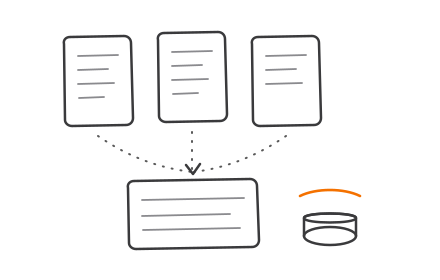
Rules engine
Your written credit policy encoded as executable rules, applied the same way every time.
Scorecards and ML models
Statistical or machine learning models layered on top of rules where they add real predictive value.
Explainability and audit trail
Every decision traceable to the specific rules and data that drove it, for regulator and applicant transparency.
Data integration
Credit bureau, bank statement, and income data pulled automatically instead of re-keyed by hand.
Decision dashboards
Real-time visibility into approval rates, decision speed, and policy exceptions.
Fair lending compliance
Model monitoring built to catch disparate impact before a regulator does.
Your stack, not our preferences.
When it fits, and when it doesn't.
Signs you need this
- ·Decisions vary by who reviews them, and the reasons are hard to reconstruct.
- ·Policy changes take weeks because rules are buried in code or people's heads.
- ·You want to use scores or models but need guardrails and explainability.
- ·Manual review queues are overwhelmed and slow to clear.
What's included
- ·A rules engine your risk team can read and change.
- ·Integration of bureau data, alternative data, and model scores.
- ·Automated, manual, and hybrid decision paths with review queues.
- ·Explainability, override tracking, and audit trails.
What's not
- ·The credit policy and risk appetite, which remain yours to set.
- ·Model development where you already have a data-science function; we integrate it.
- ·Final lending decisions and regulatory accountability.
When this isn't the right fit
- ·Volumes are low enough that manual underwriting is still efficient and consistent.
- ·Your policy is not yet written down clearly enough to encode.
- ·You need a decision engine live this week with no integration work.
Common questions, answered plainly.
How much does underwriting automation cost?
Can this work alongside our existing underwriters?
How do you ensure regulatory compliance?
Rules engine or ML model, which do we need?
How long does implementation take?
The rest of the stack.
Show us how this runs today.
One call. Walk us through how it works in your shop today, and we'll tell you honestly where custom software pays off, and where it doesn't.
Book the walkthrough