Estimating ARV with computer vision and property data
An after-repair value is a forecast wearing the costume of a fact. It is the single most important number in a fix-and-flip loan, because the loan is repaid from the finished property, not the one the borrower is standing in today. And it describes a building that does not yet exist. Any technology that claims to produce it instantly, to the dollar, is selling confidence it has not earned.
The useful question is not whether software can estimate ARV. It can, and quickly. The question is how to build ARV tooling that is fast, defensible, and honest about what it does not know.
Why ARV resists a single number
Three properties make ARV genuinely hard, and no amount of compute removes them.
It is forward-looking. The value depends on a renovation that has not happened, so it inherits the execution risk of the renovation. A correct ARV on a project that never gets finished is worthless.
It is condition-driven. Most of the distance between as-is and after-repair value is a condition and finish story, and condition is the thing structured data captures worst. Two identical floor plans on the same street can differ by a renovation budget.
It is local. Micro-market variation, the pace of the local sale, permitting reality, and contractor availability all move the number, and all of them live in the heads of people who work that market rather than in a national dataset.
The three-layer workflow
The pattern that works treats ARV as a pipeline of decreasing automation and increasing judgement, not a single model call.
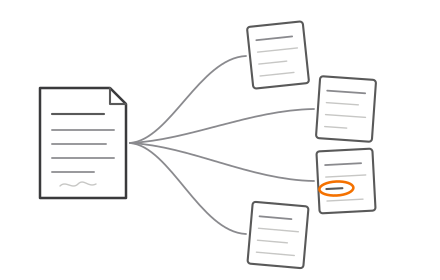
Layer one: the automated baseline. Automated property data and comparable sales produce a first-pass value range. This is where machine speed earns its place: assembling subject characteristics, pulling and filtering comparables, and returning a defensible baseline in seconds rather than hours. Fannie Mae's move toward value acceptance with property data is the same idea in the conforming world, structured property data standing in for parts of a traditional appraisal.
Layer two: condition and renovation adjustment. Computer vision reads listing and inspection photographs to estimate current condition and finish quality, and the scoped renovation budget maps the path from as-is to after-repair. This is the layer that decides whether the baseline comps are actually comparable, because a renovated comp and a tired subject are not the same asset.
Layer three: expert reconciliation. A person who knows the market reconciles the machine baseline against what they can see that the model cannot: that permits move slowly in this jurisdiction, that this contractor has finished three of these, that the block turns over in two weeks or in five months. Their job is not to re-derive the number. It is to accept, adjust, or challenge it, and to record why.
| Layer | What it does | What it is good at | What it must not do |
|---|---|---|---|
| Automated baseline | Comparable-driven value range | Speed, consistency, coverage | Emit a point estimate as final |
| Condition and renovation | Computer vision plus scoped budget | Reading finish and condition at scale | Replace the physical inspection |
| Expert reconciliation | Human market judgement | Execution and local-market risk | Re-do the arithmetic by hand |
The output is a range, and it says so
The most important design decision is the shape of the answer. An "instant ARV" that returns a single number teaches everyone downstream to trust it exactly as much as it does not deserve. A range with an explicit confidence, and the assumptions behind it, does the opposite: it tells the credit committee where the uncertainty actually sits.
That is also what the NIST view of trustworthy AI asks for. A system whose outputs are valid, and whose limits are communicated rather than buried, is one people can rely on precisely because it does not overstate itself. For a forward-looking valuation, communicating uncertainty is not a weakness of the tool. It is the feature.
It has to live inside the rules
ARV tooling used in a regulated credit decision is not free-floating. The interagency quality-control rule for automated valuation models, published in August 2024 and effective October 2025, requires institutions to maintain standards for confidence in the estimate, protection against data manipulation, avoidance of conflicts of interest, random sample testing, and compliance with nondiscrimination law.
Read that as a design brief rather than a burden. Confidence in the estimate means surfacing uncertainty. Protection against manipulation means data lineage. Random sample testing means comparing the model against realised sale prices over time. A well-built ARV system produces those controls as a by-product of being built properly, which is the same reason credit underwriting software is worth building around evidence rather than a single score.
What this means for building one
If you are commissioning ARV tooling, the tell of a serious build is what it does with doubt. A system that hides uncertainty to look decisive is a liability the first time a project overruns. A system that ranges its answer, shows the comparables and condition evidence behind it, keeps the human decision auditable, and tests itself against what actually sold, is one a credit committee and a rating agency can both stand behind.
Machine speed belongs in layer one. Judgement belongs in layer three. The value of the whole thing depends on not confusing the two.