LP reporting: automating the quarterly grind
LP reporting automation replaces the manual process of chasing portfolio company data through email and spreadsheets with standardized data intake and automated report generation, cutting typical reporting cycles from two to three weeks of analyst work down to a few days once the system is running well. The pain isn't the reporting itself, it's the twelve rounds of data-chasing that precede it every quarter.
Ask anyone who's built an LP report by hand what the hardest part is, and it's rarely the writing. It's the forty-company scavenger hunt for numbers that should already exist somewhere.
Why this is manually painful
Data is scattered by design, not by accident. Each portfolio company runs its own finance function, on its own schedule, with its own spreadsheet format. A fund with 30 portfolio companies is effectively asking 30 different organizations to hand over consistent numbers, and most of them treat that request as a lower priority than their own board deck.
Formats never match. One company sends a P&L as a PDF export from QuickBooks. Another sends a founder's own spreadsheet with custom line items. A third answers by email in prose. Someone on the fund side has to translate all of this into one consistent format before it becomes usable, and that translation work is where most of the time actually goes.
The deadline doesn't move. LPs expect reports within roughly 30-45 days of quarter close, often written into the fund's own LPA. That window doesn't expand because three portfolio companies were late, which means the fund absorbs the delay internally, usually as a scramble in the final week.
The work doesn't scale linearly. Adding portfolio companies doesn't just add proportional work, it adds coordination overhead: more people to chase, more formats to reconcile, more edge cases where one company's metric doesn't map cleanly onto the fund's standard template.
What automation actually looks like
Automating LP reporting doesn't mean removing humans from the process. It means removing the manual reformatting and chasing that currently eats most of the time, so the humans left in the loop are reviewing and approving rather than assembling from scratch.
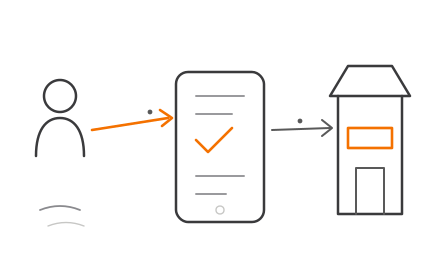
Standardized intake. Instead of an open-ended request for "your Q2 numbers," portfolio companies get a structured form or lightweight integration that captures the same fields, in the same format, every quarter. This is the single highest-leverage change, since it moves the reconciliation work upstream to a one-time setup rather than a recurring quarterly task.
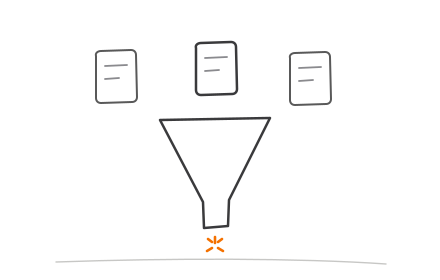
Automated aggregation and calculation. Once data lands in a consistent structure, fund-level metrics like TVPI, DPI, and IRR, and portfolio-level rollups, can be calculated automatically rather than rebuilt in a spreadsheet each cycle.
Templated report generation. LP reports get generated from the underlying data against a template that matches your fund's actual format, including any custom sections specific LPs require under side letters, rather than a person manually rebuilding a deck from scratch every quarter.
A review step, not a build step. The person who used to spend two weeks assembling the report now spends a few hours reviewing generated output for anything that looks off before it goes out. That's the real shift: from data assembly to quality review.
Realistic time savings
| Stage | Typical reporting time per quarter |
|---|---|
| Fully manual | 2-3 weeks of analyst time |
| First 1-2 quarters after automating | Modest gains as data quality issues surface |
| Mature automated system | A few days, often just hours of review |
These ranges assume the fund actually gets portfolio companies to adopt the standardized intake process, which is usually the harder rollout problem than the software itself. Founders are busy, and getting 30 of them to consistently fill out the same form takes some persistence in the first couple of quarters. If you have just closed Fund I, our guide to the Fund I reporting stack covers what LPs ask for in year one and a 90-day plan for getting the first quarter right.
This kind of system tends to work best when it's built on top of the same data your fund already tracks for VC portfolio management, rather than as a separate reporting tool bolted on afterward. If your fund is still assembling LP reports by hand each quarter, it's worth a conversation about what a VC portfolio management solution with built-in LP reporting automation would look like for your specific reporting requirements and LP base.