The pond culture record: what to capture, and why
Most of the aquaculture industry still runs its most important dataset on a paper form. The culture record, the log of one pond through one cycle, is where a shrimp or fish farm's entire economics are written down: what went in, what it ate, what the water did, what came out. And in most operations that record is a clipboard filled in during a visit, rekeyed at an office weeks later, and analysed, if at all, once the cycle it describes has already ended. The data exists. It just arrives too late and too inconsistent to be worth much.
Getting the culture record right, and getting it off paper, is the unglamorous foundation everything else in a pond operation depends on.
What a culture record is for
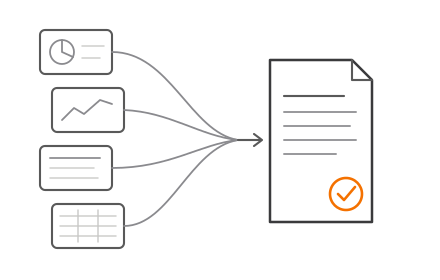
A culture record is a batch record for a production cycle that happens in water. Its job is to tie every input and every observation to a specific pond and a specific cycle, so that at any point, and especially at harvest, the numbers reconcile. Without that discipline, a feed figure is just a feed figure. With it, that same figure, set against stocking density and days of culture, becomes feed conversion ratio, which alongside survival rate is what decides whether a cycle made money.
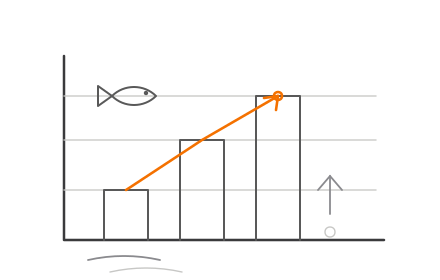
The record is not paperwork for its own sake. It is the raw material for the only two metrics that matter.
What to capture
The fields are not exotic. The discipline is in capturing them consistently, and always against a specific pond and cycle.
| Field | Why it matters |
|---|---|
| Species and stocking density | Sets the expectations everything else is judged against |
| Stocking date and days of culture | The clock the whole cycle is measured on |
| Daily feed | The largest controllable cost; the input to feed conversion |
| Water quality readings | Dissolved oxygen, pH, salinity, temperature, the daily drivers of survival |
| Sampling results | Growth and health checks that catch problems between visits |
| Harvest weight | The outcome every earlier field is reconciled to |
Miss the pond-and-cycle tagging and the rest is noise. Capture it consistently and the record calculates the business.
Why paper quietly costs money
Paper does not fail loudly. It fails by being slow and inconsistent, and both cost real yield.
It arrives too late. A water reading written down and rekeyed weeks later explains a loss after the fact. The same reading seen the same day lets someone still prevent one.
It cannot be compared. Head office cannot rank ponds or sites, or spot a technique that works, when every record is a separate sheet in a separate drawer.
It breaks the metrics. Feed conversion and survival are only as trustworthy as the daily logging behind them. Inconsistent paper entry means the two numbers the business runs on are estimates at best.
The economics of that gap are real. We modelled them in detail in what an aquaculture app is worth per pond: even conservative gains in survival and feed conversion, the direct products of catching problems sooner, add up quickly across a fleet of ponds.
From record to decision
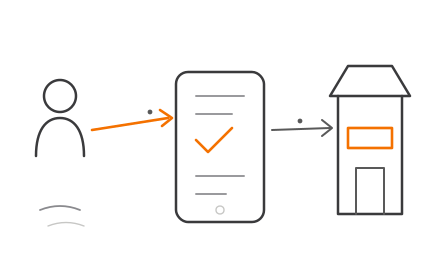
Digitising the culture record is not about replacing the technician's judgement. It is about shortening the distance between what they observe and what the operation can act on. A reading captured on-site, checked against a per-species safe range, tells the technician immediately whether a pond is drifting out of tolerance. Daily feed logged against biomass turns into a feed conversion number the manager can actually manage to. Sampling photos build a visual history per pond that a remote expert can review.
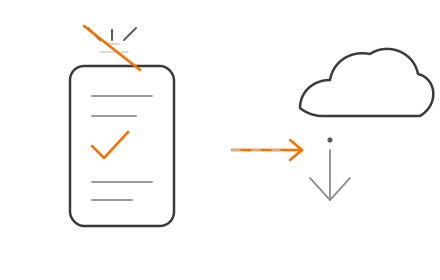
None of that works if the capture fails in the field, which is why pond software has to be offline-first before it is anything else, a point that applies to all aquaculture software and to the field apps in agriculture beside it.
We built this end to end in our offline-first aquaculture app, which replaced the paper culture record for shrimp and fish farmers across several country subsidiaries, capturing stocking, feeding, water quality, and sampling against each pond and reconciling it all to a cycle. The paper form had one virtue, that it always opened. The right software keeps that virtue and adds the thing paper never had: numbers you can act on while the cycle is still running.