From data room to rated deal: RTL securitizations
A securitization is announced as a capital-markets transaction, but the work starts much earlier, usually when the first field is entered into the loan-origination system. Rated residential transition loan deals put a lender's underwriting, documentation, servicing, and data quality under institutional scrutiny. Investors and rating agencies need to understand not only the collateral pool, but how the lender originates, monitors, and reports on the loans.
That shift became visible in 2025, when roughly 8 billion dollars of RTLs were securitized across 20 issuers, according to the Urban Institute's April 2026 report on the evolution of residential transition lending. Nearly two thirds of those deals were rated, in a market where rated RTL securitizations only emerged in 2024. The growing use of structures that reinvest principal payoffs into newly originated collateral points to a broader change: operating data is becoming capital-markets infrastructure.
The key point: a rated deal is not created in the data room. It is enabled by the consistency of the systems and controls that produced every loan in the pool.
Institutional capital asks different questions
A relationship lender may know why an exception made sense. A securitization investor needs that rationale documented and consistently reported. A warehouse provider focuses on eligibility and advance rates; a rating agency evaluates collateral characteristics, concentration, structural protection, and expected performance.
That creates a demanding information chain. Property type, geography, loan purpose, original and current balance, leverage, borrower experience, renovation budget, draw status, maturity, payment history, and valuation detail all have to be accurate and reconcilable. If a field means one thing in origination and something else in servicing, the discrepancy becomes a diligence problem.
Build the loan tape during origination, not before the deal
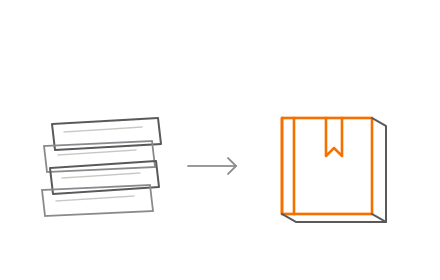
The loan tape is usually treated as a capital-markets deliverable assembled shortly before a transaction. The stronger approach is to treat it as a living output of normal operations.
Key fields need defined owners, accepted formats, and validation rules. Addresses should be standardized. Product and property classifications should use controlled values rather than free text. Original underwriting data should stay distinguishable from later updates. Exceptions should carry the approving authority and the rationale.
That discipline cuts manual reconciliation and makes it far easier to determine which loans qualify for a facility, a sale, or a securitization. It also improves day-to-day portfolio management, which is why loan tape automation pays for itself well before a deal is in sight. If the concept is new, our explainer on what a loan tape is covers the fundamentals.
Data lineage turns numbers into evidence
Institutional diligence is not satisfied by a plausible number. Reviewers need to know where it came from and whether it agrees with the underlying document.
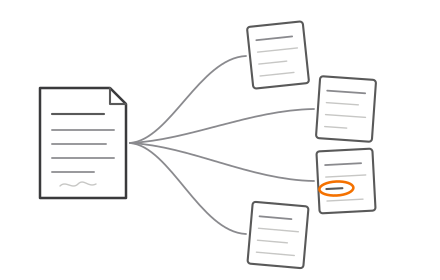
Data lineage links a field to its source: an appraisal, a budget, a title report, an executed note, an inspection, or a servicing record. Document-intelligence tools can compare extracted values against system data and flag discrepancies, though high-impact fields still need controls and human review.
When lineage is preserved, a lender answers diligence questions in minutes. When it is not, teams search folders and email threads to reconstruct the history of a file, and every reconstruction is a chance to introduce an error.
Construction loans need living collateral data
RTL pools can include properties whose condition and funded balance change throughout the loan term. That makes draw and inspection data central to credit performance rather than an operational afterthought.
A capable platform connects the approved budget, completed work, disbursed funds, remaining commitment, and inspection evidence. It shows whether progress is keeping pace with spending, and whether the remaining budget still looks sufficient to finish the project. For capital providers that gives a clearer view of exposure; for the lender it supports eligibility monitoring and surfaces a drifting project before it becomes a servicing event.
Servicing telemetry carries the reporting load
Securitization does not end the need for good data. It increases it. Payment status, extensions, modifications, draws, maturities, payoffs, and delinquencies all have to reach investor and trustee reporting on schedule.
Automation can validate totals, identify missing values, and reconcile cash movements across systems, while exception dashboards point operations teams at the records that actually need correction. The objective is not to automate accountability away. It is to cut preventable defects so responsible teams have time for the genuine exceptions.
A revolving structure raises the bar
In a revolving securitization, new collateral enters the pool as loans pay off. That supports capital recycling, and it makes eligibility controls and data consistency more important, not less. Each new loan has to satisfy defined criteria, and the platform has to demonstrate that the pool stays within concentration and performance limits.
Rules engines can screen candidate loans while portfolio analytics model how substitutions shift geography, product mix, leverage, and maturity. Authorized professionals still govern the decision, but they work from a current portfolio view instead of a manually assembled snapshot.
Technology lowers the operational cost of capital
The economics of a securitization depend on more than the coupon paid to investors. Diligence expense, defect remediation, reporting overhead, and the time loans sit on a warehouse line all affect the true cost of funds.
Cleaner data shortens reviews, reduces rework, and widens the execution options available. It also builds confidence with institutional partners across repeated transactions, and that confidence is earned through consistent performance and transparent reporting rather than a polished dashboard.
The data room is the final exam
The emergence of rated RTL securitizations reflects the sector's scale and professionalization, and 2025 volumes created more visibility into loan terms and credit performance than the market has previously had.
The implication for private lenders is that technology strategy and capital strategy have converged. The system that gives a borrower a quick answer is the same system that must later support diligence, surveillance, and investor trust. Building a securitization platform is really an exercise in making everyday operations produce institution-grade evidence, which is the same discipline that runs through the wider digital lending stack and every system we build for lending clients.
A rated deal closes on one day. The data discipline behind it is built on every day before and after.
For the practical readiness map, our guide on what a securitization-ready lending stack needs lays out the capabilities in the order to build them.