The digital lending stack: an end-to-end map
Written with AI assistance. Drafted and reviewed by Bharat Dangar, Salesforce Engineer.
The digital lending stack is the set of connected systems a lender uses to move a loan from application to repayment and, for many lenders, on to the capital markets. Each stage of a loan's life has its own software category, and the difference between a smooth lending operation and a painful one is usually how well those categories are connected, not how good any single one is in isolation. This is a map of the stack, stage by stage, and how the pieces fit together.
The stages of a loan, and the system for each
A loan moves through a predictable sequence, and each step has a category of software built for it.
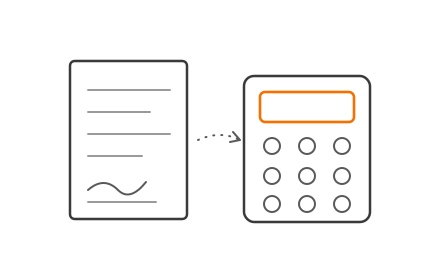
Origination. The front of the stack is the loan origination system, or LOS. It captures the application, collects documents, runs the initial checks, and carries the loan through to approval and funding. It is the borrower-facing and operations-facing heart of the early journey.
Credit decisioning. Sitting alongside origination is credit underwriting automation: the rules engines and models that decide who gets approved, for how much, and on what terms. Some lenders run deterministic rule sets, others layer in machine-learning models, and many use both, with rules as guardrails around a model's score.
Servicing. Once a loan is funded, it moves to a loan management system, or LMS, which handles the loan for the rest of its life: billing, payments, interest and fee calculation, statements, and changes like restructures. Origination is a sprint; servicing is a marathon that runs for the full term.
Collections. When payments fall behind, collections software manages the recovery workflow: segmentation, outreach sequencing, promise-to-pay tracking, and the compliance rules that govern how and when a borrower can be contacted.
Capital markets. Lenders that fund through debt facilities or securitization need two more layers. Loan tape automation turns servicing data into the clean, structured loan-level files that investors and diligence teams require. A securitization platform then handles pool selection, waterfall calculations, and investor reporting for structured deals.
Co-lending. In markets like India, co-lending adds a coordination layer on top, splitting origination, funding, and servicing across a bank and an NBFC while keeping each party's books and regulatory reporting straight.
The stack at a glance
| Layer | System | What it does |
|---|---|---|
| Origination | Loan origination system (LOS) | Application intake, documents, approval, funding |
| Decisioning | Credit underwriting | Rules and models that set approval and terms |
| Servicing | Loan management system (LMS) | Billing, payments, interest, statements, changes |
| Collections | Collections software | Recovery workflows within contact-compliance rules |
| Capital markets | Loan tape automation | Clean loan-level data for investors and diligence |
| Capital markets | Securitization platform | Pool selection, waterfalls, investor reporting |
| Coordination | Co-lending platform | Splitting origination, funding, and servicing across partners |
The connective tissue
The categories above are the easy part to name. The hard part, and where most of the real value and risk sits, is what runs between them.
Data quality. Every downstream stage inherits the data captured upstream. A field entered loosely at origination becomes a gap in the loan tape months later, when a bad tape can stall a whole diligence process. Clean data at the source is cheaper than cleaning it before every investor request.
Integrations. The stack is only as good as its connections. Origination has to hand off cleanly to servicing, servicing has to feed collections and reporting, and every layer needs a consistent view of the same loan. Point solutions that do not talk to each other create manual reconciliation, which is slow and error-prone.
Compliance. Fair-lending rules, audit trails, and model governance are not a separate module; they run through every layer. Underwriting decisions have to be explainable, collections contact has to follow the rules, and the whole chain has to be auditable. Building this in from the start is far cheaper than retrofitting it.
Build, buy, or assemble
Few lenders build the entire stack from scratch, and few find a single product that does all of it well. The realistic path is usually a deliberate mix: buy the mature, commoditized layers, and build or heavily customize the layers that carry your actual competitive edge, which is often underwriting and the borrower experience. The build vs buy decision is worth making layer by layer rather than for the stack as a whole.
Whichever way you go, treat the stack as one system with a shared data model, not a collection of tools bought separately. Lenders who get this right can move a loan from application to capital markets without re-keying it once. If you are mapping or modernizing your own stack, our work across the lending sector covers each of these layers and, more importantly, the connections between them.
FAQ
What is the digital lending stack?
What are the core systems in a lending technology stack?
Should a lender build or buy its lending stack?
How this article was written: see our editorial policy.