VC portfolio management software: build vs buy
VC portfolio management software tracks portfolio company performance, fund-level metrics like IRR and TVPI, and generates the reports LPs expect each quarter. Most firms should start with an off-the-shelf tool such as Carta, Visible, or Affinity, and only consider a custom build once portfolio size, reporting complexity, or integration needs outgrow what those platforms offer.
The decision isn't really "build vs buy" in the abstract. It's a question of when the cost of forcing your fund's data into someone else's template exceeds the cost of building something that fits.
What this software actually does
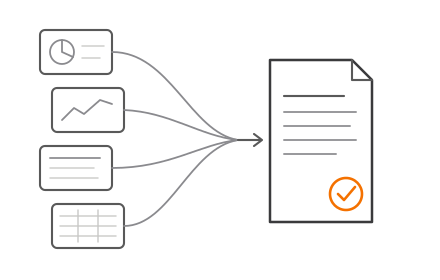
At its core, VC portfolio management software does three jobs. First, it tracks portfolio company data: revenue, headcount, burn rate, valuation marks, cap table position, and whatever KPIs the fund cares about across its companies. Second, it rolls that data up into fund-level metrics, IRR, TVPI, DPI, and per-vintage performance, that partners use internally and show to LPs. Third, it generates LP-facing reports on a quarterly or semi-annual cadence, formatted consistently across the portfolio.
Related to but distinct from this is deal flow tracking, which covers the sourcing and diligence pipeline before a company becomes a portfolio holding. Portfolio management picks up after the check is written.
Off-the-shelf options and where they fall short
Tools like Carta, Visible, Chronograph, and Affinity's portfolio modules cover the common case well: standard KPI collection forms sent to portfolio companies, templated LP report generation, and dashboards for partners. For a fund with 15-30 portfolio companies and reasonably standard metrics (ARR, growth rate, runway), these tools are cheaper and faster than building anything.
The gaps tend to show up in three places. Portfolio companies with highly varied business models (a fund that invests across SaaS, marketplaces, and hardware) don't fit one KPI template well. Funds with unusual LP reporting requirements, side letters with custom metrics, or reporting in formats a specific institutional LP requires, hit template limits fast. And funds that want to combine portfolio data with proprietary sourcing or market data in one internal system often can't, because off-the-shelf tools are closed systems by design.
A decision framework
| Factor | Leans toward buy | Leans toward build |
|---|---|---|
| Fund size | Smaller, single-fund | Larger or multi-fund platform |
| Portfolio companies | Under 40 | 40+ or highly heterogeneous |
| Reporting needs | Standard LP metrics | Custom LP formats, side letter terms |
| Internal tooling | Standalone use case | Needs to integrate with proprietary sourcing/data systems |
| Team | No in-house engineering | Has or can hire a small internal team |
Most seed and early Series A funds land firmly in the "buy" column, and that's the right call. It's not a compromise, it's the efficient choice at that scale. The calculus shifts for growth-stage and multi-fund platforms managing large asset bases across dozens of portfolio companies with LPs that each want something slightly different in their reports. At that point, the annual cost of software licenses plus the analyst hours spent manually reformatting reports around tool limitations can exceed what a custom system would cost to build and maintain.
What a realistic custom build looks like
A focused custom system doesn't need to replicate everything Carta or Visible does. It typically needs three things: a structured intake process for portfolio company data (forms or API integrations, not spreadsheets emailed quarterly), a calculation layer for fund metrics that match how your fund actually models return, and a reporting generator that outputs LP reports in the exact formats your LPs need, without a person manually rebuilding a deck every quarter.
Built well, this kind of system also becomes the foundation for LP reporting automation, turning what's usually a two-to-three week scramble each quarter into something closer to a review-and-send process. For a manager who has just closed a first fund, our Fund I reporting stack post walks through the year-one version of this decision.
If you're evaluating whether your fund has outgrown off-the-shelf tools, it's worth looking at what a VC portfolio management solution built around your specific reporting and data needs would actually involve, before committing budget either direction. Codiot works with venture funds on exactly this kind of build, from initial portfolio tracking through LP reporting automation, and can help you figure out honestly which side of the line your fund sits on.