What is a forward deployed engineer (FDE)?
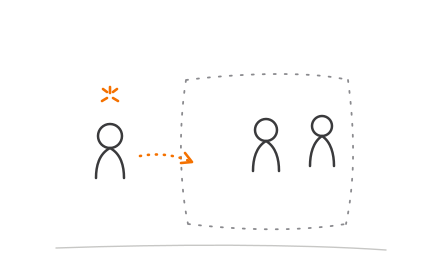
A forward deployed engineer (FDE) is a senior software engineer who works embedded inside a client's own team, using the client's tools, codebase, and standups, rather than delivering work separately from an external vendor's side of the fence. The FDE sits with the client's engineers, attends the client's planning meetings, and ships code directly into the client's systems. The defining trait isn't seniority or skill, it's where the work happens: inside the client's operating structure, not outside it.
Where the term came from
"Forward deployed engineer" originated in defense and government technology contracting, where engineers were sent to work on-site, close to the actual users and systems, instead of building software in a lab far removed from how it would actually be used. The idea was simple: software that has to work inside someone else's messy, specific reality gets built better when the engineer is physically and organizationally close to that reality.
The term crossed into commercial software over the last decade, especially at companies building complex products that needed deep integration with each client's existing data and infrastructure. It's since become a recognized staffing model well beyond its original context, used any time a company needs engineering talent that operates inside a client's environment rather than alongside it.
How an FDE differs from a regular vendor engagement
A traditional vendor relationship works through handoffs. The vendor team gathers requirements, goes away, builds the thing, and delivers it back across a boundary, a demo, a deployed package, a set of tickets closed. The client's own team reviews the output but generally didn't watch it get built.
An FDE erases that boundary. There's no separate backlog, no separate standup, no delivery ceremony where work crosses from "vendor side" to "client side." The FDE is in the client's Slack, the client's sprint planning, the client's on-call rotation if needed. When something breaks at 2am, the FDE has the same context a full-time employee would have, because they've been living inside the same system the whole time.
This matters most when the work itself resists being specified upfront. Integrations with legacy systems, data pipelines with undocumented quirks, and product features that depend on how a specific client's users actually behave are all hard to describe fully in a requirements document. An FDE learns these details by being there, not by reading a spec.
When companies actually use this model
Three situations come up repeatedly. First, a company has a specific, high-stakes integration or migration that needs senior engineering attention now, and hiring permanently would take too long. Second, a company is scaling a product into a new client or market and needs someone who can adapt the product to that client's specific systems in real time. Third, a company wants engineering capacity that ramps down cleanly once the integration work is done, without the complexity of a layoff.
None of these are "we're short-staffed, send bodies" situations. They're specific, integration-heavy problems where context and embeddedness matter more than raw headcount. That's also why the model tends to attract senior engineers rather than junior ones: an FDE is expected to make judgment calls inside someone else's codebase from day one, which requires experience a junior hire usually doesn't have yet.
Where this fits into a broader digital transformation
FDEs are often one piece of a larger digital transformation effort, brought in specifically for the parts of a modernization project that need someone embedded in both the legacy system and the new one being built around it. If your team is evaluating whether an embedded model fits your situation, our page on forward deployed engineers covers how the engagement is typically structured, from onboarding through ramp-down.
The short version: if the work needs someone who thinks and operates as part of your team, not a vendor sending updates from across a wall, that's what a forward deployed engineer is for.
A week in the life
Monday starts in the client's standup, not the vendor's. The FDE picks up a ticket from the client's own backlog, works in the client's repository, and ships through the client's pipeline. Midweek they pair with an internal engineer on a gnarly integration, and the pairing is the point: the internal engineer leaves knowing how the thing works. They sit in the architecture discussion not as a guest but as the person who will live with the decision. Friday they demo inside the client's own review, and the work is indistinguishable from the internal team's except for where the payroll comes from. Contrast that with a classic vendor week, which happens in another building, another repo, and another cadence, surfacing only at the status meeting.
How to tell whether an FDE engagement is working
The measures are the same ones you would apply to a strong internal hire, plus one. Is cycle time on the streams they touch improving? Are they shipping to production, not to a staging branch nobody merges? Do internal engineers ask them questions unprompted, which is the honest signal of earned trust? And the extra one: is knowledge accumulating on your side of the wall? A good FDE leaves documentation, patterns, and upskilled teammates behind them. If the engagement ends and the capability leaves with it, you had a contractor with a fashionable title, not a forward deployed engineer.
What the model costs relative to the alternatives
An FDE typically prices above a standard offshore developer and below a brand-name consultancy, and the comparison only makes sense against outcomes. A consultancy bills for a team wrapped in account management; a staffing firm bills for a resume; an FDE engagement bills for a senior engineer whose explicit job includes making your team better. The right cost comparison is not day rate against day rate but capability retained per dollar: when the engagement ends, the consultancy takes its methodology home, while the FDE model is designed to leave the capability behind.
Where the model does not fit
FDEs are not the answer to everything, and the failure modes are known. If the work is a well-bounded build with a clean spec, a dedicated external team is usually cheaper and the embedding adds little. If the organization cannot grant an outsider real access to its repositories and meetings, the FDE spends the engagement negotiating permissions instead of shipping. And if the goal is quietly replacing internal hiring forever, the model disappoints, because its whole design assumes the capability eventually lives with your own people. The FDE fit is specific: real technical work inside your systems, plus an explicit intent to absorb what the engineer knows.