Why AI popularized forward deployed engineering
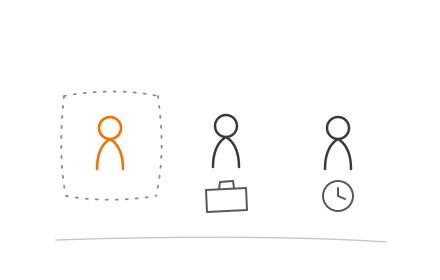
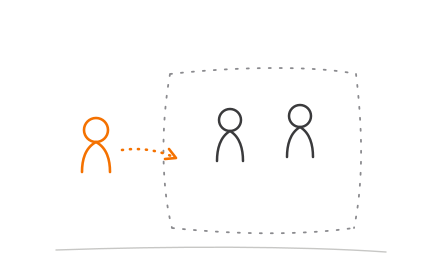
AI companies popularized forward deployed engineering because AI features generally can't be delivered as a self-contained handoff the way a typical software feature can. An AI model or feature is only as good as its connection to a client's actual data, workflows, and edge cases, and that connection has to be built and tuned on an ongoing basis, inside the client's own systems. Embedding an engineer directly in the client's team, rather than building in isolation and delivering across a wall, became the practical answer, and that's the model that turned "forward deployed engineer" from a niche term into a recognized job category.
Why a standard feature handoff usually works
Most conventional software features can be specified reasonably well upfront. A payment flow, a reporting dashboard, a user authentication system: these have known shapes. A vendor team can gather requirements, build the feature against a spec, test it, and deliver it, and the client's team can pick it up and run it. The feature's correctness doesn't depend heavily on the specific quirks of the client's live data.
Why AI features break that pattern
An AI feature is different in a structural way. Its usefulness depends on how well it performs against the client's actual data, which is messy, specific, and full of edge cases no generic spec anticipates. A recommendation model trained on generic data behaves differently than one tuned against a specific company's real customer behavior. A document-processing AI feature that works well on a demo dataset can fail quietly against a client's actual document formats, which nobody wrote down anywhere because the client's team didn't think to.
Discovering and correcting for these gaps requires an engineer who can see the client's real data and real usage patterns directly, and iterate against them repeatedly. That's very hard to do from across an organizational wall, delivering a build every few weeks based on secondhand descriptions of what's going wrong. It's much easier to do when the engineer is sitting inside the client's team, watching the feature perform against real inputs, and adjusting it in near real time.
Why the model outlived its AI-specific origin
Once AI companies proved out the embedded model for AI integration work, the same logic turned out to apply more broadly than anyone initially framed it. Any software project where the hard part is integration with a client's specific, messy, real systems, not building a generic feature, benefits from the same structure. Legacy system migrations, complex data pipeline work, and custom enterprise platforms all share the trait that made AI integration need an embedded model: the work resists being fully specified in advance, and a lot of the real problem only becomes visible once someone is inside the system looking at it.
This is also why forward deployed engineering has become a standard staffing option well beyond AI teams. A company modernizing a legacy claims system, for instance, faces largely the same integration challenge an AI company faces when connecting a model to a client's live data: undocumented quirks, systems that don't behave the way the diagrams say they do, and a real cost to guessing wrong. Embedding a senior engineer who can see the system directly and adjust as they go solves both problems the same way.
Where this leaves teams planning a build
If your project's hardest part is connecting new capability, AI or otherwise, to your organization's specific existing systems, that's a strong signal an embedded engineering model fits better than a traditional build-and-handoff engagement. Our page on forward deployed engineers covers how that kind of engagement is typically staffed and run. And if the integration work is part of a larger modernization effort rather than a single feature, it's worth reading about our approach to digital transformation more broadly, since the two are usually connected in practice.