What is a loan origination system (LOS)?
A loan origination system (LOS) is the software platform that takes a borrower from initial application through underwriting to a funded loan. It replaces manual, spreadsheet-and-email workflows with a single system that captures borrower data, routes documents, applies credit and pricing rules, and tracks a loan's status at every stage. Lenders use an LOS to cut approval times, reduce manual rework, and give underwriters, brokers, and borrowers a shared, current view of every file in the pipeline.
The core modules of an LOS
Whether it's a vendor platform or a custom build, most origination systems are built around the same four modules.
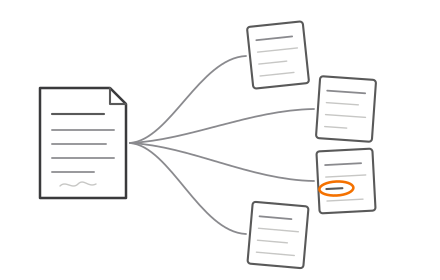
Borrower portal. Where applicants submit personal and financial information, upload documents, and track status. A weak borrower portal is the single biggest driver of abandoned applications, since borrowers who can't see where their file stands tend to call, email, or simply drop off.
Broker or dealer portal. For lenders who originate through a third-party channel (mortgage brokers, auto dealers, point-of-sale partners), this is where partners submit deals, check pricing, and see decisions. It needs its own permission model, since brokers should see their own pipeline and pricing, not the lender's internal underwriting notes.
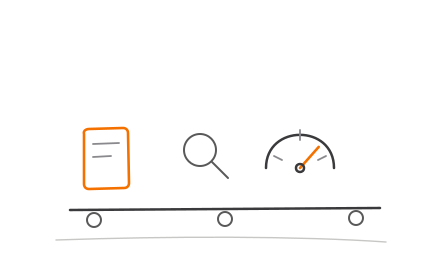
Underwriting engine. The rules layer that applies credit policy: income and debt calculations, credit bureau pulls, automated decisioning rules, and stipulations. This is the part of an LOS that most directly reflects a lender's risk appetite, and it's usually the hardest thing to bend an off-the-shelf platform around.
Document pipeline. Collection, verification, and storage of pay stubs, bank statements, tax returns, titles, and disclosures, ideally with OCR or data extraction so a human isn't re-typing numbers from a PDF into a form. Document handling is also where compliance requirements (retention, redaction, audit trail) live.
Around these four, most systems add pricing engines, e-signature and disclosure workflows, investor or funding integrations, and reporting dashboards for compliance and portfolio monitoring.
Off-the-shelf vs. a custom LOS
An off-the-shelf LOS makes sense for lenders whose credit box, product mix, and volume look like most other lenders in their category. Vendor platforms come with built-in compliance templates, faster time to launch, and lower upfront cost, and for a conventional mortgage shop or a standard consumer installment lender, that's usually the right call.
Custom or heavily configured systems tend to win for lenders with a genuinely different credit box, alternative data sources feeding underwriting decisions, unusual product structures (merchant cash advances, revenue-based financing, embedded lending at point of sale), or origination volume high enough that per-loan vendor fees start to outweigh the cost of owning the platform. The tell is usually that a lender's underwriting team keeps building workarounds, spreadsheets, or manual overrides around the edges of their current system, because the vendor platform simply can't express the rules they actually want to run.
A useful gut check: if your credit policy could be described the same way as five other lenders in your niche, an off-the-shelf platform will likely serve you well. If your underwriting logic is your competitive edge, a system that can't fully encode it is quietly capping your growth.
Codiot builds loan origination system platforms for lenders whose credit policy, data sources, or volume have outgrown what packaged software can flex to support. For a broader look at how origination fits into the rest of a lending operation, see our lending industry page.
The origination workflow, stage by stage
Every LOS, custom or off-the-shelf, models the same underlying pipeline. What differs is how much of each stage is automated and how faithfully the system encodes your credit policy.
| Stage | What happens | What the system must do well |
|---|---|---|
| Application | Borrower or broker submits the file | Clean intake forms, document upload, duplicate detection |
| Verification | Identity, income, and collateral get validated | Integrations to KYC, bureau, and valuation services |
| Underwriting | The file is measured against credit policy | Rules engine, exception routing, a full audit trail |
| Decision | Approve, decline, or counter | Consistent decisioning and compliant adverse-action output |
| Closing and funding | Documents signed, money moves | E-sign integration, funding checklists, handoff to servicing |
The stages look sequential on paper, but real files loop: a verification finding sends the file back, an underwriting exception needs a second document, a counter-offer restarts the decision. A good LOS treats these loops as first-class citizens instead of exceptions that fall out to email.
LOS vs LMS: where the boundary sits
An LOS ends when the loan funds. Everything after that first payment, statements, escrow, modifications, payoff quotes, lives in a loan management system. Teams shopping for "lending software" often conflate the two and end up with a tool that does neither stage well. The boundary matters for buying decisions: origination is where your credit policy differentiates you, which argues for control; servicing is more standardized, which argues for proven off-the-shelf systems unless your loan products are unusual.
The integrations an LOS lives or dies by
An LOS is only as strong as its connections. The non-negotiables for most US lenders: credit bureau pulls, identity and KYC verification, bank data or income verification, document management with e-sign, and flood, title, or collateral valuation services depending on the asset class. Each integration is also a failure point, so the system needs to handle a bureau timeout or a stale valuation gracefully, with retries and human-visible queues rather than silent stalls.
Compliance is a feature, not an afterthought
US origination carries regulatory weight that generic workflow tools do not understand. The system needs to produce adverse action notices with accurate reasons, retain a complete decision audit trail, apply policy consistently enough to survive a fair-lending review, and respect timing rules on disclosures. When lenders say their spreadsheet-and-email process keeps them up at night, this is usually the part they mean.
Signs you have outgrown your current LOS
The pattern repeats across lenders: volume grows and the workarounds multiply. The common signals are underwriters re-keying data between systems, exceptions managed in inboxes instead of queues, policy changes that take a vendor ticket and a quarter to land, reporting assembled by hand at month-end, and a growing gap between what the credit committee approved and what the system actually enforces. Two or three of these together usually mean the system is now shaping the business instead of serving it.
What implementing an LOS actually looks like
Whether the system is bought or built, the rollout pattern that works is incremental. Lenders typically start with one loan product, often the highest-volume or most painful one, and run the new system in parallel with the old process for a defined pilot window. Pipeline loans in flight are usually left to finish in the old system rather than migrated mid-process, because a half-underwritten file that changes systems is a compliance question waiting to be asked. The pilot's job is to surface the mismatches between documented policy and actual practice, and there are always some. Only after the pilot holds does the second product move over, and by the third the migration has become routine.
Questions to ask before committing to any LOS
A short list separates systems that will fit from systems that will fight you. How exactly does the platform encode a credit policy change, and can your team make one without a vendor ticket? What does the audit trail capture, and can it reconstruct a decision two years later? Which of your required integrations exist today versus on a roadmap? How are exceptions routed and tracked? What happens to your data and your workflows if you leave? And for custom builds, the mirror-image questions: who maintains the rules engine after launch, and how will the system absorb the loan product you have not designed yet? The answers matter more than any feature checklist, because origination systems are ten-year decisions wearing two-year price tags.
How long an LOS takes to stand up
Timelines depend on the path chosen. Configuring an off-the-shelf platform for a single loan product commonly runs three to six months including integrations and testing, with the calendar dominated by data migration and the compliance review rather than the software itself. A custom build targets a focused first release in a similar four-to-six-month window but keeps compounding afterward, adding products and automation in short cycles. The honest planning number for either path includes the pilot period: a system is not implemented when it is installed, it is implemented when a full month of real volume has flowed through it and the exception queue has stopped surprising anyone. Lenders who plan to the install date and not the proven date consistently announce their new system one quarter too early.