MCP for lenders: connecting your LOS to AI safely
MCP (Model Context Protocol) is an open standard that lets AI tools like Claude or ChatGPT securely read from and act on your systems, including a loan origination system, through a controlled server you govern, instead of copy-pasted exports and uncontrolled data flows. Lending software vendors have started shipping MCP servers natively, which shifts the question for lenders from "should we connect AI to our loan data" to "how do we do it without creating a compliance problem." This post answers the second question, from the intersection of lending and AI engineering.
What is MCP, in lending terms?
MCP is a standard way to put a governed interface in front of a system so AI tools can use it safely. In lending terms, it is how an AI assistant reaches your LOS or servicing system without anyone exporting data to a spreadsheet first.
Strip away the generic technology framing and it is simple. Today, when someone wants an AI tool to help with loan data, the usual path is to export records and paste them into a chat window: uncontrolled, unlogged, and a compliance headache. An MCP server replaces that with a defined interface. The AI tool connects to the server, the server decides what it can see and do, and every interaction runs through something you own and can audit. The data stays behind your controls instead of leaving them.
The reason this matters now is that the vendors are moving. The Mortgage Office announced an MCP server integration allowing customers to connect their lending data to external AI tools, alongside a rebuild of its origination platform with AI embedded (The Mortgage Office, 2026). When origination platforms ship this natively, MCP stops being a niche engineering idea and becomes a standard capability lenders are expected to use well.
What can a lender actually do with an MCP-connected LOS?
Ask questions of the whole portfolio in plain language, analyse loan tapes, surface exceptions, and draft reporting, without an export step or a dedicated analyst for every query. The work that used to require a data pull and a specialist becomes a direct conversation with the data.
The concrete workflows are already visible in the market: lenders are already building data lakes from servicing data and using AI tools like Claude to analyze portfolios, surface trends, and produce reporting that previously required a dedicated analyst (The Mortgage Office, 2026). Translate that into a day's work and it means a servicing lead can ask which loans in a segment are drifting, an ops manager can get a first draft of a board report from live data, and an analyst can spend time on judgment instead of assembling the numbers.
The loan tape is the natural anchor for this. So much of lending analysis reconciles to the tape, and an MCP-connected system lets you interrogate it conversationally instead of exporting and pivoting; if the concept is unfamiliar, our explainer on what a loan tape is covers the fundamentals. It is the same idea we built into DataTalk, our conversational analytics work: plain-language questions against live data, with the reasoning shown, so teams stop waiting on reports.
Why is "safely" the operative word?
Because an AI tool with access to loan data is an access-control and audit problem before it is an AI problem. Permissions, read-versus-write boundaries, PII exposure, and logging decide whether the connection is an asset or a liability.
The risks are specific and worth naming without drama. Permissions scoping determines what the AI can reach; a server that exposes the whole database because that was easiest is the classic mistake. Read versus write is the sharpest line: reading data to analyse it is low-risk, while allowing the AI to change records is a different category that needs deliberate controls. PII exposure has to be handled at the server, deciding what sensitive fields are even reachable and how they are masked. Audit trails matter because a regulated lender must be able to answer, after the fact, what was accessed and by whom. And how the model handles the data it sees, retention, training, and residency, is a question you ask before connecting, not after.
None of this is a reason to avoid MCP. It is the reason to implement it as a governed interface rather than an open door. The protocol gives you the controls; using them is the work.
Should you build an MCP server or wait for your vendor?
If your LOS vendor ships an MCP server, start there. Build a custom one when you need cross-system scope or your vendor is lagging. The decision is about coverage and timing, not ideology.
The honest framework is short. When your origination or servicing vendor already offers an MCP server, the fastest safe path is to turn it on and configure it well, because the hard integration work is done and your effort goes into scoping and governance. When your need spans multiple systems the vendor does not cover, or when your vendor has not shipped anything and you cannot wait, a custom MCP server built over your existing APIs is the answer, at the cost of a real engineering project. We build these, both the custom servers and the safe rollout around a vendor's, so the choice can be made on your actual situation rather than on what is easiest to sell. The point is to match the build to the gap: do not custom-build what your vendor already ships, and do not wait indefinitely for a vendor that is not moving.
What does a safe lender MCP rollout look like?
Read-only first, scoped to specific data, with the outputs evaluated and every interaction logged, and only then scoped write actions. It mirrors how a careful team ships any agent: prove behaviour before granting autonomy.
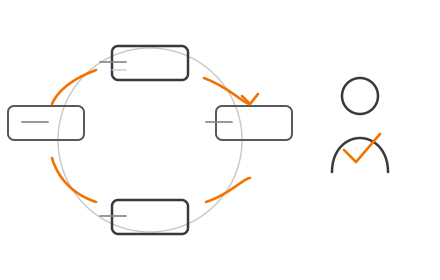
Here is the phased shape that keeps a rollout out of trouble:
- Read-only to start. The AI can query and analyse, nothing more. Most of the value, portfolio queries, tape analysis, reporting, lives here and carries the least risk.
- Scoped data. Expose the specific datasets the use case needs, not the whole system. Narrow is safe and easy to widen; wide is hard to walk back.
- Evaluate the outputs. Test that the answers are correct, that the tool refuses when it should, and that it does not confidently invent. This is the same discipline our post on how to evaluate LLM outputs describes, applied to loan data.
- Audit logging. Every access and action recorded, so the compliance answer exists before anyone asks the question.
- Then, scoped write actions. Only once reading is proven do you enable the AI to take actions, behind clear permissions and full logging.
That progression is deliberately the same one we apply to AI agents and to Agentforce work: earn autonomy with evidence. For the system of record underneath all of this, our loan origination system solution work is where the LOS side is built to be interrogated safely in the first place.
Where does this go next?
Toward agents that do not just read loan data but act on it, with the governance bar rising as the autonomy does. The direction is clear even if the timeline is not.
The current wave is analysis: asking questions, surfacing trends, drafting reports. The next is action: agents that draft decisions, prepare files, and update records within defined boundaries. The capability is arriving fast, and credit decisioning is one of the first places it shows up. As AI moves from reading to acting on loan data, the safety work described above stops being optional and becomes the thing that decides whether a lender can use any of this at all. The lenders who set up governed, audited, read-first connections now are the ones who will be able to grant more autonomy later without flinching. For teams whose lending data already lives in Salesforce, how Claudeforce connects Salesforce data to Claude shows what that governed connection can look like in practice. If you want that foundation built properly, talk to us.