What is CPQ? Configure, Price, Quote in plain language
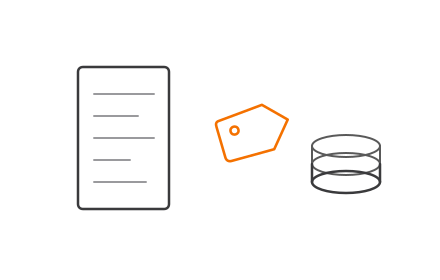
CPQ stands for Configure, Price, Quote, and it is software that helps sales teams build an accurate quote quickly: pick a valid product configuration, apply the correct pricing, and produce a clean proposal without touching a spreadsheet. It sits between your product catalog and your customer, turning what is often a slow, error-prone manual process into something a rep can do reliably in minutes.
The three steps, and what each one solves
Each letter in CPQ replaces a specific way that manual quoting goes wrong.
- Configure. The rep selects options, and the system enforces what is actually buildable and sellable. Incompatible add-ons are blocked, required components are included automatically, and dependencies are handled for you. This kills the "we quoted something we cannot deliver" problem.
- Price. The tool applies list prices, volume tiers, contract-specific rates, and discount rules, then routes anything outside policy for approval. Nobody is keying prices from memory or an outdated sheet, so the number the customer sees is a number finance can honor.
- Quote. A branded, itemized quote or proposal is generated on demand, ready to send or push into an order. The same data flows forward, which matters because the quote is the front door to the whole order-to-cash process.
When a business actually needs CPQ
CPQ is not for every company. If you sell a handful of simple products at fixed prices, a CRM opportunity and a template are fine. CPQ starts to pay off when one or more of these is true:
| Signal | What it looks like | How CPQ helps |
|---|---|---|
| Complex configuration | Many options with rules about what can combine | Enforces valid builds automatically |
| Layered pricing | Tiers, bundles, contract rates, regional pricing | Applies the right price without manual lookups |
| Discount approvals | Reps request non-standard discounts constantly | Routes approvals by rule, with an audit trail |
| Slow quote turnaround | Deals wait days for a correct quote | Cuts quoting from days to minutes |
The tell is usually speed and accuracy together: quotes take too long and too many of them are wrong. That combination is expensive, because it slows deals and erodes margin at the same time.
Where CPQ sits in quote-to-cash
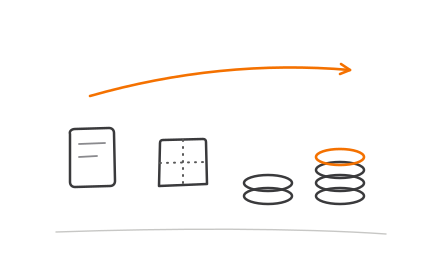
CPQ is not an island. The quote it produces is the first document in a chain that runs all the way to cash: an accepted quote becomes an order, the order drives fulfillment, fulfillment triggers an invoice, and the invoice becomes revenue. That whole downstream flow is the order-to-cash process, and the quote is its front door.
This is why CPQ errors are more expensive than they first appear. A wrong price on a quote does not just embarrass a rep; it becomes a wrong invoice, which becomes a customer dispute, which becomes delayed cash and a credit note that finance has to explain at month end. Fixing the error at the quote stage costs minutes. Fixing it after invoicing costs weeks.
Practically, that means a CPQ implementation is as much an integration project as a sales tool. Upstream it reads from the CRM, where the opportunity lives. Downstream it must hand clean, structured data to the ERP or billing system without anyone retyping line items. When you evaluate any CPQ approach, the question "how does an accepted quote become an order and an invoice" deserves as much attention as the quoting screens themselves.
Buy, configure, or build
There are three honest paths to CPQ, and the right one depends on how unusual your rules are.
Off-the-shelf CPQ, including CPQ inside Salesforce, covers the majority of businesses well and is the fastest way to start. A custom CPQ build makes sense when your pricing or configuration logic is genuinely distinctive, for example manufacturers pricing highly engineered products, where forcing your rules into a vendor's model creates more workarounds than it removes. The CPQ implementation work we do usually starts by mapping the real rules first, because that decision, buy versus build, should follow the complexity of your logic rather than the other way around.
If quoting is currently a bottleneck, the practical next step is to write down your actual configuration and pricing rules on one page. That document tells you almost immediately whether a standard CPQ tool will fit or whether your logic needs something built around it.
For the manufacturing-specific version of this, our guide on CPQ for manufacturers covers configurable bills of materials, multi-country pricing, and MES and ERP integration.