What is order to cash (OTC)? The process explained
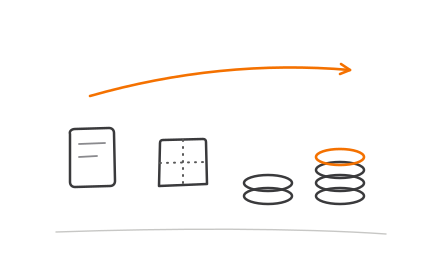
Order to cash (OTC, sometimes written O2C) is the process that runs from the moment a customer places an order to the moment your company has collected and reconciled payment for it. It covers order capture, credit approval, fulfillment, invoicing, and collections, and it's usually one of the most cross-functional processes in a company because sales, operations, finance, and accounting all touch it before it's done.
The stages, in order
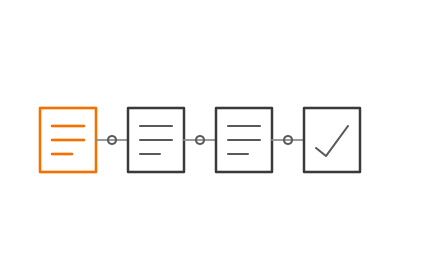
Every OTC cycle covers the same rough ground, even if the tooling differs by company size.
Order capture and validation. A customer places an order through a sales rep, a portal, an EDI feed, or a website. Someone (a person or a system) checks that the order is complete, priced correctly, and matches inventory or capacity.
Credit check. Before fulfillment, the order gets checked against the customer's credit limit and payment history. B2B companies with net-30 or net-60 terms lean on this step heavily; skip it and you find out about a customer's cash problems only after you've shipped to them.
Fulfillment or delivery. The product ships or the service gets delivered. For subscription or usage-based businesses, this stage is really "provisioning" or "usage metering" rather than a physical shipment.
Invoicing. An invoice goes out reflecting what was actually delivered, at the agreed price and terms. This sounds simple and is the single most common place OTC breaks down in growing companies.
Collections. Someone follows up on invoices that are approaching or past due, resolves disputes, and gets the customer to pay.
Cash application. The payment arrives and gets matched to the correct invoice(s) and closed out in the accounting system. Unapplied cash sitting in a suspense account is a quiet but real drag on close-the-books timing.
Where it commonly breaks in growing companies
A very small company can run OTC out of email, spreadsheets, and one person's memory. That stops working as revenue scales into the tens of millions, and the symptoms are consistent across industries.
Manual re-entry between systems. Sales takes the order in a CRM, someone retypes it into an ERP or fulfillment system, and a third person re-keys it again for invoicing. Every handoff is a chance to introduce a pricing error, a wrong quantity, or a delay of a day or two while the order sits in someone's inbox.
Invoice delays. If invoicing depends on someone manually confirming delivery and generating a document, invoices routinely go out 5-15 days after fulfillment. Every day an invoice is late is a day added to the payment clock before the customer's terms even start counting.
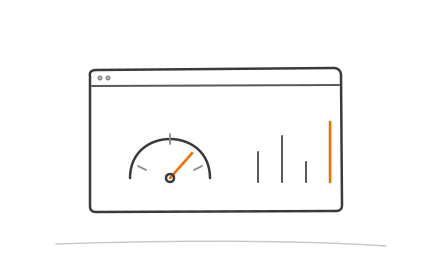
Poor collections visibility. Without a shared, current view of what's outstanding, collections becomes reactive: someone notices a large invoice is 60 days overdue by accident, not because a system flagged it at day 31. Smaller, easier-to-collect invoices get chased aggressively while large stale ones age quietly.
Disconnected credit and sales data. Sales keeps closing deals with customers whose credit standing has quietly deteriorated, because the credit check step lives in a different system nobody checks before quoting.
Why this matters beyond finance
OTC problems don't stay contained to the finance team. Slow invoicing delays cash that could fund growth. Poor collections visibility means write-offs surprise leadership instead of getting managed early. Manual re-entry errors show up as customer disputes, which slow down the very collections process that's already stretched thin. The stages are sequential, so a delay or error early in the chain (a wrong order quantity, a missed credit flag) compounds by the time it reaches collections.
Fixing it without a full ERP rebuild
Companies often assume fixing OTC means ripping out their ERP or CRM. In practice, the highest-leverage fixes are usually integration and automation layered on top of what you already run: connecting order capture directly to invoicing so nothing gets re-typed, triggering invoices automatically on confirmed delivery instead of waiting on a person, and giving collections a dashboard instead of a spreadsheet. That's the scope of a well-run order-to-cash automation project: close the gaps between the systems you have rather than replace them wholesale.
If you're trying to figure out which stage is costing you the most, the practical first step is timing each handoff for a sample of 20-30 recent orders: how many days from order to invoice, and from invoice to payment. That single exercise usually makes the worst bottleneck obvious before you spend a dollar on tooling.