
Services
Strategy, design, engineering, and cloud, delivered by one accountable team.
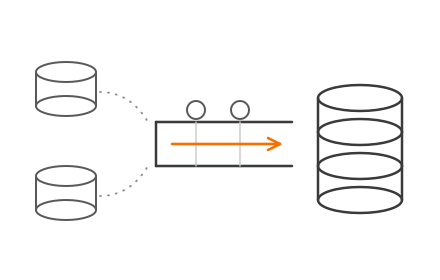
Data engineering services
Pipelines, warehouses, and reporting you can trust. The unglamorous plumbing that decides whether your analytics and AI are worth anything.
Explore→
Web development services
Fast, maintainable web applications, from marketing sites to complex platforms, built on modern stacks like React, Next.js, and Node.
Explore→
Mobile app development services
Native and cross-platform apps people actually keep. iOS, Android, Flutter, and React Native, designed and shipped end to end.
Explore→
Custom software development
When off-the-shelf doesn't fit, we build the system that does: internal tools, platforms, and integrations shaped around how you work.
Explore→
Salesforce development services
Implementation, customization, and integrations that make Salesforce fit your business, not the other way around. Apex, Flows, LWC, and CPQ, done properly.
Explore→
Cloud and DevOps services
From chaos to cloud. Migration, architecture, and CI/CD on AWS, Azure, and GCP, so your product scales without surprises.
Explore→
UI/UX design services
Interfaces that earn trust in the first five seconds. Research, flows, and pixel-final design that developers love to build.
Explore→
Digital transformation services
Less slideware, more shipped systems. We modernize legacy processes into software your teams actually adopt.
Explore→
Forward deployed engineers (FDE)
Senior engineers embedded inside your team, working in your codebase and your standups, accountability of an employee, flexibility of a partner.
Explore→
Global capability center services in India (GCC)
Global capability center services with everything handled: your own engineering center in India, talent, operations, and compliance, on a build-operate-transfer path to full ownership.
Explore→
Extended product team
Plug a senior product pod, engineers, designer, QA, into your existing team. Your roadmap, your rituals, more throughput.
Explore→
AI development services
We're an AI-native agency: AI in how we build, not just what we build. LLM features, agents, and AI products taken from idea to production, with the engineering discipline AI projects usually lack.
Explore→
AI factory
An AI factory is the repeatable setup, infrastructure, team, and process, that turns AI use cases into shipped software, one after another. We build yours, or run it for you.
Explore→
AI agent development
Agents that do real work in your systems, with guardrails, evals, and audit trails. LLM integration, RAG pipelines, and agentic workflows built for production, not demos.
Explore→
AppExchange app development services
Your product, built to pass security review and live on the AppExchange, by engineers who've shipped there before.
Explore→
Agentforce development services
AI agents inside Salesforce that do real work, built by a team that ships both Salesforce and production AI, and will tell you honestly which one you need.
Explore→Not sure which service fits?
Tell us what you're building. We'll reply within two business days with an honest take on scope, timeline, and cost.
Get a free estimate