One borrower, twenty LLCs: seeing true sponsor risk
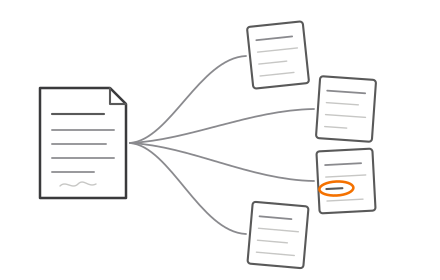
A professional real-estate investor rarely borrows through one legal entity, and a lender that treats each LLC as an unrelated customer will systematically understate its exposure. A sponsor may set up a separate LLC per property, run operations through a management company, bring different equity partners into each deal, and guarantee through one or two principals. That structure is sensible for liability and accounting. It also makes one borrower relationship look like twenty inside a loan-origination system.
The challenge is not collecting more data. It is resolving who and what the data already represents.
Why conventional customer records fall short
Loan-origination systems are organised around transactions. An application names a borrowing entity, a property secures the loan, and the file moves through underwriting. That works for closing a loan. It works badly for seeing across many of them.
Names are inconsistent. "Oak Street Holdings LLC" appears elsewhere as "Oak St. Holdings," a principal uses a middle initial on one file and not another, addresses change, ownership percentages shift, and a guarantor sits behind several entities. A contractor on one project turns out to be an affiliate on another.
Exact-match search cannot reliably connect those records. The result is duplicate customer profiles, incomplete exposure reports, and manual detective work every time a familiar-looking deal arrives.
Entity resolution is the foundation
Entity resolution combines standardised identifiers with controlled matching logic to decide when two records describe the same thing. Useful inputs for a private lender include legal names, tax identifiers, formation records, beneficial owners, guarantors, addresses, phone numbers, email domains, bank accounts, and property ownership.
The system proposes likely matches with a confidence level. High-confidence connections can be accepted automatically; ambiguous ones should go to a person. The point is not to collapse entities into one another, but to build a reliable map of how they relate.
From a customer list to a relationship graph
Once entities resolve, the portfolio can be represented as a graph. Nodes are sponsors, LLCs, properties, loans, guarantors, contractors, brokers, and bank accounts. Edges are ownership, guarantees, project roles, and financial relationships.
That structure answers questions a flat loan table cannot:
- How much total exposure connects to this sponsor?
- Which projects depend on the same general contractor?
- Are several properties concentrated in one neighbourhood or one exit window?
- Does a newly disclosed LLC connect to an existing guarantor?
- Are supposedly unrelated borrowers sharing a bank account or contact detail?
These matter at origination. They matter more as the portfolio grows.
Portfolio risk is more than total balance
Aggregate exposure is the starting point, not the answer. A sponsor with ten completed projects and staggered maturities may carry less risk than a sponsor with five projects all entering the most cash-intensive phase at once.
A useful portfolio view combines relationship data with timing and performance: remaining construction commitments, expected completion dates, maturity clusters, equity requirements, draw velocity, and geographic concentration. Comparing the sponsor's stated schedule against observed progress is often where the real signal sits.
That supports better conversations rather than just better reports. A lender can see that a capable sponsor has taken on too many simultaneous starts, or that one delayed sale would tighten liquidity across several projects. Raised early, that is a useful discussion. Raised late, it is a workout.
Relationship intelligence strengthens fraud controls
Connected data surfaces patterns worth reviewing: several supposedly unrelated applicants sharing a bank account, repeated use of one device or email domain, sudden ownership changes, circular transfers, or an undisclosed relationship between a borrower and a vendor.
None of these prove wrongdoing. They are prompts to verify. FinCEN has repeatedly highlighted the real-estate sector's exposure to high-value wire fraud and the importance of coordination between business, fraud, cybersecurity, and risk teams. Shared relationship data is what lets those teams argue from the same facts instead of separate spreadsheets.
Build it with controls
A graph of people, businesses, and financial relationships is sensitive. Access should be role-based, and collection limited to what a legitimate business or compliance purpose requires. Sources, match logic, and user changes should be logged.
Teams also need a correction path, because probabilistic matching gets things wrong in both directions: two entities wrongly linked, or one entity wrongly split into several profiles. A shared address may indicate a real relationship, a shared service provider, or nothing at all. Context decides, and someone has to be able to fix the record when the system guesses badly.
Better visibility improves the borrower experience
Portfolio intelligence is not only about finding risk. It removes friction for good repeat customers. If a lender understands a sponsor's history across LLCs, the next application should not start from zero: verified experience, ownership information, and completed-project performance can be reused where appropriate.
That is a more accurate form of relationship lending. It recognises the full track record standing behind a newly formed borrowing entity, while still underwriting the specific property and business plan in front of it. Getting there depends on the same data discipline that makes credit underwriting automation trustworthy, and on the connected systems described in the digital lending stack.
The professional investor may borrow through twenty LLCs. The lender should still be able to see one coherent operating story, and everything we build for lending clients starts from that assumption.