What Is an MCP Server? A Plain-Language Guide
An MCP server is a standard way to let an AI assistant read from, and act in, one of your systems safely, without a custom integration built from scratch for every tool. MCP stands for Model Context Protocol, an open standard introduced by Anthropic, and the easiest way to picture it is a USB port: one agreed-upon socket that many different devices can plug into. An MCP server is the socket for a particular system, your CRM, your database, your internal tool, exposing what the AI is allowed to see and do in a consistent, governed way. This guide explains it in plain business language, with no hype, because MCP is plumbing, and good plumbing is boring on purpose.
I write about AI the way I would explain it to a colleague who runs a business, not a research lab, so this stays practical. If you have ever wished your AI assistant could actually reach your systems instead of you copying and pasting data into it, MCP is the piece that makes that possible in a safe, repeatable way.
What is an MCP server, in one working sentence?
An MCP server is a program that exposes a specific system's data and actions to an AI assistant through a standard interface, so the assistant can ask that system questions and, when allowed, do things in it. That is the whole idea. The system might be your customer database, your project tracker, or a bespoke internal tool; the MCP server sits in front of it and presents it to any compatible AI client in one agreed-upon way.
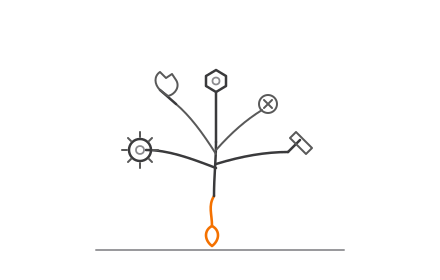
The USB comparison is worth keeping because it is accurate, not just friendly. Before a common standard, connecting an AI to each system was a bespoke job, a special cable for every device. MCP is the standard socket: build the server once, and any MCP-compatible AI assistant can plug in. The server decides what is on the other side of the socket, which data can be read and which actions can be taken, and the AI client simply uses what is offered. That separation, one side offering capabilities and the other side using them, is why the standard scales.
What problem does it solve?
The problem MCP solves is the copy-paste gap between AI assistants and the systems where your work actually lives. Today, a lot of AI use looks like this: someone exports data from a system, pastes it into a chat, gets an answer, and manually carries the result back. It works, barely, but it is slow, error-prone, and completely ungoverned, because the moment data leaves the system by hand, nobody is tracking what was shared or what was done with it.
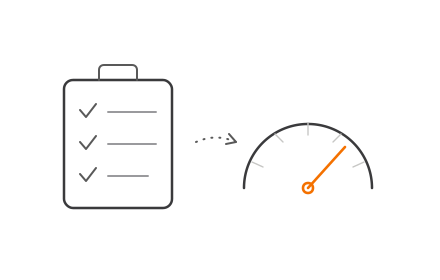
MCP replaces that with a governed connection. Instead of exporting a spreadsheet and pasting it in, the AI asks the MCP server directly, within permissions the server enforces, and the answer comes from live data rather than a stale copy. The before-and-after is stark: before, humans are the integration, ferrying data back and forth with no controls; after, the connection is defined, permissioned, and repeatable. That shift, from manual copy-paste to a governed link, is the entire point, and it is why MCP matters to a business even though it sounds like a technical detail.
How does an MCP connection actually work?
An MCP connection has two sides and a simple contract between them. On one side is the client, the AI assistant or the application it runs inside. On the other side is the server, the program you or a vendor builds to represent a specific system. The client connects to the server and asks what it offers; the server answers with two kinds of things: resources, which are data the AI can read, and tools, which are actions the AI can take. Permissions sit around all of it, deciding what this client, in this context, is actually allowed to read and do.
Picture it as a conversation with a helpful but strictly-scoped assistant at a counter. The AI walks up and asks, what can I do here? The server replies, you can look up these records and you can create this kind of entry, nothing else. The AI can then read what it is allowed to read and request the actions it is allowed to request, and the server carries them out against the real system, or refuses if permission is not granted. Nothing about this requires the AI to have open access to your system; it only ever sees the specific resources and tools the server chooses to expose. That is the design, and it is why MCP can be both useful and controlled at the same time.
A worked example: reading
Start with the safer half, reading. Imagine your support team wants to ask an AI assistant questions about open tickets: how many are unresolved, which customers are waiting longest, what the common themes are this week. Without MCP, someone exports the ticket data and pastes it in, and the answer is only as fresh as the export. With an MCP server in front of the ticket system, the AI asks the server directly and reasons over live data.
In this read-only shape, the server exposes resources, the ticket records the AI is allowed to see, and no tools that change anything. The AI can answer questions, summarize, and spot patterns, but it cannot alter a single ticket, because the server never offered it the ability to. This is the ideal place to start with MCP: high value, low risk, because the worst an AI can do is read something it was permitted to read. Many businesses get real value from reading alone and never need to go further, which is exactly why it is the right first step.
A worked example: acting
Now the half that needs more care, acting. Suppose you want the same assistant to not just report on tickets but create one, say, log a new issue a customer raised over chat. That is a tool, an action that changes the system, and it is where the governance in MCP earns its keep. The server exposes a create-ticket tool, but a well-designed setup wraps it in the right controls: the AI can propose the action, and a human approves it before it takes effect, or it is restricted to low-risk actions where automatic execution is acceptable.
The human-approval framing is the honest default for anything that changes real data. The AI drafts the new ticket; a person confirms it; the server writes it to the system. You get the speed of the AI doing the work with a person keeping the final say on anything consequential. As trust in a specific action grows, you can loosen the approval for the low-stakes cases, but you decide that deliberately, action by action, rather than handing over blanket write access. Acting is where MCP goes from a convenience to a capability, and where thinking about permissions and approval is not optional.
What MCP is not
It is worth being blunt about what MCP is not, because the hype around AI blurs it. MCP is not an AI agent; it does not decide anything or act on its own. It is the connection an agent or assistant uses to reach a system. MCP is not a model; it has nothing to do with how smart the AI is, only with what the AI can reach. And MCP is not magic; it does not make an AI understand your business, it just gives the AI a governed door into a system it would otherwise have to guess about.
Keeping those distinctions straight saves a lot of confusion. An MCP server does not think, it exposes. The intelligence is in the AI client; the systems are your existing tools; MCP is the standardized plumbing between them. That is not a limitation to apologize for, it is the reason it is trustworthy: boring, well-defined plumbing is exactly what you want between a powerful AI and your real business data. If you also want to be sure the AI's answers are actually good once it is connected, that is a separate discipline, and our guide on how to evaluate LLM outputs covers it.
Where this is heading for businesses
The direction is easy to read: MCP is becoming a common way for AI assistants to connect to the tools businesses already run, which means the question is shifting from whether your AI can reach your systems to which systems you connect first and how carefully. For popular products, ready-made MCP servers are appearing; for your own internal systems, a purpose-built server is often the faster path to real value, because no vendor will build one for a system only you have. Our applied write-up on MCP for lenders shows what that looks like in one specific domain.
The grounded takeaway is that MCP turns AI from something that sits beside your systems into something that can work with them, under controls you set. That is a meaningful shift, and it rewards understanding the plumbing now rather than later. It is also why Salesforce's Claudeforce matters, since it brings this same MCP-style connection into Salesforce as a native capability. If you are thinking about connecting AI to your own systems, our AI agents team builds these connections, our Agentforce development work uses MCP-style connectivity inside the Salesforce world, and you can talk to us to scope a first, safe, read-first server for a system that matters to you.