AI Chips Compared, 2026: Nvidia, Google, Amazon, Microsoft, OpenAI, AMD, and the Inference Specialists, Side by Side
- Nvidia
- Amazon
- OpenAI
- AMD
- Microsoft
This AI chips comparison for 2026 starts with the market as it is: Nvidia still sells most of the AI accelerators bought today, every major cloud now runs chips it designed itself, and OpenAI has joined them with an inference chip built with Broadcom. The center of gravity has moved from training models to running them: much of the silicon announced in 2026 is built first for inference. For most businesses, though, the chip is not a purchase. It arrives inside a cloud and a model, so the real decision is which cloud, which model, and what each answer costs.
We build AI products and agents for clients on whatever cloud and silicon they already run. We sell no hardware and have no vendor relationship with any company in this comparison. Every specification on this page is the vendor's own published claim, not our measurement, and each row links to its source. Benchmark on your own workload before you commit to anything.
Who is making AI chips, and why did everyone start?
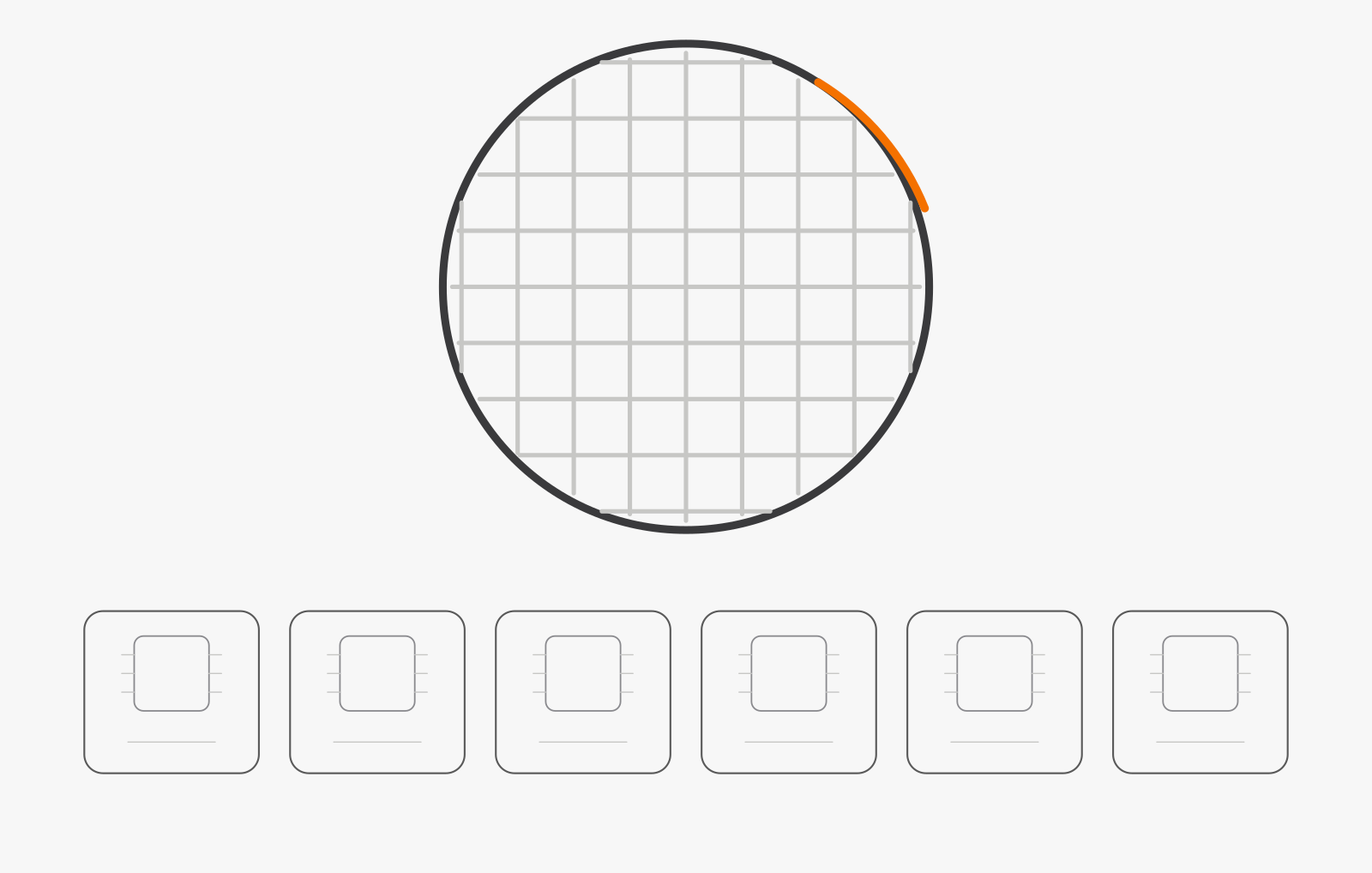
Nvidia is still the default. Its Form 10-Q for the quarter ended July 26, 2026 reports data center revenue of $89.0 billion, up 117% from a year earlier, and says its next architecture, Vera Rubin, began production shipments in the following quarter. Share estimates come from analysts, not from Nvidia, and they vary, so we show the range with both sources.
Nvidia's share of AI chips, as named outlets report it: 70% to 95%.
- Mizuho Securities estimates Nvidia controls between 70% and 95% of the market for AI chips used for training and deploying models. CNBC, June 2, 2024
- Analysts say Nvidia has more than 90% of the market for AI chips with its graphics processors. CNBC, November 25, 2025
Solid arc: the low estimate. Dashed band: the range up to the high one. Both estimates date from 2024 and 2025; we did not find a 2026 figure from a named outlet.
Everyone else started for the same two reasons: cost and supply. A company that serves AI to hundreds of millions of people pays for inference every time someone asks a question, so a chip tuned to its own models and data centers can pay for itself. Owning a design also means not waiting in one supplier's queue.
The vendors say as much. Microsoft says its Maia family will become the primary inference system for its own products and services. Meta says it deploys hundreds of thousands of its MTIA chips for inference. Google describes its eighth generation of TPUs as the result of more than a decade of development, and Amazon says its Bedrock service already serves production workloads on Trainium3. OpenAI has signed compute deals with Nvidia, AMD, and Broadcom, and in June 2026 it unveiled its own chip. In its words, "inference is where AI reaches people."
That is the shift behind this page. Training a frontier model is a large but occasional bill. Serving it is a bill that grows with every user, and most of the chips announced in 2026, from Google's TPU 8i to Microsoft's Maia 300 and OpenAI's Jalapeño, are built first for that job.
What are the three ways to build an AI chip?
Every AI accelerator does the same core work: it multiplies large matrices of numbers and moves data between memory and the units that do the math. The designs differ in how programmable they are and in where they keep the data. Three patterns cover almost everything on the market.
General-purpose GPUs
A GPU packs thousands of programmable cores onto one die, with matrix units inside each core and stacks of high-bandwidth memory (HBM) beside it. Nvidia and AMD build them, and the flexibility is the point: almost any model, framework, or experiment runs on a GPU, through Nvidia's CUDA or AMD's ROCm software. The price of that flexibility is power and cost per answer, which is exactly where the custom chips compete.
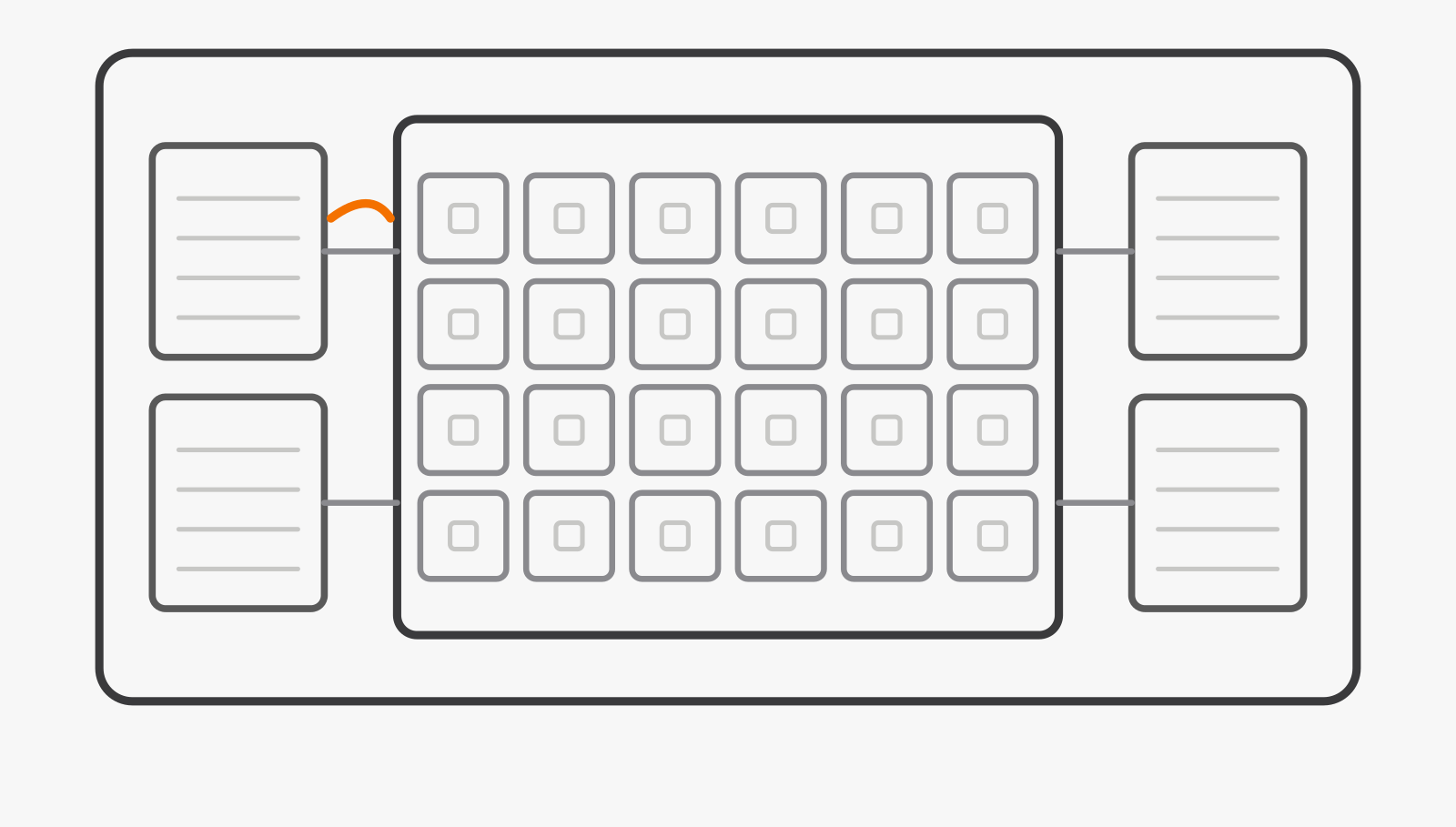 HBM memory stacksCores with tensor units
Systolic-array ASICs
An ASIC (application-specific integrated circuit) gives up some flexibility for efficiency. Google's documentation describes the matrix units in its TPUs as systolic arrays: grids of multiply-accumulate cells, 256 by 256 in Trillium and Ironwood, where data flows from cell to cell instead of returning to memory between steps. AWS describes the tensor engine in NeuronCore-v2, the core inside Inferentia2 and the first Trainium, the same way. Microsoft's Maia and Meta's MTIA are custom ASICs too. The trade is software: each one needs its vendor's own compiler stack, such as AWS Neuron for Trainium.
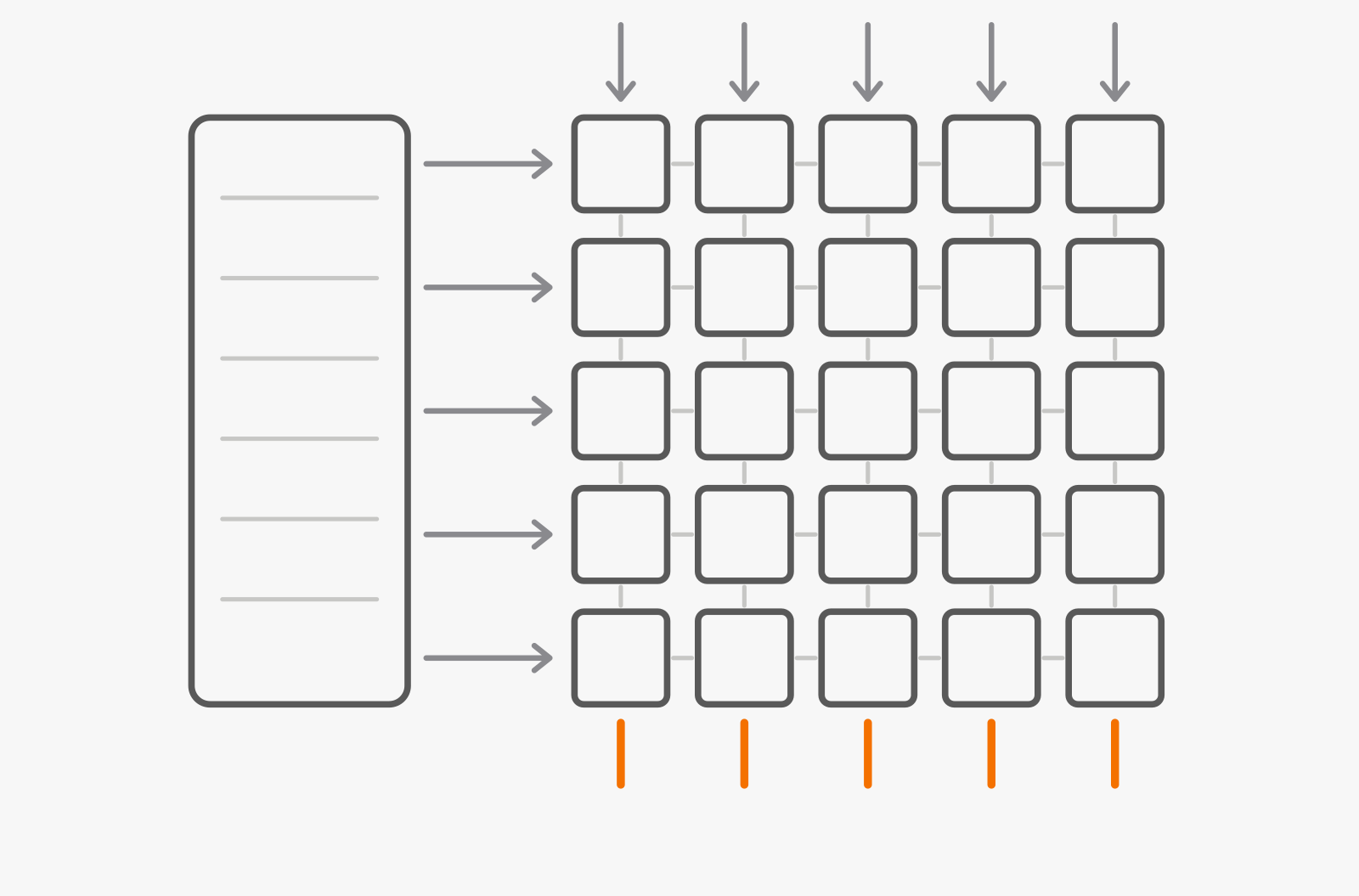 Inputs from on-chip memoryResults out
Specialist inference designs
The specialists attack the slowest part of serving a model: fetching weights from memory for every token. Groq's LPU, now licensed to Nvidia, keeps weights in on-chip SRAM, which is very fast but small, so a large model spans many chips. Cerebras builds one processor out of a whole silicon wafer, with 44 GB of on-chip SRAM. Etched says it combines HBM and SRAM. Qualcomm takes the opposite route, with 768 GB of LPDDR memory per card, aimed at very large models.
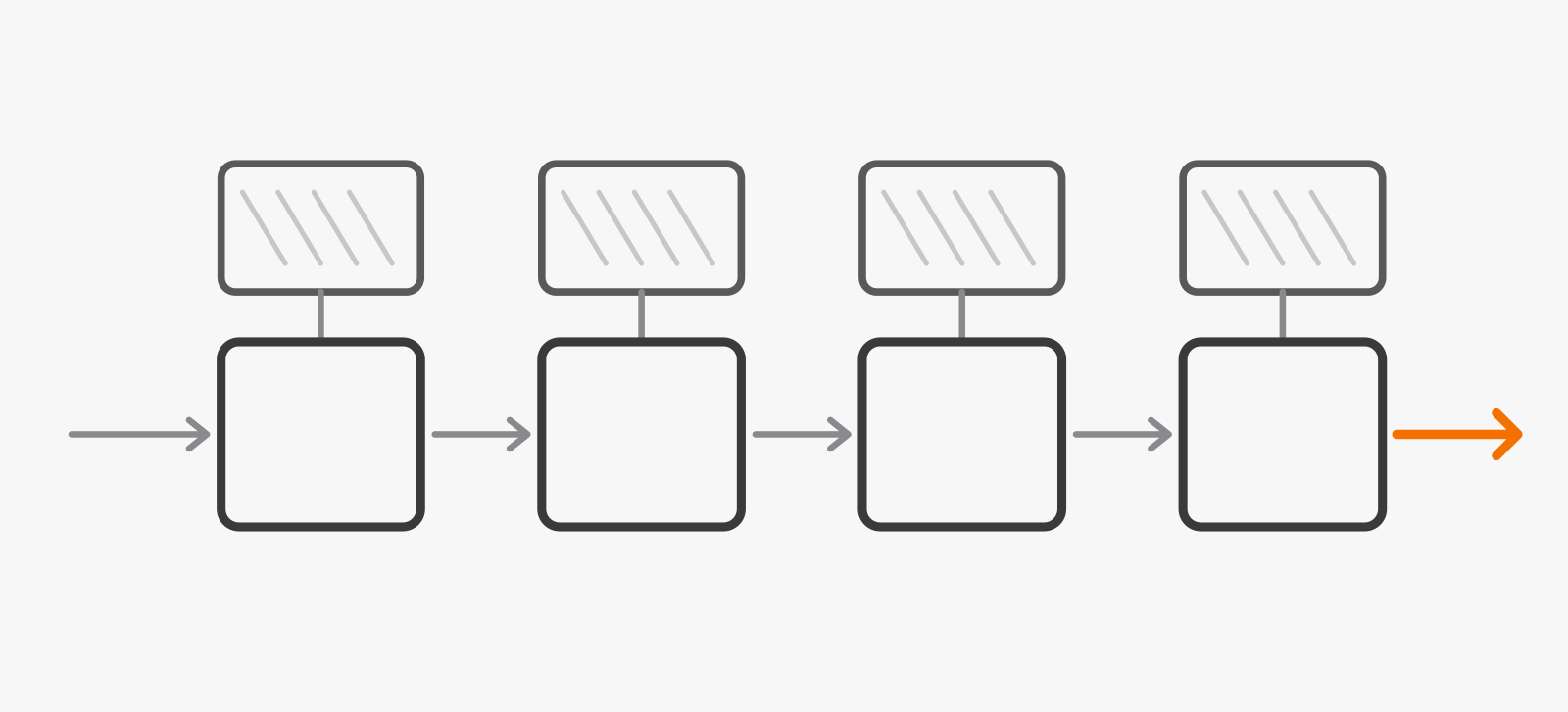 Weights stay in on-chip SRAM beside each stagePrompt inTokens out
How do the chips compare side by side?
The table lists 26 chips from ten vendors, from parts you can rent today to chips that exist only in a vendor's own data centers or in its plans. Every figure is the vendor's own published claim. Where a vendor has not published a figure, the cell says Not disclosed, and we never estimate one. Sort any column, filter by vendor, workload, or availability, and set your situation to see which chips you could actually use. Tick up to three chips to compare memory and bandwidth. The view you build is kept in the page address, so you can share it.
Showing all 26 chips.
Compare up to three chips
Tick the box beside a chip name to compare its memory and bandwidth here, with the values and sources as text.
The table scrolls sideways for availability, dates, and sources.
| Vendor | Chip | Generation | Architecture | Primary workload | Memory | Memory bandwidth | Process node | Availability | Status date | Sources | Vendor claim |
|---|---|---|---|---|---|---|---|---|---|---|---|
| Nvidia | B200 | Blackwell | GPU | Training and inference | Up to 192 GB HBM3E | 8 TB/s | TSMC 4NP | Available to customers. Shipping (HGX B200). Rent on AWS, Google Cloud, and Azure. | Page undated; read this day | Vendor claimVerified | |
| Nvidia | B300 | Blackwell Ultra | GPU | Training and inference | Up to 288 GB HBM3E | 8 TB/s | TSMC 4NP | Available to customers. Shipping (HGX B300, GB300 NVL72). Rent on AWS, Google Cloud, and Azure. | Page undated; read this day | Vendor claimVerified | |
| Nvidia | Rubin GPU | Vera Rubin | GPU | Training and inference | Up to 288 GB HBM4 | Up to 22 TB/s | Not disclosed | Available to customers. Production shipments began in Nvidia's fiscal Q3 2027 (from late July 2026). Nvidia names AWS, Google Cloud, and Azure among cloud partners from the second half of 2026. | Vendor claimVerified | ||
| Nvidia | Rubin CPX | Rubin | GPU, for long-context inference | Inference | 128 GB GDDR7 | Not disclosed | Not disclosed | Announced, not yet available. Expected at the end of 2026. | Vendor claimVerified | ||
| Nvidia | Groq 3 LPU | Groq 3 (in the LPX rack) | LPU, SRAM-based inference processor | Inference | 500 MB on-chip SRAM per LPU | 150 TB/s per LPU (on-chip SRAM) | Not disclosed | Announced, not yet available. LPX racks, paired with Vera Rubin, due in the second half of 2026. | Vendor claimVerified | ||
| Trillium (TPU v6e) | Trillium | TPU (ASIC with systolic-array matrix units) | Training and inference | 32 GB HBM | 1,638 GB/s | Not disclosed | Available to customers. Rent on Google Cloud. | Vendor claimVerified | |||
| Ironwood (TPU7x) | Seventh generation TPU | TPU (ASIC with systolic-array matrix units) | Training and inference | 192 GB HBM | 7,380 GB/s | Not disclosed | Available to customers. Rent on Google Cloud (Google's latest available TPU). | Vendor claimVerified | |||
| TPU 8t | Eighth generation TPU | TPU (ASIC) | Training | 216 GB HBM | 6,528 GB/s | Not disclosed | Announced, not yet available. Announced April 2026. Google says generally available on Google Cloud later in 2026. | Vendor claimVerified | |||
| TPU 8i | Eighth generation TPU | TPU (ASIC) | Inference | 288 GB HBM | 8,601 GB/s | Not disclosed | Announced, not yet available. Announced April 2026. Google says generally available on Google Cloud later in 2026. | Vendor claimVerified | |||
| Amazon (AWS) | Inferentia2 | Second generation Inferentia | ASIC (NeuronCore-v2) | Inference | 32 GiB HBM | 820 GiB/s | Not disclosed | Available to customers. Rent on AWS (Inf2 instances), including Asia Pacific (Mumbai). | Page undated; read this day | Vendor claimVerified | |
| Amazon (AWS) | Trainium2 | Trainium | ASIC (NeuronCore) | Training and inference | 96 GiB HBM | 2.9 TB/s | Not disclosed | Available to customers. Rent on AWS (Trn2 instances and UltraServers), including Asia Pacific (Hyderabad). | Vendor claimVerified | ||
| Amazon (AWS) | Trainium3 | AWS's fourth generation AI chip | ASIC (NeuronCore) | Training and inference | 144 GB HBM3e | 4.9 TB/s | 3nm (foundry not named) | Available to customers. Generally available on AWS (Trn3 UltraServers). Amazon Bedrock serves production workloads on it. | Vendor claimVerified | ||
| Amazon (AWS) | Trainium4 | Trainium | ASIC | Not disclosed | Not disclosed | Not disclosed | Not disclosed | Announced, not yet available. Delivery expected to begin in 2027. | Vendor claimVerified | ||
| Microsoft | Maia 200 | Azure Maia | ASIC | Inference | 216 GB HBM3e | 7 TB/s | TSMC 3nm | Vendor's own use. In production for Microsoft services, including Microsoft Copilot; GitHub Copilot and Microsoft Foundry to follow by the end of 2026. Not offered as rentable instances. | Vendor claimVerified | ||
| Microsoft | Maia 300 | Third generation Azure Maia | ASIC (chiplets) | Inference | 288 GB HBM4 | 18 TB/s | TSMC N2P (compute chiplets) | Vendor's own use. Production deployments in 2027, for Microsoft products and services. | Vendor claimVerified | ||
| OpenAI | Jalapeño | OpenAI's first Intelligence Processor | ASIC, built with Broadcom | Inference | Not disclosed | Not disclosed | Not disclosed | Vendor's own use. Initial deployment targeted by the end of 2026, in OpenAI's own infrastructure. | Vendor claimVerified | ||
| AMD | Instinct MI355X | CDNA 4 | GPU | Training and inference | 288 GB HBM3E | 8 TB/s | TSMC 3nm and 6nm | Available to customers. Launched June 12, 2025. Eight-GPU platforms through server makers. | Vendor claimVerified | ||
| AMD | Instinct MI455X | CDNA 5 | GPU | Training and inference | 432 GB HBM4 | 23.3 TB/s | TSMC 2nm and 3nm | Available to customers. Launched July 23, 2026, for the Helios rack. AMD expects Helios volume deployments in the second half of 2026. | Vendor claimVerified | ||
| Meta | MTIA 300 | MTIA | ASIC | Training | 216 GB HBM3E | Not disclosed | Not disclosed | Vendor's own use. In production at Meta, training ranking and recommendation models. | Vendor claimVerified | ||
| Meta | MTIA 400 | MTIA | ASIC | Training and inference | Not disclosed | Not disclosed | Not disclosed | Vendor's own use. Lab testing finished; Meta says it is on the path to deployment in its data centers. | Vendor claimVerified | ||
| Meta | MTIA 450 | MTIA | ASIC | Inference | Not disclosed | Not disclosed | Not disclosed | Vendor's own use. Mass deployment scheduled for early 2027. | Vendor claimVerified | ||
| Meta | MTIA 500 | MTIA | ASIC | Inference | Not disclosed | Not disclosed | Not disclosed | Vendor's own use. Mass deployment scheduled for 2027. | Vendor claimVerified | ||
| Cerebras | WSE-3 Turbo | Wafer Scale Engine 3 Turbo (in the CS-4) | Wafer-scale processor | Training and inference | 44 GB on-chip SRAM | 43.2 PB/s (on-chip SRAM) | Not disclosed | Available to customers. First CS-4 systems ship in the third quarter of 2026. | Vendor claimVerified | ||
| Etched | First-generation inference chip | First generation (not named on Etched's site) | ASIC, HBM and SRAM hybrid | Inference | Not disclosed | Not disclosed | TSMC N4P | Available to customers. First rack shipped to a customer in August 2026; racks in validation with customers. | Vendor claimVerified | ||
| Qualcomm | AI200 | Qualcomm Dragonfly | Inference accelerator card, rack-scale | Inference | 768 GB LPDDR per card | Not disclosed | Not disclosed | Announced, not yet available. Qualcomm says AI200 racks begin deployment in 2026; HUMAIN targets AI200 and AI250 racks from 2026. | Vendor claimVerified | ||
| Qualcomm | AI250 | Second generation Dragonfly | Inference accelerator card with near-memory compute | Inference | 768 GB per card | 133 TB/s effective per card (effective, per Qualcomm) | Not disclosed | Announced, not yet available. No date on Qualcomm's product page; HUMAIN targets AI200 and AI250 racks from 2026. | Vendor claimVerified |
Units are as each vendor publishes them: AWS states GiB, about 7% larger than a GB. On-chip SRAM bandwidth and Qualcomm's "effective" bandwidth are not like-for-like with HBM bandwidth.
Two cautions for reading it. Memory figures are not like for like across designs: on-chip SRAM bandwidth (Cerebras, Groq) and Qualcomm's "effective" bandwidth are different measures from HBM bandwidth. And capacity varies by product: Nvidia notes that HBM capacity varies by SKU, and Google Cloud lists its B200 machines at 180 GB per GPU against Nvidia's maximum of 192 GB.
The same story over time, from the first Blackwell announcement to the 2027 deployments the vendors have promised:
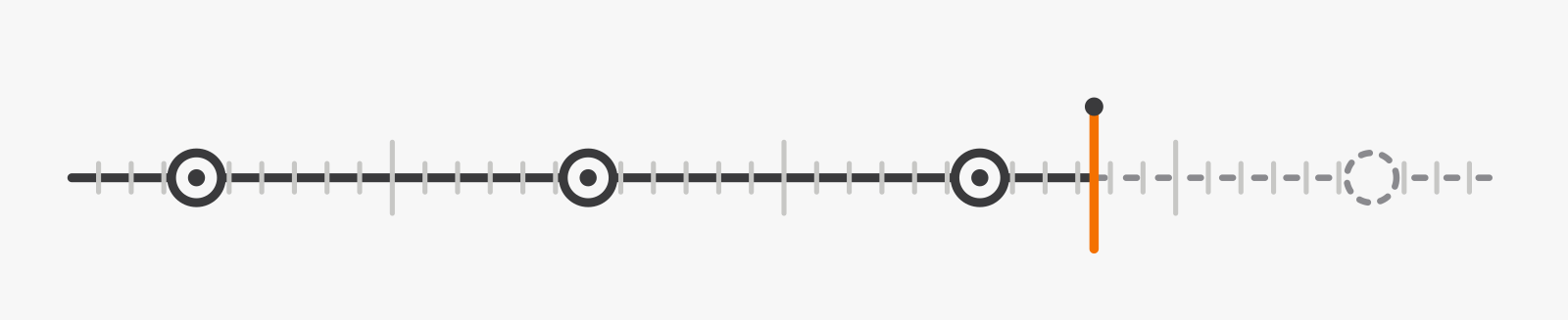
2024
- Mar Nvidia announces Blackwell
- Mar Cerebras unveils WSE-3
- Apr Meta's next MTIA serves models in production
- Dec AWS Trainium2 instances generally available
- Dec Google Trillium generally available
2025
- Jun AMD launches MI355X
- Sep Nvidia announces Rubin CPX
- Sep to Oct OpenAI signs compute deals with Nvidia, AMD, and Broadcom
- Oct Qualcomm AI200 and AI250, with HUMAIN as first customer
- Dec AWS Trainium3 generally available
- Dec Groq licenses its inference technology to Nvidia
2026
- Jan Nvidia details Rubin; Microsoft launches Maia 200
- Apr Google announces TPU 8t and TPU 8i
- Jun OpenAI and Broadcom unveil Jalapeño
- Jul AMD launches MI455X
- Aug Rubin production shipments under way; Cerebras CS-4; Etched ships its first rack
- Oct Maia 200 in production for Microsoft services
- Late 2026 Planned: TPU 8t and 8i, Groq 3 LPX, Rubin CPX, Jalapeño, Qualcomm AI200 racks
2027
- 2027 Planned: AWS Trainium4 deliveries begin
- 2027 Planned: Microsoft Maia 300 production deployments
- Early 2027 Planned: Meta MTIA 450, then MTIA 500
- To 2029 Planned: OpenAI and Broadcom racks keep deploying
What is Nvidia shipping, and what comes next?
Blackwell is what most teams rent today. Nvidia's technical blog lists the Blackwell GPU (B200) at up to 192 GB of HBM3E and 8 TB/s of memory bandwidth, and Blackwell Ultra (B300) at up to 288 GB with the same bandwidth, both on TSMC's 4NP process. Nvidia positions Blackwell Ultra for training and AI reasoning. You can rent both on all three large clouds: AWS lists P6-B200 and P6-B300 instance types, Google Cloud offers A4, A4X, and A4X Max machines, and Azure offers the ND GB200 v6 and ND GB300 v6 series.
Rubin is the next step. Nvidia says each Rubin GPU carries up to 288 GB of HBM4 at up to 22 TB/s, and its August 2026 filing says production shipments have begun. In March it named AWS, Google Cloud, Azure, and Oracle among the cloud providers expected to offer Rubin-based products from the second half of 2026. Two inference parts sit alongside it: Rubin CPX, a GPU for very long contexts with 128 GB of GDDR7, expected at the end of 2026, and Groq 3 LPX racks, built on the Groq LPU design Nvidia licensed in December 2025, due in the second half of 2026. Nvidia has also described Vera Rubin Ultra rack configurations and a later Feynman generation; the table lists only chips with published figures or dates.
What is Google building with TPUs?
Google has built TPUs for more than a decade, by its own account, and rents them through Google Cloud. Trillium became generally available in December 2024. Ironwood, its seventh generation and its latest available TPU, has 192 GB of HBM and 7,380 GB/s of bandwidth per chip, according to Google's documentation.
In April 2026 Google split its eighth generation in two. TPU 8t is for large-scale training, with 216 GB of HBM per chip and superpods of 9,600 chips sharing two petabytes of memory. TPU 8i is for serving, with 288 GB per chip, and Google claims it delivers 80% better performance per dollar than the previous generation. Google says both will be generally available later in 2026.
The practical limits are worth knowing. Code has to target Google's TPU software stack rather than CUDA, and Google's TPU regions and zones page listed no zone in India when we checked.
What does Amazon offer with Trainium and Inferentia?
AWS runs two chip lines. Inferentia2 serves models, with 32 GiB of HBM per chip, and AWS rents it as Inf2 instances, including in Asia Pacific (Mumbai). Trainium handles both training and inference. Trainium2 (96 GiB, 2.9 TB/s per chip) became generally available in December 2024, and AWS lists Trn2 in Asia Pacific (Hyderabad). Trainium3, which AWS calls its first 3nm AI chip, has 144 GB of HBM3e and 4.9 TB/s, and its UltraServers became generally available in December 2025.
AWS claims Trn2 instances offer 30% to 40% better price performance than its GPU-based P5e and P5en instances, a vendor claim worth testing on your own model. Announcing its partnership with OpenAI in February 2026, Amazon said Trainium4 is expected to begin delivery in 2027. AWS also rents Nvidia's Blackwell GPUs, so choosing AWS does not mean choosing Trainium.
What is Microsoft doing with Maia?
Microsoft's chips serve Microsoft first. Maia 200, announced in January 2026, is an inference chip on TSMC's 3nm process with 216 GB of HBM3e and 7 TB/s of bandwidth. In October Microsoft said it is in production for Microsoft Copilot, with GitHub Copilot and Microsoft Foundry to follow by the end of the year, and that it is deploying across the United States, Europe, and Australia.
Maia 300, announced the same month, uses TSMC's N2P process for its compute chiplets, with 288 GB of HBM4 and 18 TB/s per accelerator, and begins production deployments in 2027. Microsoft does not offer Maia as virtual machines you can rent. Azure customers meet it through Microsoft's own services, while Azure's rentable accelerators are Nvidia and AMD GPUs.
What is OpenAI building with Broadcom?
OpenAI designs the accelerators, and Broadcom develops and deploys them with it. Their October 2025 agreement covers 10 gigawatts of OpenAI-designed accelerators in racks networked with Broadcom's Ethernet, deployed from the second half of 2026 through the end of 2029.
In June 2026 the two unveiled Jalapeño, which OpenAI calls its first Intelligence Processor, designed from scratch for large language model inference with Celestica handling boards and racks. OpenAI says the chip went from design to tape-out in nine months, that engineering samples run real workloads at production target frequency and power, and that early testing shows performance per watt substantially better than current state of the art. It has promised a technical report. It has not published memory, bandwidth, or process node, so those cells read Not disclosed. Initial deployment is targeted by the end of 2026.
OpenAI is not leaving its suppliers. It has also announced a 6 gigawatt agreement with AMD, starting with Instinct MI450 GPUs in the second half of 2026, and a letter of intent with Nvidia for at least 10 gigawatts on Vera Rubin. OpenAI says Jalapeño is informed by the systems it runs across ChatGPT, Codex, and its API, so that is where most businesses would meet it.
What about AMD, Meta, and the specialists?
AMD is the other GPU maker. The Instinct MI355X, launched in June 2025, has 288 GB of HBM3E and 8 TB/s. The MI455X, launched in July 2026 on TSMC 2nm and 3nm, has 432 GB of HBM4 and 23.3 TB/s, and goes into AMD's Helios rack: 72 GPUs, a reference design that server makers build, with volume deployments expected in the second half of 2026. AMD's software is ROCm.
Meta builds MTIA for its own apps, with Broadcom as its design partner. MTIA 300 is in production for training ranking and recommendation models, with 216 GB of HBM3E. MTIA 400 has finished lab testing, and Meta schedules MTIA 450 for early 2027 and MTIA 500 for 2027, both built first for generative AI inference. Meta builds them for its own workloads.
Cerebras builds the WSE-3 Turbo, a single wafer-sized processor with 44 GB of on-chip SRAM. Its CS-4 system combines three of them, and Cerebras says the first CS-4 shipments begin in the third quarter of 2026. Groq licensed its inference technology to Nvidia in December 2025; Groq continues as an independent company, and GroqCloud keeps running on its own LPUs. Etched says its first chip came back from TSMC's N4P process and that it shipped its first rack to a customer in August 2026, without publishing specifications. Qualcomm sells inference cards and racks: AI200 with 768 GB of LPDDR per card, which Qualcomm says begins deployment in 2026, and AI250, which Qualcomm says reaches 133 TB/s of effective bandwidth per card through near-memory compute.
What does this mean for a business that does not buy chips?
Almost nobody reading this will buy an accelerator. You will rent capacity from a cloud or call a model through an API, and the chip shows up indirectly: in the price per token, in latency, in which regions you can use, and in how hard it is to move later. The useful move is to turn the chip question into questions your cloud provider must answer.
| Your question | What to ask your cloud provider |
|---|---|
| Can we run our model on it? | Which instance types or managed endpoints run our model family, and on which accelerator? |
| Is the model we want served there? | Which models does your managed AI service offer, and on which hardware generation? |
| What will an answer cost? | What is the price per million input and output tokens, or per accelerator hour, and what commitment does it need? |
| Can our data stay in India? | Which regions offer this instance or model, including Mumbai and Hyderabad? |
| Can we move later? | Which SDK or compiler does it need (CUDA, ROCm, Neuron, or Google's TPU stack), and what changes if we switch? |
| What happens at peak? | What capacity can we reserve, and what are the quotas and queue times? |
Region availability is where the differences get concrete. When we checked on October 19, 2026, AWS listed Inferentia2 (Inf2) instances in Mumbai and Trainium2 (Trn2) in Hyderabad, with Nvidia B200 instances in both. Google's TPU zones listed none in India. Azure's product availability table listed its H100-based NC series in Central India and none of its ND series in any Indian region, and Microsoft has not named an Indian region for Maia. Lists like these change every quarter, so ask for the current one.
The cost question deserves its own discipline. A chip that is 30% cheaper per token does nothing if your agent makes three times as many calls as it needs to. Lock-in works the same way: if your application talks to models through a thin layer you control, the chip underneath stays a pricing decision rather than a rewrite, which is the idea behind the agent harness pattern.
How should you decide where your AI workload runs?
Work from the model to the chip, not the other way round.
- Pick the models first. A proprietary model such as GPT, Claude, or Gemini runs where its owner runs it, and the chip is the owner's choice. An open-weight model gives you the hardware choice, along with the work of hosting it.
- If you call APIs, compare the numbers you pay. Price per million tokens, latency at your volumes, data terms, and region. Chips matter here only through those numbers.
- If you host models, shortlist where your data and commitments already are. Moving data and renegotiating cloud commitments often costs more than any chip saves.
- Benchmark your own prompts. Run your real workload on two or three candidate instance types and measure tokens per second, latency at the 95th percentile, and cost per million tokens. Vendor benchmarks are run on the vendor's chosen models.
- Separate training from serving. Training needs large clusters for weeks, where Nvidia, TPUs, and Trainium compete. Serving needs memory, efficiency, and capacity close to your users, and that is where most of the new chips aim.
- Keep the exit open, and recheck every quarter. Prefer portable frameworks unless a vendor's own stack saves enough to justify the lock-in, and revisit the choice as prices and chips change.
If the choice involves rules in your own systems, such as which model a request may use or how much it may spend, a decision service can make those rules explicit; decision APIs, explained compares the options. For where agents themselves should run, our read of Cloudflare Flue and the three-layer agent stack covers the runtime side.
Where does this leave you?
Every figure on this page was checked against the vendor's own pages on October 19, 2026, and every row in the table carries that date and its sources. We re-verify the page every quarter and record each pass in the changelog below.
If you are deciding where an AI product or agent should run, or want a second opinion on a plan you already have, talk to our AI team. Our AI development page explains how we take AI features to production on the cloud you already use.
What has changed on this page?
- October 19, 2026: First published. All 26 rows, the roadmap, and the share range verified the same day.
Nvidia, Blackwell, Rubin, CUDA, Google, TPU, Trillium, Ironwood, Amazon Web Services, AWS, Trainium, Inferentia, Microsoft, Azure, Maia, OpenAI, Jalapeño, Broadcom, AMD, Instinct, ROCm, Meta, MTIA, Cerebras, Groq, Etched, Qualcomm, and Dragonfly are trademarks of their respective owners. This article is independent commentary for informational purposes; product names are used only to identify the products discussed.
Sources beyond the table, as of October 19, 2026: Nvidia Form 10-Q for the quarter ended July 26, 2026; Nvidia, Blackwell platform announcement (March 18, 2024); Nvidia, Vera Rubin POD (March 16, 2026); Groq and Nvidia licensing agreement (December 24, 2025); Google Cloud, TPU architecture; Google Cloud, Trillium generally available (December 12, 2024); AWS Neuron, NeuronCore-v2 architecture; AWS, EC2 Trn2 instances; Azure product availability by region; OpenAI and Broadcom collaboration (October 13, 2025); OpenAI and AMD partnership (October 6, 2025); OpenAI and Nvidia partnership (September 22, 2025); AMD, MI400 Series and Helios; Meta and Broadcom (April 14, 2026); Groq, What is a Language Processing Unit? (March 7, 2025). Market share: CNBC, June 2, 2024 and November 25, 2025. Specifications change between announcements and shipping products; confirm them with the vendor before you buy capacity.