The Journey of a Loan: From Application to the Loan Tape
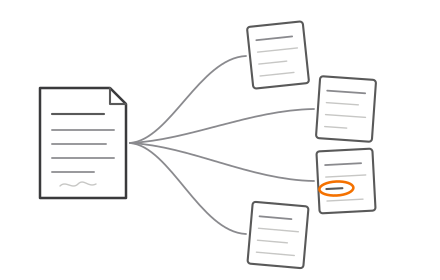
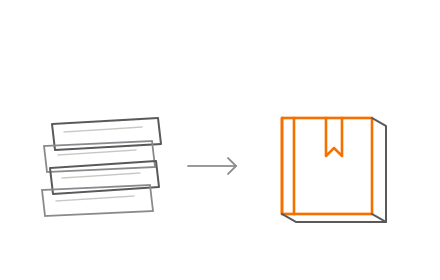
The loan lifecycle explained in one image: a loan tape is the loan's biography, and every stage of the journey writes a line of it. A single loan travels from a borrower's few minutes on an application form, through underwriting, closing, funding, and years of servicing, and at every stop a system records what happened. Follow one loan end to end and you learn the thing that matters most about lending technology: the tape an investor reads at the finish is only as honest as the systems that wrote it along the way. A lender who understands the journey understands why clean systems matter; an investor who reads the tape is reading the journey backwards.
We build these systems for lenders, so we tend to describe a loan not as a product but as a record that grows. Below is one loan's journey, stage by stage. At each stop, three things are worth naming: what happens, which system does it, and what data gets written to the loan's record, because that data is what everything downstream depends on.
The whole journey on one map
Every stage of a loan's life adds to a single growing record, and this is the map of it. The table is the spine of the whole piece: read it top to bottom and you have followed a loan from a borrower's request to the row an investor eventually reads.
| Stage | What happens | System responsible | Data written to the loan's record |
|---|---|---|---|
| Application | Borrower submits identity, the request, and collateral basics | Intake portal into the loan origination system | Applicant identity, requested terms, collateral description |
| Underwriting | Credit, collateral, and ratios assessed; the decision is made | LOS decisioning and rules engine, plus bureau and data integrations | Scores, DSCR or LTV or DTI, decision, conditions |
| Approval and closing | Terms locked, documents generated and executed | LOS with document and e-signature tooling | Final terms, collateral, covenants, maturity |
| Funding and boarding | Money disburses; the loan moves to servicing | LOS handing off to the servicing system | Funded amount, boarding record, servicing setup |
| Servicing | Payments, draws, delinquencies, modifications | Loan management and servicing system | Payment history, days past due, draws, modification flags, balance |
| The loan tape | The record is compiled into one row per loan | Reporting layer over the origination and servicing data | Every field above, read as the loan's biography |
Application: the borrower's few minutes, the lender's first data
The journey starts when a borrower spends a few minutes on an application, and in those minutes the lender gains its first structured data about a loan that does not yet exist. What happens is simple from the borrower's side and consequential from ours: they state who they are, what they want, and, for a secured loan, what stands behind it. The system is the intake portal that feeds the loan origination system, the platform that will own the front half of this journey. The data written is the loan's first few lines: applicant identity, the requested amount, purpose, and term, and the basics of any collateral. None of it is a decision yet. It is the raw material a decision will be made from, and if it is captured cleanly here, every later stage inherits a better starting point. Our companion piece on the loan origination workflow walks these intake steps in more detail.
Underwriting: where the loan's fate is decided
Underwriting is where the lender decides whether the loan should exist, weighing the borrower, the collateral, and the deal against policy. What happens is assessment: a credit view of the borrower, a valuation of the collateral, and the ratios that matter for the asset class, debt-to-income for a consumer loan, and debt-service coverage and loan-to-value for asset-based and private credit. The system is the LOS decisioning and rules engine, wired to credit bureaus and data sources, and it is also where AI-assisted decisioning now sits, handling the clean, rules-based checks while a person still owns the judgment on the loans that are not clean. The data written is the analytical core of the record: scores, ratios, the decision itself, and the conditions attached to an approval. For asset-based books, where the collateral and the deal carry the underwriting, our note on loan origination for private credit covers why this stage looks so different from consumer lending.
Approval and closing: the moment the loan legally exists
Approval locks the terms and closing executes the documents, and that is the moment the loan legally exists rather than merely being contemplated. What happens is finalization: the terms are set, the documents are generated, and they are signed, usually electronically, with any outstanding conditions cleared first. The system is the LOS working with document and e-signature tooling. The data written is the most quoted data in the loan's whole life: the final rate, amount, term, and maturity, the collateral and lien position, and any covenants. These are the exact fields a loan tape will one day report, which is why getting them recorded cleanly here, rather than reconstructing them later, saves so much pain downstream. A loan that closes with a clean, complete set of terms is a loan whose biography starts honest.
Funding and boarding: the handoff where data breaks
Funding moves the money and boarding moves the loan from the origination system to servicing, and this handoff is where data quality most often breaks. What happens is two things in quick succession: the loan is disbursed, and then it is boarded onto the servicing platform that will carry it for years. The system changes here, from the LOS to a loan management and servicing system, with payments and banking in the loop. The honest note is the whole reason to name this stage: origination and servicing systems almost never model a loan identically, so fields do not map cleanly, and the origination record and the servicing record start to drift apart unless someone designs the seam deliberately. This is the join we spend the most care on when we build, because a break here quietly corrupts everything the tape will later report. The same fragility is why a system migration has to protect this handoff above almost everything else.
Boarding is one of nine handoffs a loan crosses before it reaches a bond; our piece on loan data integration for private lenders follows all of them and what the drift costs at the warehouse line.
Servicing: the long middle of the journey
Servicing is the long middle of the journey, where payments, draws, delinquencies, and modifications each append a new line to the loan's record. What happens spans years: scheduled payments come in, and for staged products like residential transition loans the money goes out in draws against inspections and holdbacks rather than a single disbursement. Delinquencies get tracked, modifications get processed, and eventually the loan pays off. The system is the loan management and servicing platform, and its job is to keep an accurate, event-by-event history. The data written is everything that happens after closing: payment history, days past due, draw records, modification and charge-off flags, and the current balance, all accumulating into the performance picture that decides whether this is a clean loan or a distressed one. For the draw-heavy mechanics of RTL and how they feed later financing, our piece on RTL and securitization technology goes deeper.
The loan tape: the biography, assembled
The loan tape is the loan's biography, assembled from everything the earlier stages wrote, one row per loan with a column for each attribute. What happens is compilation rather than creation: the tape pulls the identity and terms from origination and the performance from servicing into a single loan-level record. Who reads it is the people whose money depends on it, investors, securitization desks, financing lines, and auditors, none of whom see the individual systems, only the tape. Why it matters is the thesis of this whole journey: every earlier stage decided the tape's accuracy, because the tape is only a readout of the record those stages wrote. The standard set of fields a tape must carry, and what makes one clean, is exactly what we cover in the loan tape data standards section. A clean tape is not a reporting achievement; it is the visible proof that the journey behind it was run on systems that agreed with each other.
Beyond one loan: portfolios, securitization, and querying the journey
Beyond a single loan, the same records aggregate into portfolios, feed securitizations, and increasingly become something a lender can question directly. What happens is scale: individual biographies become a book, and that book is what gets financed, sold, or securitized. This is not a niche concern: Moody's expects private credit assets under management to exceed $2 trillion in 2026, per its 2026 private credit outlook (January 2026), and every dollar of it runs on loan-level records exactly like the one we just followed. The newer development is that a lender can now ask questions of the whole journey at once: once the data across origination and servicing lives in one governed place, an AI layer can query the portfolio and surface the loans that need attention, which is what the emerging MCP standard for lenders is built to do safely.
Journeys that do not follow the map
Most writing about lending follows the happy path, but the loans that do not follow the map are exactly where system design gets tested. Plenty of applications never become loans: they are declined in underwriting or withdrawn by the borrower, and a system has to record those outcomes as cleanly as the approvals, because a decline is data too, and a portfolio's shape depends on what fell out and why. Live loans wander off the map as well, through modifications, forbearance, and workouts, where the original terms change and the record has to reflect a loan that no longer matches the one that closed. These unhappy paths are the real test, because a platform designed only for the clean journey handles them with spreadsheets and workarounds, and every workaround is a place the loan's biography quietly stops being true. The measure of a lending system is not how it books a perfect loan; it is how faithfully it records the imperfect ones.
That is the whole point of following one loan from end to end. The loan tape is the loan's biography, and every stage, the application, the underwriting, the closing, the boarding handoff, and the years of servicing, writes a line of it. Build the systems so each line is true, and the tape at the end tells an honest story without a scramble; let any stage write a careless line, and someone reading the tape backwards will eventually find it. If you are building or fixing the systems that carry a loan through this journey, our loan origination system work is where we design that record to stay honest from application to tape, and you can talk to us when you want it scoped against the loans you actually make.
Get the due-diligence checklist
The concrete questions to ask any loan origination system vendor before you sign, across viability, data model fit, audit and reporting, integrations, migration, pricing, and reference calls.
Get the checklist→Assess your lending stack
A 3-minute self-assessment scored on 5 dimensions: origination, loan tape, integrations, compliance, and AI readiness.
Start the 3-minute assessment→