Introduction
Most organisations collect more data than they know what to do with. According to a 2020 IDC/Seagate report, 68% of enterprise data goes unleveraged — not because it lacks value, but because traditional analytics tools simply cannot process it fast enough or at the right depth to generate timely decisions.
The gap between data collection and actionable insight is where most businesses lose. Scheduled reports, static dashboards, and manual queries produce answers that describe the past — rarely what's happening now, and almost never what's coming next.
AI changes that equation. By embedding machine learning, natural language processing, and intelligent automation into the analytics workflow, organisations can move from periodic reviews to continuous, real-time intelligence. Analysts don't get replaced — they get tools that actually surface answers worth acting on.
This article covers what AI analytics actually is, how it improves each stage of the analytics workflow, the key capabilities driving it, the business benefits, the real risks, and where this technology is heading.
TL;DR
- Traditional analytics can't keep pace with today's data volume — AI fills the gap with speed and scale
- AI enhances all four analytics types: descriptive, diagnostic, predictive, and prescriptive
- ML, NLP querying, anomaly detection, and generative AI now handle tasks that once required specialist teams
- Real-time insights and plain-language querying make analytics accessible to non-technical teams
- Data quality, model opacity, and governance gaps are the key risks to address before scaling AI analytics
What Is AI in Data Analytics?
AI in data analytics means applying machine learning, natural language processing, and automation to how data is collected, interpreted, and acted upon. Where traditional analytics relied on manual queries, scheduled reports, and fixed models, AI-powered analytics continuously learns and surfaces insights — without waiting for someone to ask the right question.
The Four Types of Analytics AI Enhances
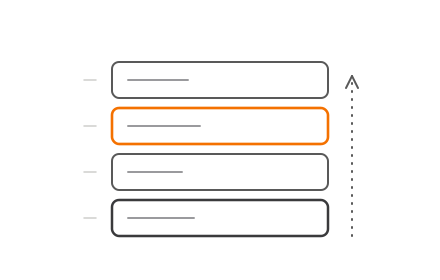
Most analytics work falls into four categories. AI meaningfully elevates what's possible in each:
| Type | Question It Answers | How AI Elevates It |
|---|---|---|
| Descriptive | What happened? | Automates aggregation across more sources, faster |
| Diagnostic | Why did it happen? | Identifies correlations and root causes across complex datasets |
| Predictive | What will happen? | Runs continuous ML models on live data streams |
| Prescriptive | What should we do? | Recommends specific actions, not just forecasts |

The prescriptive tier — where AI moves from insight to recommendation — is where the most business value sits, and where manual methods hit a hard wall.
AI Changes the Analyst's Role, Not Their Relevance
That shift toward prescriptive intelligence raises a fair question: what happens to the analysts themselves? AI takes over the repetitive, manual work — cleaning datasets, running standard queries, generating routine reports. The analyst's role shifts toward model oversight, strategic interpretation, and translating AI outputs into decisions. It's a higher-order function, and most organizations find themselves needing more analytical capacity, not less.
Gartner notes that AI is creating new roles in data and analytics — not eliminating them.
How AI Transforms Each Stage of the Analytics Workflow
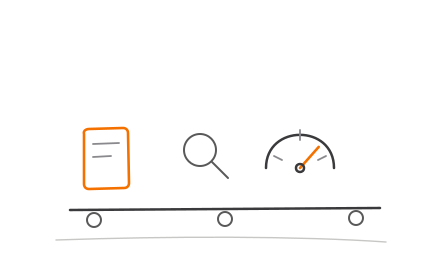
The standard analytics process moves through five stages: data collection → preparation → analysis → visualisation → decision-making. AI has a distinct and material impact at each one.
Data Collection
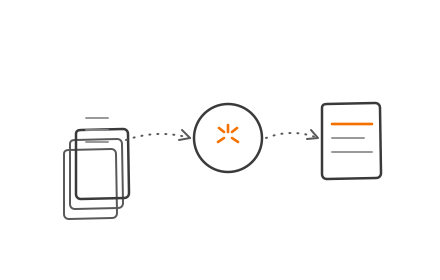
Manually building pipelines for every new data source — APIs, sensors, application logs, third-party feeds — is slow and expensive. AI automates ingestion across these sources, normalising formats as data arrives and handling high-volume, real-time streams without requiring custom engineering for each connection.
Organisations can pull from more sources, more frequently — without scaling their engineering teams to match.
Data Preparation
Data preparation is still the most time-consuming part of analytics work. Anaconda's 2022 State of Data Science report found that data professionals spend roughly 38% of their time on preparation and cleansing alone.
AI tools cut that significantly by:
- Automatically detecting anomalies and outliers
- Filling or flagging missing values based on learned patterns
- Standardising formats across disparate datasets
- Joining related tables without manual mapping
Each of those hours recovered is time analysts can redirect toward actual analysis.
Analysis and Visualisation
Traditional BI tools wait for a scheduled report or a user to run a query. AI-powered analysis runs continuously — monitoring data streams, detecting pattern shifts, and flagging anomalies in real time.
NLP-powered querying takes this further. Users can type or ask questions in plain language — "Which regions had the highest churn last quarter?" — and receive instant visual answers. This removes the SQL barrier for business users who need data access but lack technical training.
Decision-Making
Faster insights only matter if they reach decisions in time to act on them. AI-assisted decision-making moves leaders from reviewing last month's performance to acting on forward-looking intelligence:
- Forecast future outcomes based on current trend signals
- Surface risks and opportunities before they appear in standard reports
- Model scenarios interactively ("what if we increased pricing by 10%?")
The decision window that once stretched weeks now compresses to hours, sometimes less.

Key AI Capabilities Powering Modern Analytics
Machine Learning
ML algorithms train on historical data to surface patterns that statistical models would miss. Practical applications include:
- Identifies at-risk customer accounts before they churn
- Estimates future inventory needs using sales patterns and external signals
- Flags unusual transaction behaviour in real time for fraud prevention
ML models also get more accurate over time — the more data flows through them, the sharper their predictions become.
Natural Language Processing
NLP operates in two directions within analytics:
- Natural Language Querying (NLQ): Users ask data questions in plain language; the system translates and runs the query automatically
- Natural Language Generation (NLG): The system converts complex query results into readable summaries and narrative reports
Together, they open up analytics to business users who have no interest in writing queries — the data comes to them, in plain language.
Predictive and Prescriptive Analytics
Predictive analytics forecasts outcomes based on historical patterns — a retailer estimating seasonal demand, a lender scoring loan default probability. Prescriptive analytics goes further: instead of flagging that a warehouse will run short in two weeks, it recommends the exact order quantity, timing, and supplier given current constraints.
Generative AI in Analytics
Gartner predicts that 75% of new analytics content will be contextualised through GenAI by 2027. The near-term applications are already visible:
- Automated narrative reports from raw query outputs
- Synthetic data generation for training models where real data is limited
- Conversational interfaces that let business users explore data without any BI tool expertise
Anomaly Detection
AI continuously monitors data streams and flags unusual behaviour — irregular transaction patterns, sudden KPI drops, equipment sensor deviations — before they escalate into larger problems. In sectors like finance and manufacturing, catching anomalies early is the difference between a minor correction and a costly one.
Business Benefits of AI in Data Analytics
Faster, Real-Time Insights
Over 50% of analytics and AI leaders report their organisations now use AI for automated insights and natural language queries, according to Gartner's 2025 research. The practical impact: reporting cycles that once ran weekly or monthly now produce always-current intelligence, letting teams act on trends as they form rather than after they've peaked.
Improved Accuracy and Pattern Detection
ML models identify subtle correlations across large, multi-variable datasets — the kind of signal that gets lost in manual analysis. In financial services, this means more precise risk scoring and earlier identification of credit stress, with fraud detection catching patterns that rule-based systems miss. Accenture research found that companies with AI-led processes achieved 2.5x higher revenue growth compared to peers — though this reflects broad AI adoption rather than analytics alone.
Democratisation of Analytics
Self-service BI has historically struggled to reach most of the organisation. Forrester found that self-service capabilities had reached only about 20% of non-IT professionals — leaving 80% still dependent on analyst teams for data access. NLP interfaces change that by removing the technical barrier.
Sales managers, operations leads, and finance teams can query data directly. This widens the return on analytics investment across the organisation without adding headcount.
Scalable Insight Generation
Wider data access also means greater demand on the underlying infrastructure. AI-powered pipelines, shared models, and automated reporting handle that load — delivering consistent insights across departments and regions without proportional hiring. One well-built model serves multiple teams simultaneously.
Accessibility for SMEs and Enterprises Alike
Large enterprises no longer hold a monopoly on AI analytics. Platforms have become more accessible, and for startups and SMEs without a dedicated data science team, partnering with a specialist like Codiot — which covers data engineering, business intelligence, and AI implementation — means building the right data foundation early rather than rearchitecting it under pressure later.
Challenges and Risks to Consider
Data Quality, Bias, and Interpretability
AI outputs are only as reliable as the data they learn from. Gartner estimates poor data quality costs organisations at least USD $12.9 million per year on average. Biased or incomplete training data produces skewed models — in sectors like lending or investment, that translates directly to unfair or non-compliant outcomes.
Many ML models also function as "black boxes": they produce results, but explaining exactly how a conclusion was reached is difficult. NIST's AI Risk Management Framework specifically identifies explainability and interpretability as critical requirements for responsible AI deployment.

Getting AI analytics right depends on having clean data pipelines and governance policies in place before deployment — not retrofitted after problems emerge.
Over-Reliance on Automation
AI-generated insights are a starting point, not a verdict. Human oversight remains essential for:
- Validating model assumptions against real-world context
- Catching outputs that are technically accurate but practically wrong
- Maintaining version control and reproducible workflows
- Ensuring audit trails exist for regulated decisions
Gartner has flagged "agent drift" — where autonomous AI systems deviate from intended behaviour over time — as a growing concern as AI takes on more analytical tasks.
Privacy and Compliance
Analytics systems routinely process sensitive customer and financial data. For organisations handling EU residents' data, GDPR Article 22 gives data subjects the right to challenge decisions made solely through automated processing — particularly in credit decisions or profiling. For domestic operations, India's Digital Personal Data Protection Act, 2023 establishes binding rules around lawful data processing and individual rights.
Any AI analytics implementation touching personal data requires:
- Role-based access controls limiting data exposure
- Transparency documentation explaining how automated decisions are made
- Legal review before processing sensitive categories of data
The Future of AI in Data Analytics
The near-term trajectory is clear across three dimensions:
- Conversational interfaces will make querying as simple as messaging a colleague, powered by generative AI
- Predictive models will update continuously from streaming data rather than relying on periodic retraining
- Systems will proactively flag emerging patterns without waiting for a user to ask the right question
The rise of AI agents is the most significant development. Gartner describes "perceptive analytics": AI agents that continuously monitor data environments, run queries, recommend models, flag quality issues, and surface anomalies on behalf of analysts. For small analytics teams, this effectively multiplies capacity without adding headcount.

None of this works well without clean data underneath it. Businesses that establish a unified data foundation now will be far better positioned to benefit from these advances as they mature. That means building proper data pipelines, standardising data storage, and investing in governance before layering AI on top.
Codiot's data engineering and AI implementation services help startups, SMEs, and enterprises build that foundation and begin piloting AI analytics in focused, practical areas without navigating every technical decision alone.
Frequently Asked Questions
What is AI data analytics?
AI data analytics uses artificial intelligence techniques — including machine learning, NLP, and predictive modelling — to automate how data is collected, analysed, and interpreted. Unlike traditional statistical methods, it processes larger datasets faster and surfaces patterns that manual analysis would miss.
What does an AI data analyst do?
An AI data analyst uses AI-powered tools to automate routine tasks like data cleaning and report generation, builds and monitors ML models, and validates AI-generated outputs before translating findings into strategic recommendations. The role focuses on judgment and interpretation rather than manual data processing.
What are the 4 types of data analytics?
The four types are descriptive (what happened), diagnostic (why it happened), predictive (what will happen), and prescriptive (what should be done). AI enhances all four by processing data faster, running continuous models, and uncovering deeper patterns than manual methods allow.
How is AI different from traditional data analytics?
Traditional analytics relies on manual data preparation, static dashboards, and scheduled reporting. AI analytics automates data processing, enables real-time continuous analysis, and uses ML models to surface predictions and hidden patterns — turning analytics into a continuous intelligence system rather than a periodic review.
What are the main risks of using AI in data analytics?
The key risks are poor data quality producing biased outputs, opaque ML models making results difficult to interpret, and over-reliance on automation without adequate human oversight. Strong governance practices, clean data infrastructure, and clear audit trails are essential safeguards.
How can businesses get started with AI-driven analytics?
Start with a clean, unified data foundation, then pilot AI in one focused workflow — such as automating a recurring report or building a simple predictive model. Working with an experienced implementation partner can compress your timeline and reduce technical risk on that first rollout.