Revolutionizing Loan Origination with AI Technology

Introduction

Not long ago, applying for a business loan meant submitting stacks of paperwork, waiting days for a credit analyst to review your file, and calling the bank repeatedly for status updates. Borrowers tolerated it because there was no alternative.

That calculus has shifted. AI-powered origination systems now process documents in seconds, evaluate creditworthiness from richer datasets than any human analyst could review, and return decisions in minutes rather than days. McKinsey reports that one credit-risk digitisation programme cut "time to yes" from 24–48 hours to just 4 minutes while reducing cost per origination by 30–40%.

Those numbers have moved from pilot projects to production floors across the industry. Lenders who cannot match the speed and accuracy of AI-first competitors are already losing application volume.

What follows covers each stage of the origination lifecycle, the measurable benefits AI delivers, the risks to manage, and what to look for when selecting a solution.


TL;DR

  • AI reduces loan approval timelines from days to minutes by automating document processing, credit decisioning, and compliance checks.
  • Generative AI automates time-consuming tasks like credit memo drafting; agentic AI is emerging as a framework for multi-step autonomous workflows.
  • Lenders gain faster approvals, lower origination costs, stronger compliance, and the ability to scale volume without proportional headcount growth.
  • Managing three core risks — algorithmic bias, data privacy, and model explainability — is essential for regulatory compliance.

How AI Is Transforming the Loan Origination Process

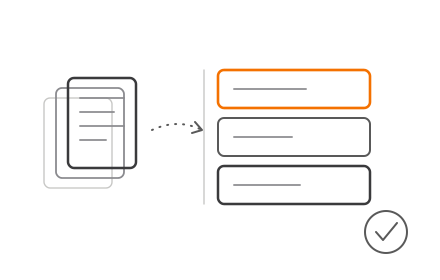
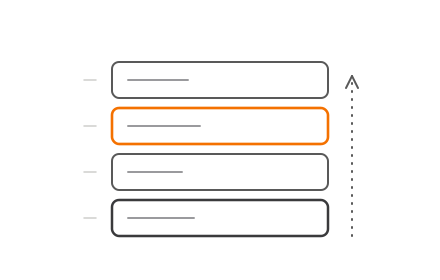
Traditional origination moves through a predictable sequence: application intake, document collection, credit analysis, underwriting, and approval. The bottlenecks cluster in the middle stages — specifically document review, data verification, and credit spreading — where analysts spend hours on tasks that are repetitive but consequential. AI addresses each of these bottlenecks directly.

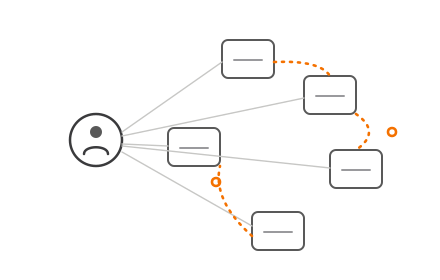
Traditional versus AI-powered loan origination lifecycle stage comparison infographic

Automated Document Processing and Data Extraction

Manual document review is one of the most labour-intensive steps in origination. Analysts open pay stubs, bank statements, and tax filings, then manually key data into the LOS — introducing both delay and transcription error.

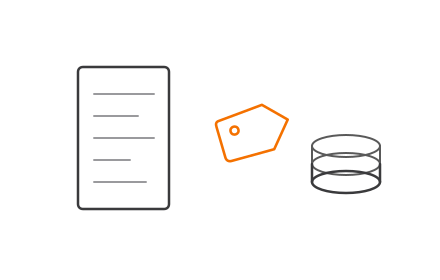
Intelligent document processing (IDP) eliminates most of this. According to Deloitte, AI-powered IDP in lending can reduce data-field error rates from 1–3% to less than 0.1%, and cut relationship manager data entry time from 2–3 hours to minutes. Modern AI/OCR tools now identify documents and extract fields with confidence approaching the 90th percentile, compared with roughly 50% accuracy from older models.

Natural language processing adds another layer: systems can cross-reference extracted data against application fields in real time, flagging inconsistencies (a stated income that doesn't align with bank deposit patterns, for example) before those gaps create underwriting delays downstream.

AI-Powered Credit Decisioning

Traditional credit scoring uses a narrow slice of financial history. AI-powered decision engines use far more, combining bureau data with cash flow patterns, rent payment history, utility consistency, and payroll integrations to build a fuller, more accurate creditworthiness assessment.

FinRegLab's research found that ML models integrating electronic bank-account cash-flow data with traditional bureau data were the most predictive overall, and achieved the highest approval rates across most borrower subgroups while maintaining low false-positive rates. Better data doesn't just improve accuracy — it expands access to credit.

Urban Institute found that including positive rent payment data reduced the share of participants with no credit score from 16% to 8%, expanding the eligible borrower pool without increasing risk exposure.

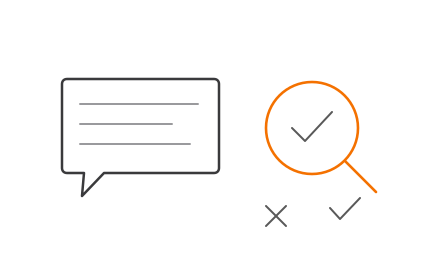
AI decision engines also apply lender-defined rules and regulatory constraints simultaneously, ensuring every approval or decline is consistent and explainable rather than subject to individual analyst variability.

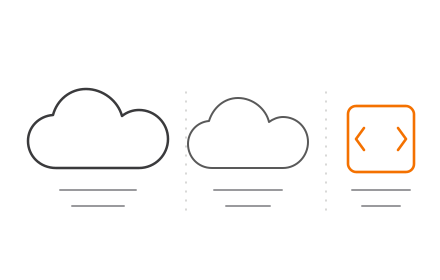
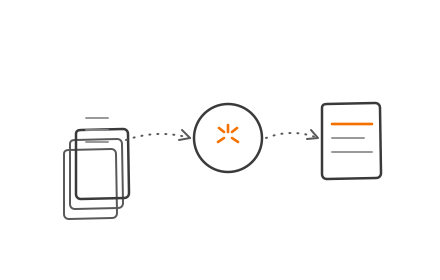
AI credit decisioning data sources feeding into unified creditworthiness assessment model

Conversational Interfaces and Frictionless Onboarding

Context-aware conversational AI guides borrowers through applications dynamically, adjusting questions based on the borrower's profile and explaining documentation requirements in plain language. The practical result: fewer abandoned applications caused by confusing form fields, and fewer back-and-forth document requests that stall origination mid-process. Fannie Mae's 2024 survey found 71% of recent homebuyers said digital processes made the mortgage experience easier, and 75% cited process speed as a benefit.

Embedded Lending and Real-Time Origination

Embedded lending represents a structural shift in how credit products reach borrowers. Rather than routing applicants to a separate banking portal, origination systems operate via APIs and integrate directly into e-commerce checkouts, dealer management platforms, or B2B vendor systems.

Credit decisions happen inside the purchase journey — invisible to the borrower as a separate step, but powered by AI-driven credit decisioning underneath. For lenders, this means meeting borrowers at the point of intent rather than waiting for them to seek out a loan application.


Key Benefits of AI-Powered Loan Origination

Faster Approvals

Borrowers now expect fast decisions as a minimum, not a selling point. McKinsey's benchmark of 4-minute decisions reflects where AI-first lenders are already operating. Deloitte reports a separate case where an AI-powered risk engine produced a loan decision in under 15 minutes, compared with a process that previously took weeks.

Lenders still running multi-day approval cycles face a straightforward problem: borrowers who receive an instant decision from a competitor will rarely wait.

Reduced Operational Costs

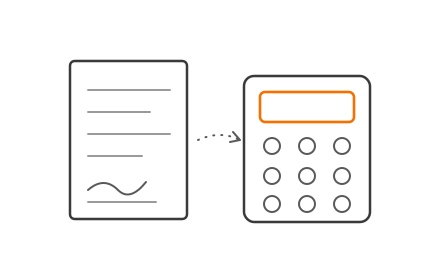
Automation of repetitive tasks — data entry, document verification, compliance checks, statement generation — reduces the manual labour required per loan.

Key cost benchmarks:

  • 30–40% reduction in cost per origination after credit-risk digitisation (McKinsey)
  • 40–50% reduction in relationship manager manual processing time through agentic AI (Deloitte)
  • 75–90% cost reduction estimated for retail account management acceptance in one Deloitte digital lending case study

AI loan origination cost reduction benchmarks showing three key savings metrics

For context on why this matters: Urban Institute data shows mortgage production costs reached $12,450 per loan by Q4 2022, up from $3,700 in 2009. Automation is the most direct lever for compressing that cost base.

Stronger Regulatory Compliance

AI-enabled LOS platforms can be configured to automatically apply applicable lending regulations at the point of decision, generate audit trails for every step, and update compliance parameters as regulations change.

This matters because the alternative — manual compliance review — doesn't scale and creates inconsistency. Note that compliance-aware AI is a design requirement, not an automatic feature. The CFPB and federal partners have explicitly stated that automated systems are not an excuse for unlawful outcomes; the governance framework around the AI matters as much as the model itself.

Improved Borrower Experience

Borrowers applying for loans in 2025 compare the experience against the digital products they use every day — and consumer apps have set a high standard.

AI reduces friction in three concrete ways:

  • Fewer document re-requests through upfront intelligent verification
  • Real-time status updates throughout the process
  • Omnichannel access — mobile, web, and in-branch — with consistent experience across all touchpoints

Fannie Mae's data shows only about one-third of homebuyers were offered digital bank-account verification during their mortgage application. Lenders who close that gap have a clear differentiation opportunity.

Scalability Without Proportional Headcount Growth

Origination volume is not evenly distributed. Marketing campaigns, rate changes, and seasonal demand spikes create pressure that manual operations struggle to absorb without emergency hiring.

AI-powered origination handles volume spikes with the same speed and consistency as baseline periods. The infrastructure processes 100 or 100,000 applications through the same intelligent workflows. Scalability is built into the architecture, not dependent on headcount.


GenAI and Agentic AI: The Next Frontier in Loan Origination

Traditional ML-based automation extracts and classifies. Generative AI combines inputs from multiple sources to produce structured, meaningful outputs. That distinction matters in lending.

Automating Credit Memos with GenAI

Credit memo drafting is one of the most time-consuming tasks in commercial lending. ProSight Financial Association reports that compiling a single credit memo can take up to 8 hours, requiring a credit officer to pull data from customer systems, tax returns, ownership structures, and credit reports before writing a coherent analysis.

GenAI cuts that timeline sharply. By pulling together data from multiple source documents into a structured, consistent memo, these systems return a complete draft in minutes. RMA and ProSight's research involving nine of the top ten US banks found that 20% of surveyed financial institutions had already implemented GenAI for credit risk work, with 60% planning to do so within the following year.

Time savings are only part of the gain. The bigger payoff is analyst capacity redirected toward the judgment-intensive work that automation cannot handle.

Agentic AI: From Automation to Autonomous Origination

Agentic AI refers to systems that can independently complete multi-step processes: perceiving a situation, making sequential decisions, and taking action without requiring human instruction at each step. MIT Sloan describes agentic AI as systems of AI agents designed to independently complete multistep processes — and identifies five deployment challenges including data integration, model validation, drift monitoring, and governance.

Two lending-specific implications stand out:

  • 24/7 origination capacity: Applications submitted outside business hours receive the same intelligent processing as those submitted during peak hours
  • Continuous improvement: Systems that track the downstream performance of every loan they approve can refine their decision-making over time

A realistic note: fully autonomous, no-human-intervention end-to-end origination is not broadly deployed in production lending today. Current agentic AI implementations are primarily focused on workflow assistance and handoff management — meaningful productivity gains, but not fully autonomous origination.

The Human + AI Partnership

AI does not replace loan officers. It changes what they spend their time on.

Tasks like routine decisioning, document verification, and data entry shift to AI. What remains for human professionals:

  • Complex underwriting judgment on edge cases
  • Relationship management and borrower communication requiring empathy
  • Review of AI-flagged escalations with full context attached
  • Oversight and governance of AI model performance

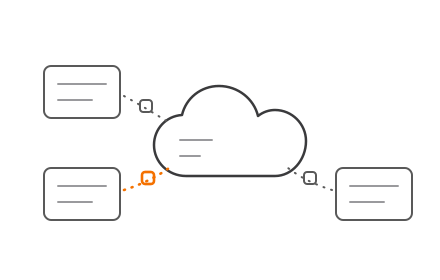
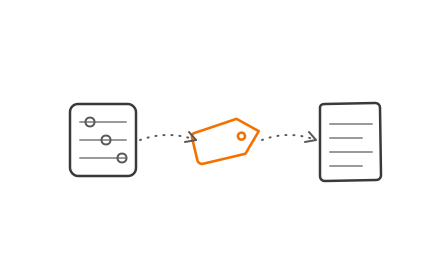
Human versus AI task division in modern loan origination workflow split diagram

The role becomes more strategically demanding, focused on decisions and relationships that algorithms are not equipped to handle.


Risks and Ethical Considerations

Algorithmic Bias and Fair Lending

AI models trained on historical lending data inherit the biases encoded in that history. The Philadelphia Fed found that while automated underwriting reduces the racial gap in mortgage approval rates, it does not eliminate it — and that algorithms can inadvertently correlate with impermissible variables like race and gender in ways that aren't visible in the model output.

The Urban Institute's research goes further, finding that AI models can actively amplify — not just perpetuate — racial disparities in mortgage underwriting by latching onto proxy variables or learning patterns from historically biased training data.

Lenders must:

  • Conduct regular model audits and disparate impact testing across protected classes
  • Maintain explainability in model outputs to identify proxy variable risk
  • Treat fair lending compliance as a model governance requirement, not an afterthought

Data Privacy and Security

Loan origination handles some of the most sensitive personal data in existence: income records, employment history, tax filings, identity documents, and banking data. Every AI system in the origination stack must be built with data protection in mind — appropriate encryption, strict access controls, secure data pipelines, and clear governance policies.

This matters most for lenders operating across multiple jurisdictions or using third-party AI vendors, where data handling practices may not align by default with the lender's own compliance posture.

Regulatory and Explainability Requirements

The CFPB has been explicit on this point. CFPB Circular 2022-03 states that creditors using complex algorithms — including AI and ML — must provide specific and accurate reasons for adverse actions, and that opacity is not an acceptable compliance defense. A follow-up circular in 2023 clarified that sample-form checklist reasons are insufficient when the actual decision was driven by a model those generic reasons don't reflect.

In the EU, the AI Act classifies credit-scoring AI as high-risk, carrying corresponding transparency and human oversight requirements.

The practical implication: explainable AI (XAI) is a non-negotiable design requirement for any AI system making or influencing credit decisions. Key compliance obligations include:

  • Providing specific, model-accurate adverse action reasons (not generic checklists)
  • Implementing XAI frameworks — such as SHAP or LIME — to surface decision drivers
  • Ensuring human oversight protocols are built into high-risk model pipelines

How to Choose and Implement an AI Loan Origination Solution

Key Evaluation Criteria

When assessing AI-powered LOS platforms, lenders should evaluate:

  • Cloud-native architecture for real-time processing and elastic scalability
  • Pre-built compliance frameworks that can be configured to applicable regulations
  • Open API integrations with core banking systems, credit bureaus, and data providers
  • Configurability to match internal workflows and product-specific requirements
  • Explainability features that support adverse-action notice obligations
  • Provider track record in financial services specifically — not just general enterprise software

Gartner defines commercial loan origination solutions as software applications enabling institutions to manage the end-to-end process, from origination through settlement. The best platforms support all of that in a single, connected workflow rather than stitching together point solutions.

Integration and Change Management

Technical implementation is only part of the challenge. Successful AI LOS adoption also requires:

  1. Data migration planning — establishing clean, complete historical data before go-live
  2. Staff retraining — loan officers and analysts need to understand new workflows and handoff points
  3. Stakeholder alignment across risk, compliance, IT, and operations teams before implementation begins
  4. Phased rollout strategy — piloting with a loan product or branch before full deployment to manage disruption

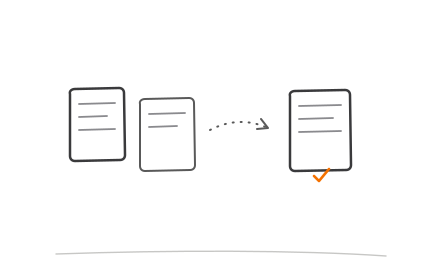
4-step AI loan origination system implementation and change management process flow

RMA and ProSight's research found that 75% of senior credit risk executives cite risk and governance as a significant obstacle to scaling AI, and 67% cite lack of internal GenAI capabilities. These are change management problems as much as technical ones.

Partnering with the Right AI Development Expertise

Building or customizing an AI loan origination system requires specific knowledge of both financial services workflows and modern AI engineering — two domains that rarely overlap in off-the-shelf platforms. Most pre-built solutions don't map cleanly onto a lender's product mix, compliance environment, or existing technology stack, which is why the build-vs-configure decision is rarely straightforward.

Codiot works with lenders navigating exactly this decision. Their experience across investment, finance, and private lending operations covers the specific components that matter in production: intelligent data pipelines, ML model integration, NLP-based document processing, mobile-first borrower interfaces, and Salesforce-connected workflows for institutions already running Salesforce as their CRM or servicing platform.

For lenders evaluating whether to configure an existing platform, build custom components, or pursue a hybrid approach, the right partner helps define that scope early — before architectural decisions lock in constraints that are costly to reverse later.


Frequently Asked Questions

What is an AI loan origination system?

An AI loan origination system is a digital lending platform that uses machine learning, NLP, and automation to manage everything from application intake through approval — reducing manual work, accelerating decisions, and improving accuracy across document processing and credit analysis compared to traditional LOS platforms.

Will mortgage loan officers be replaced by AI?

Unlikely. AI automates high-volume routine tasks — document verification, initial screening, data entry — but complex underwriting judgment, borrower relationships, and edge-case decision-making still require human professionals. The role becomes more strategic, not obsolete.

What is the best AI loan origination software?

The right solution depends on the lender's size, loan product mix, regulatory environment, and existing technology stack. Key criteria include cloud-native architecture, AI-powered decisioning, compliance configurability, and API flexibility. Consulting with an experienced AI development partner helps evaluate fit and identify where custom capability is needed.

How does AI improve the accuracy of credit decisions?

AI models analyse far more data points than traditional scoring — cash flow patterns, rent history, payment behaviour — while eliminating human inconsistency. FinRegLab research shows ML models combining bureau and cash-flow data outperform traditional scoring in both predictive accuracy and approval rates across borrower subgroups.

What are the biggest risks of implementing AI in loan origination?

The main risks are algorithmic bias (historical training data can encode past discrimination), data privacy obligations (sensitive borrower data demands rigorous security and governance), and explainability gaps — models that cannot justify adverse decisions create regulatory and legal exposure under RBI guidelines and applicable fair lending regulations.