The Role of AI in Business Intelligence: Complete Guide

Introduction

Most organisations collect more data than ever before — and understand less of it. According to Seagate and IDC research, 68% of enterprise data goes unleveraged, sitting in systems that produce dashboards nobody acts on. Meanwhile, Forrester found that fewer than 20% of enterprise decision-makers actually use BI applications hands-on — and only 7% report advanced insights-driven capabilities.

The problem isn't data volume. Organisations have plenty of data — what they lack is the intelligence layer to act on it.

Traditional BI dashboards were built for a slower world. They answer "what happened last quarter?" when the real question is "what should we do next week?" As data grows more complex and decisions move faster, those static reports create bottlenecks rather than clarity.

This guide covers the full shift from historical reporting to predictive intelligence: what AI-powered BI actually means, the technologies behind it, real-world applications across industries, and how to implement it without common pitfalls. Whether you're building your first data stack or rethinking an existing BI investment, the principles apply.


TL;DR

  • 68% of enterprise data goes unleveraged — traditional dashboards aren't closing the gap
  • AI transforms BI from descriptive ("what happened") to predictive and prescriptive ("what will happen" and "what should we do")
  • Core technologies: machine learning, NLP, deep learning, and predictive/prescriptive analytics engines
  • Real-world impact: McKinsey reports AI-driven forecasting reduces supply chain errors by 20–50%
  • Successful implementation starts with defined objectives, clean data infrastructure, and iterative pilots

What Is AI in Business Intelligence?

Traditional BI: The Rearview Mirror

Traditional BI is a system for collecting, organising, and visualising historical data. Its core function is KPI monitoring, standardised reporting, and data visualisation through dashboards. It answers one question well: what happened?

That's useful, but it's backward-looking by design. Analysts pull data, build reports, and present findings to decision-makers — often days or weeks after the events they describe. The process is structured, human-driven, and reactive.

AI-Powered BI: The Intelligence Layer

AI business intelligence, sometimes called augmented analytics, integrates machine learning, natural language processing (NLP), and predictive modelling with traditional BI frameworks. Augmented analytics platforms incorporate NLP and ML capabilities to shift the core question from "what happened?" to three more valuable ones:

  • Why did it happen? (diagnostic)
  • What will happen next? (predictive)
  • What should we do about it? (prescriptive)

Each question unlocks a different tier of decision-making — from understanding past performance to actively shaping future outcomes. The table below maps out where traditional and AI-powered BI each stand.

Traditional vs. AI-Powered BI at a Glance

Dimension Traditional BI AI-Powered BI
Analytics type Descriptive Predictive + prescriptive
Data handled Structured only Structured and unstructured
Query method SQL / analyst-built reports Natural language queries
Insight generation Manual, analyst-driven Automated, continuous
Posture Reactive Proactive

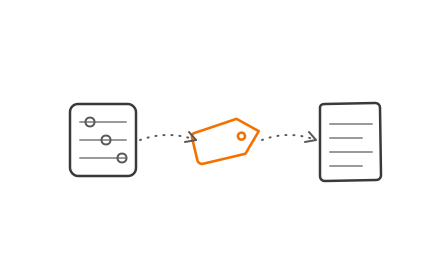
Traditional BI versus AI-powered BI five-dimension side-by-side comparison infographic

How AI Transforms Traditional BI: Key Benefits

From Reactive to Proactive Decision-Making

Traditional BI tells you a problem happened after it happened. AI-powered BI surfaces signals before they become crises: it flags customer churn risk before accounts go quiet and detects demand shifts before stockouts appear.

Gartner reported in 2025 that more than 50% of analytics and AI leaders are already using AI tools for automated insights and natural-language queries — and predicts 75% of new analytics content will be contextualised through generative AI by 2027. The shift is already underway at scale.

Forecasting Accuracy That Moves the Needle

ML models trained on historical data identify patterns that human analysts cannot detect at speed or scale. The downstream impact is measurable: McKinsey found AI-driven supply chain forecasting can reduce forecasting errors by 20–50% and reduce inventory levels by 20–30% through improved demand prediction. Those numbers translate directly into margin improvement across retail, manufacturing, and distribution.

Data Democratisation Through NLP

Traditional BI created an analytics bottleneck. Non-technical users — a marketing manager, a finance lead, an operations head — had to queue requests to an analyst who could write SQL. That delay kills the value of real-time data.

NLP-powered BI eliminates this dependency. A user types "show me revenue by region this quarter" in plain language. The system parses intent, maps it to the data model, and returns a visualised result — no SQL, no ticket, no wait. Self-service analytics becomes genuinely self-service.

Automated Data Preparation

Self-service queries are only part of the picture. The manual burden deeper in BI workflows is equally severe. IDC estimates 80% of analyst time is spent on data discovery, preparation, and protection — leaving only 20% for actual analysis. AI automates the most time-consuming tasks:

  • Data cleaning and deduplication
  • Anomaly detection in time-series data
  • Scheduled report generation
  • Metric drift alerts

Analysts shift from wrangling spreadsheets to interpreting outputs and making recommendations. The work becomes higher value, not just faster.


The AI Technologies Powering Modern Business Intelligence

Machine Learning for Predictive Modelling

ML sits at the core of AI-powered BI. Two broad categories matter most:

  • Supervised learning trains on labelled historical data to predict outcomes. Applications include lead scoring, churn prediction, and revenue forecasting. Salesforce Einstein Lead Scoring, for example, ranks prospects by how closely they match patterns from past conversions.
  • Unsupervised learning finds structure in unlabelled data. Applications include customer segmentation, anomaly detection, and exploratory clustering that surfaces patterns analysts didn't know to look for.

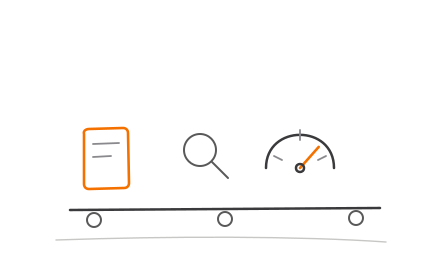
Supervised versus unsupervised machine learning BI applications comparison infographic

NLP for Conversational Analytics

NLP is what makes BI accessible to non-technical users. When a user submits a plain-language query, NLP parses the intent, translates it into a structured data query, and returns a formatted result. Microsoft Power BI's Q&A feature is a working example — users explore datasets by typing questions rather than building reports.

At scale, NLP removes the single biggest adoption barrier for traditional BI: the need for technical intermediaries. The result is faster insight delivery and broader adoption across non-analyst teams.

Key NLP capabilities in BI:

  • Natural-language querying of structured databases
  • Automated report generation from voice or text input
  • Real-time translation of business questions into data queries

Where NLP lowers the barrier to accessing data, deep learning raises the ceiling on what BI systems can detect within it.

Deep Learning for Complex Pattern Recognition

Deep learning uses multi-layered neural networks to surface patterns in large, complex, or unstructured datasets where traditional ML falls short. Key BI applications:

  • Fraud detection : Mastercard's Decision Intelligence Pro uses recurrent neural networks to scan transaction relationships, improving fraud detection rates by an average of 20%, with some cases reaching 300%
  • Sentiment analysis : processing customer reviews, support tickets, or social data at volume to surface qualitative signals alongside quantitative metrics
  • Behavioural pattern recognition : identifying subtle signals in sequential user data before they manifest as churn or conversion

Predictive and Prescriptive Analytics Engines

These two capabilities are often conflated but serve different purposes:

  • Predictive analytics answers: what will happen? It uses historical data and statistical modelling to forecast outcomes like demand, revenue, or customer behaviour.
  • Prescriptive analytics answers: what should we do about it? It combines forecasts with optimisation models to recommend the best action for a defined goal.

UPS's ORION system puts prescriptive analytics into practice. It analyses delivery routes and operational constraints to recommend optimised package sequences for drivers — generating more than $320M in savings by 2015, even at partial deployment.


Predictive versus prescriptive analytics definitions and UPS ORION real-world outcomes

AI in BI: Real-World Use Cases Across Industries

Finance and Lending

AI-powered BI in financial services operates at a scale and speed that manual analysis cannot match. Mastercard's Decision Intelligence Pro scans 1 trillion data points per transaction assessment to determine legitimacy in real time. Beyond fraud detection, AI supports:

  • Dynamic credit risk assessment using broader behavioural data signals
  • Financial forecasting dashboards that update with real-time market inputs
  • Anomaly detection across transaction streams for compliance monitoring

For investment firms and private lending operations, these capabilities translate directly into reduced exposure risk and stronger portfolio decision-making.

Retail and E-Commerce

ML demand forecasting has become a standard capability for competitive retailers. McKinsey's cross-industry research shows forecasting errors can fall 20–50% with AI, while inventory levels drop 20–30% — directly reducing both stockouts and carrying costs. Zalando has built a scalable dynamic inventory optimisation system that applies this logic at enterprise volume.

AI also drives real-time campaign performance analysis and personalised recommendation engines that respond to browsing and purchase behaviour — two capabilities that compound the inventory gains with revenue-side impact.

Marketing and Sales

AI reshapes how marketing and sales teams allocate effort:

  • Lead scoring ranks prospects by conversion probability, so sales teams contact the right accounts first rather than working through flat lists
  • Cross-channel campaign analysis surfaces which creatives, audiences, and channels drive highest ROI — not after the campaign ends, but while it's running
  • Automated reporting cuts manual campaign labour dramatically — a Salesforce-commissioned Forrester study found AI marketing tools delivered 299% ROI over three years, with a 90% reduction in reporting labour and 60% lift in email conversion rates

Supply Chain and Operations

AI predicts disruptions before they occur — analysing external signals like weather events, port activity, and supplier patterns to flag risk early. UPS's ORION system demonstrates what prescriptive analytics can achieve at scale: route recommendations that reduced fuel consumption by 10 million gallons annually at full deployment.


How to Implement AI in Your BI Strategy

Start With Defined Business Objectives

The most common implementation mistake is starting with tools. A platform evaluation before a clear use case produces exploratory AI that never becomes operational.

Anchor every AI-BI initiative to a specific, measurable problem:

  • Reduce customer churn rate by X% within 12 months
  • Improve demand forecast accuracy from ±20% to ±10%
  • Reduce time-to-insight from weekly reports to daily automated alerts

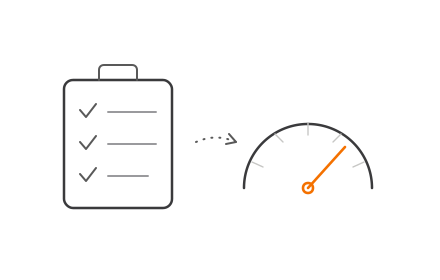
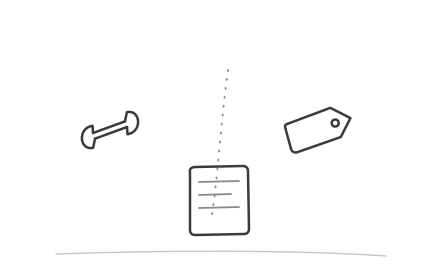
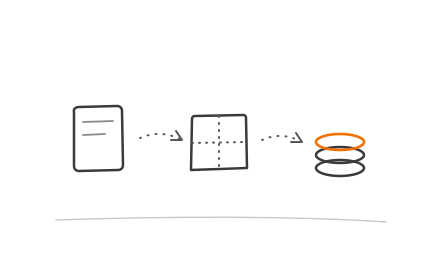
Three-step AI business intelligence implementation framework with measurable objectives examples

Clear objectives also define your success metrics upfront — so you know exactly when the AI is working and when it needs recalibration.

Audit and Govern Your Data Infrastructure

AI models perform only as well as the data feeding them. Gartner predicts that through 2026, organizations will abandon 60% of AI projects unsupported by AI-ready data. Before selecting any tool, assess:

  • Are key metrics fully captured across all relevant time horizons?
  • Do metric definitions match consistently across departments and systems?
  • Are fields named and typed uniformly across data sources?
  • Is there enough historical volume for ML models to learn meaningful patterns?

For startups and SMEs without in-house data engineering capability, this foundation-building phase is where external expertise — like Codiot's data engineering and AI integration services — accelerates the path from raw data to deployable models.

Select Tools and Iterate

With objectives set and data governed, evaluate platforms against:

  • Warehouse and data stack compatibility
  • NLP and self-service query capabilities
  • Governance controls and access management
  • Scalability across departments and data volumes

Start with a single pilot use case. Monitor prediction accuracy and user adoption rates before scaling. Models that perform well in one department provide proof of concept for broader rollout.


Overcoming Common Challenges in AI-BI Integration

Data Quality and Governance

AI amplifies data weaknesses — inconsistent metric definitions, duplicated records, and fragmented source systems produce unreliable predictions at speed. Governance frameworks need to be in place before any model goes live, not patched in afterward.

Establish before deploying any model:

  • Standardised metric definitions documented and enforced
  • Transformation logic tracked and version-controlled
  • Data freshness monitored with automated alerts on stale feeds

Model Interpretability and Trust

Decision-makers won't act on outputs they don't understand. IBM's 2023 Global AI Adoption Index found 83% of enterprises say explaining how AI arrived at a decision is important — and 50% of IT professionals view non-explainable AI outcomes as a significant adoption barrier.

Prioritise models with explainability features:

  • Feature importance scores that surface which variables drove a prediction
  • Confidence intervals that communicate uncertainty alongside outputs
  • Counterfactual outputs that show what would need to change to get a different result

For high-stakes decisions — credit risk, pricing, hiring — require human-in-the-loop validation before models operate autonomously.

Skills Gaps and Organisational Change

The technical infrastructure is often the easier problem to solve. IBM found 52% of IT professionals cite lack of skills and training as a medium or large barrier to trustworthy AI. Building confidence, driving adoption, and sustaining momentum across teams takes equal investment:

  • Role-specific training programmes for analysts and business stakeholders
  • Clear AI-driven KPI ownership so outcomes have accountable owners
  • Defined feedback loops between technical teams and business users to refine models over time

Frequently Asked Questions

What is AI business intelligence?

AI business intelligence integrates machine learning, NLP, and predictive analytics with traditional BI systems. This shifts BI from historical reporting to predictive and prescriptive insights, addressing not just what happened, but why it happened and what to do next.

What are the 4 pillars of business intelligence?

The four pillars are descriptive BI (what happened), diagnostic BI (why it happened), predictive BI (what will happen), and prescriptive BI (what should be done). AI supercharges the predictive and prescriptive tiers, enabling automation and real-time recommendations at scale.

What is the difference between traditional BI and AI-powered BI?

Traditional BI relies on static dashboards, structured data, and analyst-built reports. It is reactive by design. AI-powered BI processes both structured and unstructured data, supports natural language queries, and proactively surfaces risks and opportunities in real time.

What are the key AI technologies used in business intelligence?

The core technologies include:

  • Machine learning for predictive modelling and pattern recognition
  • NLP for conversational, natural language queries
  • Deep learning for fraud detection and unstructured data analysis
  • Prescriptive analytics engines that pair forecasts with optimisation recommendations

How can small and mid-sized businesses benefit from AI in BI?

AI-powered BI tools are no longer enterprise-only. SMEs and startups can use cloud-native platforms to automate reporting, run predictive models without large in-house analytics teams, and compete on insight speed against organisations with significantly larger data functions.

What are the biggest challenges in implementing AI in BI?

Most implementations fail due to poor data quality, low model interpretability, and organisational skills gaps. Data issues erode model reliability; interpretability problems reduce stakeholder trust; skills gaps slow team-wide adoption. Addressing all three before deployment significantly improves success rates.