Introduction
Auto lending is unforgiving on timing. Dealers route deals to whoever responds first, borrowers expect decisions in minutes, and regulators expect airtight documentation for every loan in the portfolio. Yet many lenders still run origination on fragmented systems that treat vehicle-specific data as an afterthought and force underwriters through manual steps that kill cycle time.
That gap between a purpose-built auto loan origination system and a generic LOS hits where it hurts: approval speed, portfolio quality, and dealer relationships.
This post breaks down the 6 features that define a capable auto LOS, whether you're evaluating an off-the-shelf platform or planning a custom build. Each feature ties directly to a measurable outcome — so you know exactly what to look for and why it matters.
TL;DR
- Auto LOS platforms need vehicle-specific capabilities — VIN data, dealer portals, and auto-specific compliance — that generic loan software doesn't handle well
- AI-powered decisioning and risk-based pricing are now baseline expectations — not advantages — when competing with fintech lenders
- Straight-through processing is the single biggest lever for scaling loan volume without proportional staffing increases
- Fraud detection must be layered into the decisioning workflow, not bolted on afterward
- Build vs. buy decisions come down to credit policy complexity, your dealer channel model, and who owns the system long-term
What Is an Auto Loan Origination System?
An auto loan origination system (LOS) is specialised software that manages every stage of an auto loan application within a single platform — from submission and credit evaluation through underwriting, documentation, and funding.
General-purpose loan platforms aren't built for auto lending. The gap shows up quickly in three areas that auto lending specifically requires:
- Vehicle collateral data: VIN decoding, make/model/year, NADA or Black Book valuations, and LTV calculations tied to the specific vehicle
- Dealer channel integration: Indirect lending through dealerships requires bidirectional data exchange with dealer management systems (DMS) and dealer portals
- Auto-specific regulatory disclosures: TILA disclosures for vehicle financing, adverse action notices, and risk-based pricing disclosures under CFPB guidelines
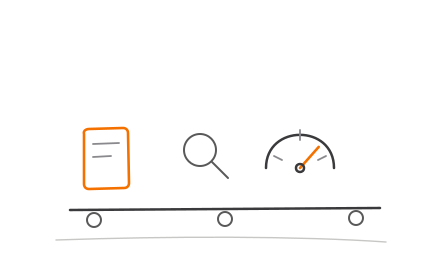
These requirements shape how an auto LOS is built. The origination process moves through predictable stages — application intake → credit scoring → underwriting → decisioning → documentation and compliance → funding — and each feature covered below accelerates or safeguards a specific point in that pipeline.

Why the Right Features Define Your Auto Lending Performance
Speed is the primary competitive variable in auto lending. According to J.D. Power's 2025 U.S. Dealer Financing Satisfaction Study, lender response time is among the top factors influencing dealer financing satisfaction and deal routing decisions. Dealers don't wait — if a lender can't respond within minutes, they move to the next one on the list.
When your loan origination system can't keep pace, the fallout compounds across multiple dimensions:
- Manual re-entry errors from disconnected systems increase stipulation requests and slow funding
- Compliance gaps create examination exposure and potential enforcement actions — the CFPB's 2024 Supervisory Highlights flagged auto finance practices around adverse action notices and fee disclosures
- Inability to scale during peak seasons forces lenders to choose between hiring and turning away volume
- Slow decisioning routes deals to competitors — fintechs and captive lenders alike — who can approve applications the same day
Each of the six features covered below addresses one or more of these failure points directly — with measurable impact on cycle times, default rates, dealer retention, and regulatory exposure.
The 6 Must-Have Features for Auto Loan Origination Systems
Feature 1: Automated Credit Scoring and AI-Powered Decisioning
A modern auto LOS should automatically pull and parse credit bureau data — from Experian, TransUnion, or Equifax — into structured financial attributes the moment an application is submitted. No manual credit requests, no re-keying.
The system should support two decisioning modes:
- Auto-decisioning: Instant approvals or declines for applications that clearly meet or miss defined thresholds
- Manual review queues: Borderline applications routed to underwriters with pre-populated risk summaries
Beyond rule-based models, machine learning adds meaningful value for auto lenders specifically. Research from FinRegLab on ML use in credit underwriting shows that ML algorithms can identify non-linear risk patterns across large datasets and incorporate alternative data sources — rental history, utility payments, bank transaction data — that traditional credit scores miss entirely.
This matters most for thin-file and non-prime auto borrowers, a segment where many lenders leave profitable volume on the table.
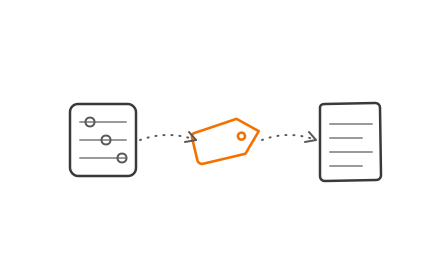
Lenders must be able to configure scoring models independently — defining scoring attributes from both application and bureau data, assigning credit grades, and mapping grades to decisioning outcomes without submitting a development ticket for each new lending product or policy change.
Feature 2: Built-In Regulatory Compliance Engine
Auto lending carries a specific and evolving compliance burden. The core requirements include:
- TILA disclosures (Regulation Z) — APR, finance charge, total of payments, and payment schedule for every vehicle loan
- Adverse action notices under ECOA/Regulation B — required within 30 days of a credit decision
- Risk-based pricing disclosures under CFPB's Regulation V — triggered when a borrower receives materially less favorable terms than other consumers
- EFTA pre-authorisation requirements for ACH payment setup
- State-specific lending regulations that vary by jurisdiction
A compliance engine should handle this automatically:
- Generate required notices and disclosures at the right stage of the origination workflow
- Store tamper-evident copies of all regulatory documents against each loan record
- Flag applications that trigger risk-based pricing rules before decisioning is finalised
- Maintain audit trails that hold up under CFPB or state regulatory examination

The critical architecture point: compliance rules change without notice. The engine must be configurable so legal or compliance teams can update logic quickly (without full redevelopment) or the lender faces both legal exposure and IT bottlenecks every time a regulation shifts.
Feature 3: Risk-Based Pricing Module
A single rate sheet across all borrowers is both a competitive and risk management problem. Risk-based pricing ties loan terms — interest rate, LTV limit, maximum loan amount — to the specific combination of borrower credit grade, loan product, vehicle type, dealer relationship, and state.
An effective pricing module should:
- Support configuration across multiple pricing parameters simultaneously
- Automatically recommend the optimal price at the decisioning step, based on live application data
- Accept bulk uploads of pricing tables from external files, reducing manual maintenance when market rates shift
- Log all pricing decisions with the inputs used, supporting fair lending analysis
Prime borrowers get rates competitive with direct lenders, while subprime pricing protects margin without manual underwriter intervention on every deal. It also reduces adverse selection — if pricing doesn't reflect actual risk, the portfolio drifts toward the borrowers who couldn't get better terms elsewhere.
Feature 4: Multi-Channel Application Intake and Dealer Portal Integration
Auto loan applications arrive through multiple channels simultaneously: dealership portals, direct online, mobile apps, phone or branch, and indirect lender platforms. An auto LOS must process all of these in real time, without creating channel-specific data silos that require manual reconciliation later.
Dealer portal integration deserves specific attention — it's an auto-specific requirement that directly affects deal routing volume. Tight dealer integration means:
- Dealers submit financing contracts, vehicle data, and customer information directly into the lender's system
- No re-keying of deal data on the lender's side
- Faster funding confirmation that strengthens the dealer relationship
Response time is often the deciding factor in deal routing. Industry data from Auto Finance News consistently shows that lenders who respond to dealer-submitted applications within minutes capture a disproportionate share of indirect volume compared to those responding in hours. Real-time application receipt with immediate credit calculation is the mechanism that makes that possible.
Feature 5: Automated Fraud Detection
Auto lending faces a distinctive fraud landscape. The most common types:
- Synthetic identity fraud — fabricated credit profiles assembled from real and fictitious data
- Straw buyer arrangements — a third party finances a vehicle for the actual buyer to circumvent credit checks
- Income and employment misrepresentation — inflated figures on application documents
- Vehicle value inflation — collateral overstated relative to actual market value
TransUnion's October 2025 auto fraud report highlights that auto fraud losses fall disproportionately on lenders serving traditionally underserved communities, underscoring both the financial and fair lending dimensions of inadequate detection.
A modern fraud detection module works as a parallel risk score alongside credit risk:
- AI flags data inconsistencies across application fields (address mismatches, employer inconsistencies, SSN patterns)
- Identity data is cross-referenced against external verification services such as LexisNexis, TransUnion TruValidate, or Experian Precise ID
- High-risk applications trigger manual review without slowing clean applications through the pipeline
- Detection logic can incorporate alternative data to catch synthetic profiles that pass bureau checks

Layering fraud detection into the decisioning workflow, rather than treating it as a separate manual step, is what separates systems that catch fraud efficiently from those that catch it too late.
Feature 6: Straight-Through Processing and Workflow Automation
Straight-through processing (STP) is the ability to take a clean, low-risk application from submission through decisioning, document generation, compliance checks, e-signature, and funding disbursement with zero manual intervention.
The workflow components that enable STP:
- Rules-based task routing — applications move to the right queue or complete automatically based on decision outcomes
- Automated document collection — stipulation requests (proof of insurance, income documentation) triggered and tracked without underwriter involvement
- E-signature integration — loan documents executed digitally at the dealer or through a borrower portal
- Automated funding triggers — disbursement initiated once all conditions clear, without a manual funding approval step
A case study from American Banker documented a credit union that transformed its loan program throughput after implementing automation — processing time reductions of this scale directly translate to higher loan volume capacity without proportional staffing increases.
For high-volume auto lenders, every manual touchpoint compounds under volume pressure. STP is what lets the origination operation grow deal flow without a proportional headcount increase — the staffing model stays flat while throughput scales.
How to Evaluate These Features Before You Build or Buy
Before committing to a platform or development approach, work through these questions:
- Does the system support your specific dealer channel model, or will integration require custom development regardless?
- Can compliance rules be updated by legal or operations staff without a developer?
- How configurable are scoring and pricing models — can your underwriting team manage them, or does every change require a vendor ticket?
- What pre-built connectors exist for Experian, TransUnion, Equifax, identity verification services, and e-signature platforms?
Off-the-Shelf vs. Custom-Built
| Factor | Off-the-Shelf | Custom-Built |
|---|---|---|
| Deployment speed | Faster (weeks to months) | Slower (months) |
| Upfront cost | Lower | Higher |
| Configurability | Limited by vendor roadmap | Full control |
| Long-term cost | Recurring licensing fees | Owned outright |
| Niche fit | Generic across loan types | Built for your credit policy |

Off-the-shelf platforms work well when your credit policies are straightforward and your dealer network is mainstream. If you operate in niche markets — subprime auto, fleet financing, specialty vehicles — or expect to scale aggressively, a custom-built LOS tends to deliver stronger long-term returns. You own the logic, control the roadmap, and never wait on a vendor's release cycle to ship a policy change.
How Codiot Helps Build Smarter Auto Loan Origination Systems
Codiot is a technology partner specialising in AI and custom software, with experience delivering end-to-end digital solutions for finance and private lending operations — spanning system architecture, data engineering, UI/UX, and Salesforce integration.
For auto LOS development, Codiot's approach centres on building systems that lenders actually own and can manage. That means designing for configurability from day one, so compliance officers and underwriters can update business rules without raising a development request.
Core capabilities built into each engagement include:
- AI-powered decisioning and fraud detection embedded directly into origination workflows
- Configurable rule engines that non-technical teams can manage and adjust independently
- Multi-channel intake and dealer portal integration modelled around the lender's specific channel structure, not a generic template
Together, these capabilities produce a system aligned to the lender's credit policies and growth trajectory — not a licensed platform that pulls you back into vendor dependency every time business rules change.
Frequently Asked Questions
What is a loan origination system?
A loan origination system (LOS) is software that automates the end-to-end process of creating a loan — from application intake through credit evaluation, underwriting, compliance, and funding. It helps lenders reduce manual effort, improve accuracy, and process applications faster.
What is the difference between LOS and POS?
A Point of Sale (POS) system handles the front-end borrower application experience, typically at the dealership or on a lender's website. The LOS handles back-end processing, decisioning, compliance, and funding. The two are often integrated but serve distinct functions.
What is an origination fee on an auto loan?
An origination fee is a one-time charge by the lender to cover the cost of processing and underwriting the auto loan, typically expressed as a flat fee or percentage of the loan amount. It is usually included in the loan's APR and disclosed under TILA requirements.
What makes auto loan origination different from other loan types?
Auto lending requires vehicle collateral valuation, dealer channel integration, VIN-level data handling, and auto-specific regulatory disclosures. A generic LOS treats these as add-ons rather than core functionality, creating gaps that affect decisioning speed and compliance accuracy.
How long does auto loan origination take with a modern LOS?
Modern AI-powered auto LOS platforms can complete credit decisioning in seconds for clean applications. Full straight-through processing, from application to funding authorization, is achievable in minutes to hours, compared to days or weeks with manual or legacy systems.
Can an auto loan origination system be customised for different lender types?
Yes. A well-architected LOS supports configurable credit policies, scoring models, pricing rules, and compliance logic — making it adaptable for banks, credit unions, captive finance companies, and independent auto lenders with different risk profiles and product sets.