Automated Loan Origination Systems for Streamlined Lending

Introduction

For any lender still running manual origination, the borrower experience tells the story clearly: weeks of waiting, repeated document uploads, re-keyed data, and status updates that arrive by email — if at all.

According to McKinsey, traditional banks averaged 3–5 weeks for small-business loan decisions, while leading digital lenders brought "time to yes" down to 5 minutes. For lenders still operating manually, that gap is a direct competitive liability.

Automated loan origination systems (LOS) are built to close it. This guide covers:

  • What an automated LOS is and how it works
  • Why manual origination breaks down at scale
  • How automation functions at each stage of the loan lifecycle
  • Which features matter most when evaluating platforms
  • How to decide whether to buy or build

TLDR

  • An automated LOS is a digital platform that manages the full loan lifecycle using rules-driven, AI-assisted workflows
  • Manual origination is slow, error-prone, and non-scalable; most banks still achieve less than 50% straight-through processing in reconciliations
  • Automation compresses multi-day approval cycles into hours by removing manual handoffs and stage delays
  • Key benefits: faster decisions, cleaner data, built-in compliance, better borrower experience, and scalable operations
  • Build vs. buy depends on your loan complexity, borrower segment, and need for proprietary credit models

What Is an Automated Loan Origination System?

An automated LOS is a digital platform that manages the full loan lifecycle — from application intake and credit assessment through underwriting, decisioning, and disbursement. It replaces fragmented manual steps with structured, rules-driven workflows that reduce processing time and compliance risk.

LOS vs. Loan Management Software

These are frequently confused, but they cover different parts of the lending lifecycle:

System Scope
Loan Origination System (LOS) Pre-disbursement: application intake, document collection, credit analysis, underwriting, approval, funding
Loan Management/Servicing Software Post-disbursement: repayment tracking, collections, account modifications, statements

Some platforms combine both. Gartner defines commercial loan origination solutions as software that enables lending institutions to manage the end-to-end commercial loan origination process — a useful benchmark for scope.

Who Needs an Automated LOS?

  • Banks and NBFCs processing high loan volumes across multiple branches
  • Fintech lenders competing on speed and digital experience
  • Credit unions managing diverse loan product portfolios
  • Private lending operations with complex multi-step approval workflows
  • Any institution where manual handoffs are creating pipeline bottlenecks or compliance risk

The Problem with Manual Loan Origination

Manual loan origination compounds problems across data quality, compliance, and scalability — well before volume pressure even enters the picture.

Data Entry Errors and Reconciliation Overhead

When loan data moves between CRM systems, credit teams, underwriting spreadsheets, and booking platforms through manual re-entry, errors accumulate at every handoff. McKinsey's 2024 analysis of corporate loan operations found that best-in-class institutions achieve 80–90% straight-through processing in reconciliations, while most banks remain below 50%. That gap represents enormous rework, duplicate records, and inconsistent credit decisions.

Data silos between front-office CRM, risk teams, and compliance functions compound this further. Without a shared system of record, different loan officers routinely reach different decisions on comparable applications, creating fairness risk and inconsistent approval rates across branches.

Compliance and Scale Ceilings

Manual processes create two hard limits:

  • Compliance exposure: Inconsistent process adherence across loan officers increases fair-lending risk. ECOA and FHA regulations prohibit discrimination in credit decisions, and inconsistent manual processes are hard to defend in an audit.
  • Hiring your way to capacity: To process more loans manually, you hire more people. Productivity gains from new commercial-loan operations staff typically take 1–2 years to materialize, making headcount-driven scaling both slow and expensive.

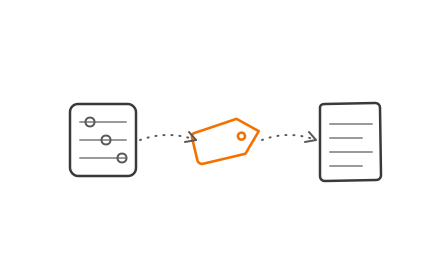
Manual loan origination two key failure points compliance risk and hiring bottleneck

How an Automated Loan Origination System Works

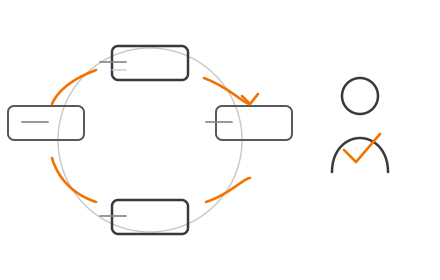
A well-designed LOS moves through five distinct stages, each targeting a specific source of manual delay.

Stage 1 — Application Intake & Customer Onboarding

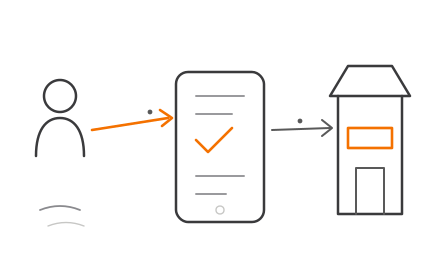
Digital borrower portals allow applicants to submit information online, with the system pre-populating fields from known data, validating inputs in real time, and routing complete versus incomplete applications automatically.

The target for a well-designed SME lending journey: a 15-minute application with document uploads, a benchmark from McKinsey's redesigned SME lending framework.

eKYC integrations further compress onboarding. World Bank research found Bangladesh's digital KYC implementation reduced onboarding from 4–5 days to 5 minutes.

Stage 2 — Document Collection & Verification

Borrowers upload financial statements, identity documents, and income proofs directly through the portal. OCR and machine learning tools extract data from those documents into structured fields, eliminating manual financial spreading. Documents are version-controlled and linked to the audit trail, giving authorised teams instant access without email chains.

Key capabilities at this stage:

  • Automated OCR extraction from uploaded financial statements and identity documents
  • Structured field mapping that eliminates manual data spreading
  • Audit-ready document versioning accessible to all authorised reviewers

Stage 3 — Credit Analysis & Risk Scoring

The system pulls data from integrated credit bureaus, accounting APIs, and bank transaction feeds to run automated financial analysis and risk scoring. In India, this means integrating with the four RBI-recognised Credit Information Companies — CIBIL, Equifax, Experian, and CRIF High Mark — all of which offer API access for real-time credit data retrieval.

Automated data retrieval at this stage is where the biggest time savings occur. McKinsey's 2022 SME lending research found that standardised documentation and automated data retrieval can reduce "time to yes" by 50% or more.

Stage 4 — Underwriting & Decision Engine

Rules-based and AI-driven decision engines assess aggregated borrower data against lender-defined credit policies to generate one of three outcomes:

  • Automated approval — for applications meeting all defined criteria
  • Automated decline — for applications falling outside policy parameters
  • Refer to underwriter — for complex or edge cases requiring human review

This approach is particularly valuable for high-volume, lower-value loans that don't warrant manual review, freeing analyst capacity for complex transactions. Suspected digital fraud attempts have risen 80% globally from pre-pandemic levels (TransUnion, 2023), making robust fraud detection logic at this stage essential.

Stage 5 — Approval, Documentation & Funding

Approved applications trigger automated generation of loan offer documents, e-signature workflows, compliance checks (including Key Fact Statement requirements under RBI's 2022 digital lending guidelines), and disbursement instructions. The target benchmark: contract signing, ID check, and cash-out all within 24 hours, with a complete, audit-ready trail captured at every step.


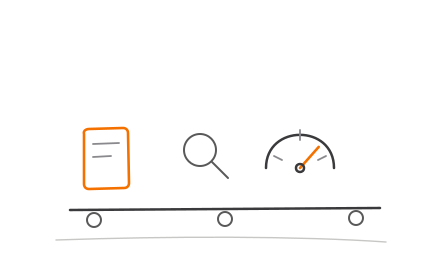
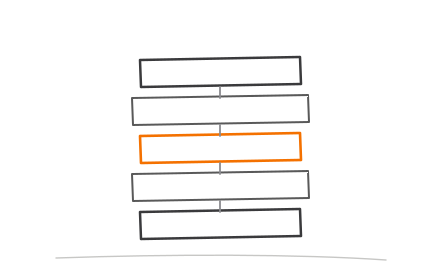
5-stage automated loan origination system workflow from intake to disbursement

Key Benefits of Automating Loan Origination

Faster Credit Decisions

Automation eliminates handoff delays, re-keying, and waiting periods between stages. Digitising SME lending journeys can deliver 20–30% operational efficiency gains and increase revenue by 10–15% through higher conversion, according to McKinsey's 2022 research. Non-bank lenders already demonstrate the ceiling: J.D. Power's 2024 consumer lending study found 68% of non-bank customers received funding within one day, versus 58% at banks.

Improved Data Integrity

A single, centralised origination platform with automated data flows means every team — credit, risk, compliance, operations — works from one verified source. This eliminates:

  • Duplicate records across departments
  • Reconciliation overhead from mismatched spreadsheet versions
  • Version-control disputes between teams

Regulatory Compliance Built In

Automated LOS platforms embed KYC, AML screening, and disclosure requirements directly into the workflow. RBI's digital lending guidelines require lender-facing safeguards including Key Fact Statements before loan execution — configuring these as automated workflow steps is far more reliable than relying on individual loan officer adherence. When regulations change, rules update centrally, removing the need to retrain loan officers across distributed teams.

Scalability Without Proportional Headcount Growth

Modernising loan operations can boost productivity by 20–50% (McKinsey, 2024). For fintech startups and private lenders scaling volume, this means the loan book can grow without adding headcount at the same rate — a concrete edge over manual lenders that face linear cost increases as volume rises.


Must-Have Features in a Modern Automated LOS

Not all LOS platforms are equal. These are the capabilities that separate functional automation from genuinely competitive systems.

AI-Powered Decision Engine

A strong decision engine does more than apply fixed approval rules — it scores, adapts, and flags risk in real time. Key requirements:

  • Risk scoring models that incorporate alternative data sources
  • Fraud detection logic that identifies anomalous application patterns
  • Adaptive models that improve as more portfolio data accumulates

Configurable Workflow Automation

Lenders' processes vary by loan type, geography, and risk appetite. A good LOS supports no-code or low-code workflow configuration — letting credit teams adjust routing rules, approval thresholds, and task assignments without requiring development work for every policy change.

Integrated Document Management with OCR

Built-in document collection and OCR-based data extraction should:

  • Reduce manual financial spreading to near zero for standard document types
  • Keep documents version-controlled and linked to the audit trail
  • Restrict access by role with full permission logging

Third-Party API Integrations

The breadth of pre-built connectors directly affects implementation speed and data richness. Priority integrations for Indian lenders include:

  • Credit bureaus: CIBIL, Equifax, Experian, CRIF High Mark — all with API access
  • KYC/AML services: RBI-compliant CDD verification
  • e-signature tools: For sub-24-hour contract execution
  • Core banking systems: For seamless disbursement and account creation

Real-Time Analytics and Reporting

Pipeline status, approval rates, processing times, risk concentration, and covenant tracking should be visible in a unified analytics layer — not assembled manually from multiple system exports. When origination data flows into one reporting environment, teams can spot concentration risk or bottlenecks before they compound.


Building vs. Buying: Choosing the Right LOS Approach

The build-vs-buy decision shapes every downstream aspect of your lending operations — speed to market, integration depth, and how much control you retain over credit logic.

Off-the-Shelf vs. Custom-Built

Factor Off-the-Shelf LOS Custom-Built LOS
Deployment speed Faster (standardised setup) Longer initial build
Configurability Limited to vendor's framework Full flexibility
Integration depth Pre-built connectors, but fixed Purpose-built for your stack
Credit model Generic Proprietary, competitive
Cost structure Lower upfront, ongoing licensing Higher upfront, lower recurring

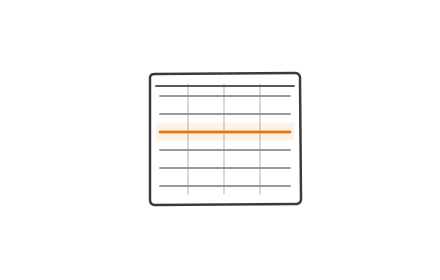
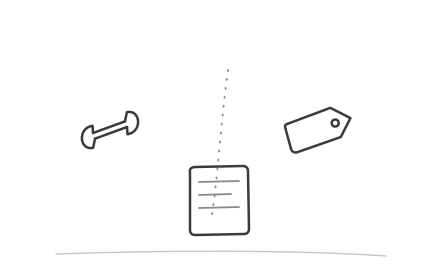
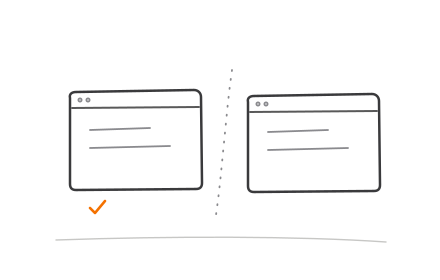
Off-the-shelf versus custom-built loan origination system side-by-side comparison infographic

Questions to Answer Before Deciding

  1. What is the volume and complexity of loans being processed?
  2. Are your workflows standard, or do they involve specialised credit models?
  3. Do you need to launch new loan products rapidly?
  4. Is deep integration with proprietary data systems or non-standard bureaus required?
  5. Do you serve a niche borrower segment where a generic UX creates friction?

For standard SME or consumer lending workflows, off-the-shelf platforms can accelerate time-to-market without heavy engineering investment.

For fintech startups, NBFCs, and private lenders with unique credit models or niche borrower segments, a custom-built system delivers proprietary decisioning and borrower journeys that off-the-shelf platforms are not designed to support. Working with a technology partner like Codiot gives lending teams the flexibility to define those workflows rather than inherit them.

Codiot's experience in data engineering and custom software for the finance sector means lending builds can incorporate purpose-built risk scoring, OCR-based document extraction, and bureau API integrations. The UI/UX is designed around specific borrower journeys from the start, not retrofitted to a vendor's defaults.


Frequently Asked Questions

What is the difference between a loan origination system and loan management software?

An LOS handles the pre-disbursement lifecycle : application intake through funding. Loan management or servicing software handles post-disbursement activities — repayment tracking, collections, and account modifications. Some platforms combine both end-to-end.

How long does it take to implement an automated loan origination system?

Off-the-shelf cloud platforms can deploy in 2–4 months with standard configurations. Custom-built or heavily integrated systems typically take 4–9 months, depending on complexity, existing infrastructure, and data migration requirements.

Can small lenders or fintech startups benefit from an automated LOS?

Automated LOS platforms are particularly valuable for smaller lenders and fintechs. They deliver consistent, high-quality lending decisions at scale without requiring the large operational teams that traditional banks rely on — so smaller players can compete on process quality, not headcount.

What role does AI play in automated loan origination?

AI powers fraud detection, risk scoring, document data extraction via OCR/ML, and adaptive decision engines that improve accuracy with each cycle. This moves the system beyond rule-based automation into lending decisions that actually learn from outcomes.

What are the biggest challenges in automating loan origination?

The main challenges are: data migration from legacy systems, integration complexity with existing core banking infrastructure, change management for lending teams, and ensuring the decision engine's rules remain aligned with regulatory requirements across geographies.

Is it better to build a custom LOS or use an off-the-shelf solution?

It depends on complexity, volume, and differentiation needs. Off-the-shelf suits standard workflows and faster deployment. Custom builds are better for lenders with specialised credit models, unique borrower segments, or a need for proprietary features that generic vendors cannot support.