Understanding Business Analytics vs Data Analytics: Key Differences

Introduction

Many business leaders face the same frustrating situation: they have access to more data than ever, yet still struggle to make confident decisions. A 2019 Deloitte survey of over 1,000 executives found that 67% were not comfortable accessing or using data from their current resources, and 62% of large companies still relied on spreadsheets.

The root of that problem often isn't a lack of data: it's usually confusion about which type of analytics they actually need.

Business analytics and data analytics sound interchangeable, but they answer fundamentally different questions. Confusing the two leads to real consequences: teams built around the wrong skill sets, tools that don't fit the actual workflow, and decisions that arrive too late to matter.

This article breaks down exactly what separates the two, where they overlap, and how to decide which one your business actually needs right now.


Key Takeaways

  • Business analytics applies data directly to business decisions; data analytics extracts patterns from data across any domain or industry
  • The core difference: business analytics is outcome-focused, data analytics is technique- and exploration-focused
  • Both share overlapping tools and skills but diverge in scope, audience, and the questions they answer
  • Early-stage businesses get faster ROI from business analytics; data analytics becomes valuable once data infrastructure is in place

Business Analytics vs Data Analytics: Quick Comparison

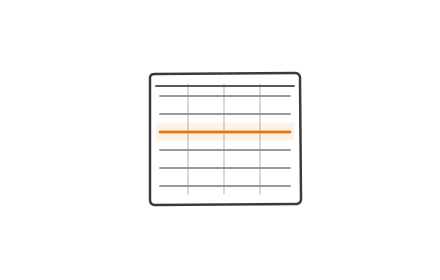
Dimension Business Analytics Data Analytics
Primary Goal Improve business decisions and performance Extract patterns and insights from data
Focus Area Strategy, operations, planning Data processing, modelling, exploration
Techniques Used Forecasting, reporting, optimisation Statistical analysis, ML, data mining, SQL
Scope Business-context applications Any domain: business, science, healthcare
Primary Audience Executives, managers, operations teams Data teams, researchers, product teams
Typical Output Dashboards, forecasts, recommendations Models, cleaned datasets, statistical reports

In practice, these fields overlap significantly. Many organisations deploy both together, and a single analyst often performs both functions. The table above highlights tendencies, not rigid boundaries.


What is Business Analytics?

INFORMS describes analytics as the practice of transforming data into information and insights for better decisions and improved results — and business analytics is exactly that, but anchored entirely to a business context.

Business analytics uses data to answer the questions that drive commercial decisions: which customer segments are churning, which product lines deserve investment, and how much inventory is needed next quarter.

The Four Core Methodologies

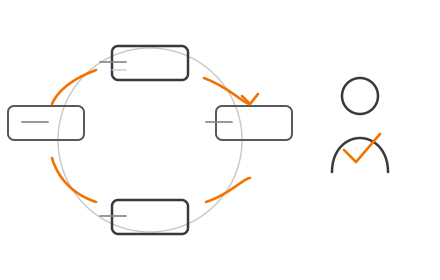
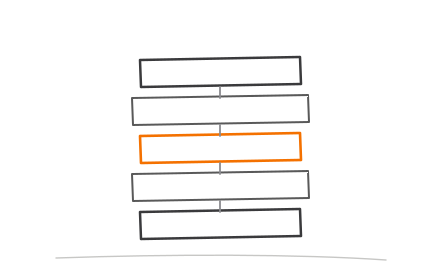
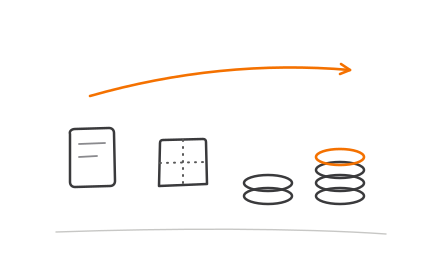
Business analytics operates across four analytical layers:

  1. Descriptive analytics: What happened? (Sales were down 12% in Q3)
  2. Diagnostic analytics: Why did it happen? (Regional pricing was misaligned with competitors)
  3. Predictive analytics: What will happen? (Demand will spike 30% in Q4 based on historical patterns)
  4. Prescriptive analytics: What should we do? (Adjust inventory levels and promotional spend accordingly)

Four types of business analytics process flow from descriptive to prescriptive

Business analytics leans heavily on predictive and prescriptive methods — the stages where data stops describing the past and starts shaping decisions about the future.

Key Skills and Tools

Executing across these layers requires a blend of technical and commercial capabilities:

  • Build dashboards and reports using Tableau or Power BI
  • Develop forecasting models with Excel or specialist planning software
  • Translate data findings into executive-ready recommendations
  • Apply business acumen: KPIs, financial drivers, and operational constraints

This is distinct from technical programming skills. A business analytics professional doesn't necessarily write machine learning code — they interpret outputs and translate them into decisions.

Business Analytics Use Cases

Common applications inside organisations include:

  • Sales forecasting and pipeline planning
  • Customer segmentation and lifetime value analysis
  • Marketing ROI and campaign performance measurement
  • Supply chain and inventory optimisation
  • Financial planning and budget modelling
  • Workforce performance and capacity planning

Real-world example: DER Touristik, a major European travel group, switched from conventional demand forecasting to analytics-driven methods. Their conventional forecasts missed actual bookings by 20–25%; after implementing SAS Visual Forecasting, the deviation dropped to just 3%. For a travel group managing hotel capacity across hundreds of destinations, that level of forecast accuracy directly determines whether rooms go unsold or guests go unaccommodated.


What is Data Analytics?

Gartner defines data and analytics as managing data for all uses and analysing it to improve decisions, business processes, and outcomes. The critical word here is "all uses" — data analytics is not confined to business contexts.

A genomics lab, a government agency, a fintech startup, and a climate research institution all practise data analytics. The discipline is about the craft of working with data: collecting it, cleaning it, transforming it, and pulling meaningful signal from it.

Core Technical Techniques

Data analytics professionals work with:

  • Statistical analysis — identifying distributions, correlations, and significance
  • Data mining — discovering patterns in large datasets without a predefined hypothesis
  • Machine learning — building models that improve predictions over time
  • Data wrangling — cleaning, transforming, and preparing messy raw data
  • Database querying — SQL, Python, R for extracting and manipulating data at scale

The emphasis is on the how of working with data — whether the analysis is technically sound, not just whether it supports a predetermined conclusion.

Roles in Data Analytics

Three roles define most data analytics teams:

  • Data engineers build and maintain the pipelines and infrastructure that move data where it needs to go
  • Data scientists develop predictive models and apply machine learning to complex problems
  • Data analysts interpret data, visualise results, and surface actionable insights from processed datasets

Together, these roles cover the full journey from raw data infrastructure to decision-ready insight — which is where business analytics picks up.

Data Analytics Use Cases

Data analytics is applied wherever large or complex datasets need to be processed and understood:

  • Website traffic and user behaviour analysis
  • Anomaly and fraud detection in financial transactions
  • A/B testing for product and marketing decisions
  • Building recommendation engines for e-commerce
  • Processing sensor data from IoT devices
  • Real-time monitoring of operational systems

Real-world example: Mastercard's 2024 AI enhancements to its fraud detection system boosted detection rates by 20% on average and reduced false positives by more than 85%. That result required processing billions of transactions, detecting subtle behavioural deviations, and scoring in near real time — a data analytics problem at scale.


Key Differences Between Business Analytics and Data Analytics

The cleanest way to distinguish the two is by where they start.

Business analytics starts with a business question. "How do we reduce churn?" "Where should we allocate budget next quarter?" "Which customers are most likely to convert?" The question drives the analysis.

Data analytics often starts with the data itself. "What patterns exist in this dataset?" "Are there anomalies we should flag?" "Can we build a model that predicts X?" The data drives the exploration.

That difference in starting point shapes everything: the skills hired, the tools used, the outputs produced, and the stakeholders served. Understanding how they relate in scope makes that clearer.

Scope and Relationship

Data analytics is the broader umbrella. Business analytics sits within it — a focused, applied form of analytical practice directed at business performance.

All business analytics draws on data analytics techniques, but not all data analytics serves business strategy purposes. The distinction is intent: one starts with a question, the other starts with a dataset.

Audience and Communication

This is where the practical difference shows up most clearly:

  • Business analytics outputs are packaged for non-technical stakeholders — dashboards, board reports, revenue forecasts, strategic recommendations
  • Data analytics outputs may be more technical — statistical models, data pipelines, anomaly detection reports, ML model performance metrics

A business analytics professional needs to present findings to a CFO. A data analytics professional might be presenting findings to a data science team.

Hybrid Territory

In many organisations — especially SMEs — a single person covers both functions. The rise of the Business Intelligence (BI) analyst role reflects this convergence: someone who can handle the technical work of querying and transforming data and translate findings into business recommendations.

Modern AI-powered analytics platforms are accelerating this convergence, making it easier for businesses to access both technical analysis and strategic insight without needing separate specialist teams for each.


Which Type of Analytics Does Your Business Need?

The honest answer: it depends on where you are and what problem you're trying to solve.

Start with Business Analytics If...

  • Your primary goal is improving decisions, not building data infrastructure
  • You're a startup or SME needing quick, actionable insights from existing data
  • Your leadership team wants dashboards, forecasts, and operational reporting
  • You don't yet have complex datasets or ML requirements

Business analytics delivers faster time-to-value for most organisations at early and mid-growth stages. Most companies start here — descriptive reporting and planning dashboards — before building toward advanced predictive capabilities.

Move Into Data Analytics When...

  • You're dealing with large, high-velocity, or complex datasets
  • You need to build predictive models or automate data pipelines
  • Your product depends on ML capabilities (recommendation engines, fraud detection)
  • You have a maturing data infrastructure that needs specialist engineering

The Performance Case for Getting This Right

The financial case for getting this right is well-documented. Brynjolfsson, Hitt, and Kim's study on data-driven decision-making found firms using data-driven approaches had output and productivity 5–6% higher than expected — a measurable premium over comparable organisations.

The gap between intent and execution, though, is significant:

  • Only 10% of organisations have reached the highest tier of analytics maturity (Deloitte)
  • 63% remain stuck in the lower stages, still building foundational capabilities
  • 77% of companies lack the data talent and skill sets needed to progress (McKinsey, 2024)
  • Only 12% have active programmes in place to build that capability

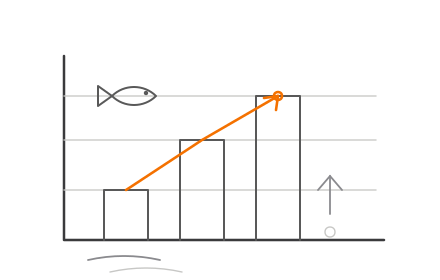
Analytics maturity gap statistics showing percentage of organizations at each capability level

For businesses that want to close this gap without assembling an in-house team from scratch, a technology partner covering end-to-end data engineering and AI-driven analytics — Codiot works across both functions — can bridge the distance between raw data and real business outcomes.


Frequently Asked Questions

Which is better: big data analytics or business analytics?

Neither is universally better. Big data analytics focuses on processing and finding patterns in massive, high-velocity datasets; business analytics focuses on applying insights to improve business decisions. Most mature organisations use both together, with big data analytics powering the back end and business analytics driving strategy.

What are the four types of data analytics?

The four types are descriptive (what happened), diagnostic (why it happened), predictive (what will happen), and prescriptive (what should be done). All four appear in both disciplines, but business analytics leans most heavily on predictive and prescriptive methods.

Can a business use both business analytics and data analytics together?

Yes — and most do. Data analytics handles the technical work of processing and analysing raw data; business analytics takes those outputs and applies them to decisions around budgeting, forecasting, and growth strategy. In practice, they function as two layers of the same pipeline.

What is the difference between a data analyst and a business analyst?

A data analyst works on processing, cleaning, and interpreting data using tools like SQL, Python, and statistical methods. A business analyst applies data insights to solve business problems and make strategic recommendations.

What tools are commonly used in business analytics vs data analytics?

Business analytics commonly uses Tableau, Power BI, Excel, and forecasting platforms. Data analytics relies more heavily on Python, R, SQL, machine learning libraries, and big data technologies. Many tools — particularly visualisation and reporting platforms — overlap across both disciplines.