The distinction between a Loan Origination System (LOS) and a Loan Management System (LMS) isn't semantic. It's operational. Confusing the two — or assuming one can substitute for the other — creates compliance gaps, servicing errors, and borrower experience failures that compound over time.
This guide breaks down what each system does, where one ends and the other begins, and how they work together across the full loan lifecycle.
TL;DR
- LOS handles pre-funding: application intake, underwriting, compliance checks, and disbursement
- LMS takes over post-funding: payments, collections, delinquency tracking, and portfolio reporting
- The two systems serve different teams and operate on completely different timescales
- Most scaling lenders (fintechs and NBFCs included) need both systems running in sync
What Is a Loan Origination System (LOS)?
Gartner defines commercial loan origination solutions as software that enables lending institutions to manage the end-to-end process of opening lending products — covering evaluation, approval, settlement, documentation, creditworthiness assessment, and risk and collateral management.
Put simply: an LOS exists to get a loan from application to funded, as accurately and quickly as possible.
Key Steps in the LOS Workflow
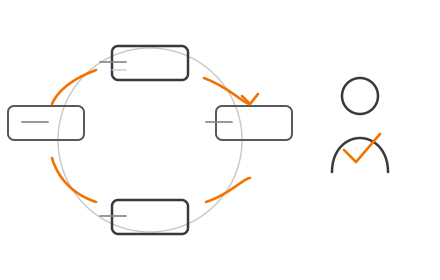
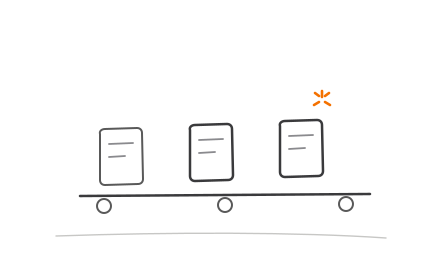
A modern LOS moves a loan application through five sequential stages:
- Application intake — Borrower data capture, document upload, and identity verification
- Credit scoring and risk assessment — Bureau pulls, internal scoring models, and risk flags
- Underwriting — Eligibility determination based on income, collateral, and policy rules
- Compliance checks — KYC/AML verification, disclosure generation, fair lending validation
- Approval and disbursement — Conditional approvals, e-signatures, and fund release

McKinsey reports that leading digital lenders have brought "time to yes" down to 5 minutes and "time to cash" to less than 24 hours — a benchmark that well-configured LOS automation can realistically hit.
Core Features of a Modern LOS
- Automated underwriting rules engine
- KYC/AML compliance modules with eKYC, video KYC, and DigiLocker support
- Credit bureau integration (CIBIL, Experian, Equifax, and others)
- Digital document handling and e-signature workflows
- Rule-based workflow automation for routing and escalations
- Regulatory compliance enforcement — covering RBI guidelines, fair lending norms, and jurisdiction-specific disclosure requirements
India's NBFC sector offers a useful adoption snapshot. The KPMG/CII 2024 report found that at one leading NBFC, 60% of loan agreements were executed through e-Stamping and 46% were digitally signed — a direct result of LOS-driven digitisation reshaping how agreements are executed.
Who Uses an LOS?
Primary users are loan officers, underwriters, risk managers, and compliance teams. Their interaction with the LOS is intensive but time-limited — typically days or weeks per loan, ending at disbursement.
What Is a Loan Management System (LMS)?
An LMS is the long-term system of record — a loan might spend two weeks in an LOS and ten years in an LMS. Gartner defines a Loan Management System as a digital platform that automates and streamlines the loan lifecycle, covering servicing, reporting, customer care, syndication, and customer monitoring.
It serves as the central repository for customer information and financial statements across the entire loan term.
Key Functions of an LMS
| Function | What It Covers |
|---|---|
| Payment processing | Posting payments, handling prepayments, tracking balances |
| Amortisation tracking | Interest calculations, principal reduction, schedule maintenance |
| Delinquency management | Early-stage alerts, dunning workflows, collections escalation |
| Borrower account management | Statements, payoff quotes, modification requests |
| Escrow handling | Tax and insurance disbursements (where applicable) |
| Regulatory reporting | Audit trails, compliance documentation, investor reporting |
One data error in a payment posting, left uncorrected, compounds across every subsequent statement. Because an LMS operates continuously — sometimes for decades — accuracy and auditability carry real financial consequences.
Features That Define a Strong LMS
- Automated payment reminders and multi-channel dunning (SMS, email, portal)
- Borrower self-service portal for statements, payments, and requests
- Real-time performance dashboards for servicing and operations teams
- Built-in compliance reporting for collections regulations (FDCPA/Reg F, RBI recovery guidelines)
- Investor reporting and portfolio analytics for private lenders and NBFCs managing large loan books
These features directly affect collections outcomes. McKinsey's research on digital collections found that digital-first borrowers are 30% more likely to make payments in late delinquency when contacted through preferred channels, and that digital collections can reduce credit losses by 10–20% while cutting operating costs by 20–30%.
Who Uses an LMS?
Servicing teams, collections staff, customer support, and operations managers. Unlike LOS users who interact with a loan in a burst, LMS users work within the system daily, across the entire loan term.
LOS vs. LMS: Key Differences Explained
The simplest summary: an LOS creates loans; an LMS manages them. They are not interchangeable.
Side-by-Side Comparison
| Dimension | LOS | LMS |
|---|---|---|
| Lifecycle stage | Pre-funding | Post-funding |
| Primary goal | Approval and disbursement | Ongoing servicing |
| Duration of use | Days to weeks per loan | Years per loan |
| Core users | Underwriters, loan officers | Servicing, collections, operations |
| Key KPIs | Time-to-fund, approval rate | Collections efficiency, delinquency rate |
| Data focus | Risk and eligibility | Payment history, portfolio performance |

The Operational Risk of Confusing the Two
When lenders expect their LOS to handle long-term servicing — or rely on their LMS to backfill origination data — the consequences are concrete and well-documented.
The CFPB's Supervisory Highlights (Issue 24, 2021) identified systemic problems caused by faulty LOS data transfers, including:
- LOS programming changes producing inaccurate debt-to-income ratios
- Credit-scoring fields corrupted during transfer to reporting systems
- Student-loan servicers failing to honour existing income-based repayment terms after transfer
- Disconnected mortgage servicing systems contributing to dual-tracking violations
These failures share a common root: origination and servicing data that wasn't cleanly separated, accurately transferred, or maintained in purpose-built systems.
Compliance Considerations for Each System
The examples above also illustrate a deeper problem — each system carries distinct regulatory obligations, and neither can absorb the other's compliance burden cleanly. The split varies by jurisdiction, but the pattern holds:
LOS compliance obligations:
- ECOA/Regulation B — non-discrimination in credit evaluation (US)
- TILA/Regulation Z — APR disclosures, finance charges, mortgage statements (US)
- HMDA/Regulation C — mortgage lending data collection and reporting (US)
- RBI Fair Practices Code — sanctioned loan terms communicated in writing to borrowers (India)
LMS compliance obligations:
- FDCPA/Regulation F — debt collection practices (US)
- CFPB Bulletin 2020-02 — servicing transfer accuracy and borrower protection (US)
- RBI recovery agent guidelines — handling borrowers with care during collections (India)
This regulatory separation is one of the strongest arguments for purpose-built systems at each stage. When one platform attempts to satisfy both sets of obligations, compliance gaps tend to appear precisely at the handoff point — where origination data becomes servicing data.
How LOS and LMS Work Together in the Loan Lifecycle
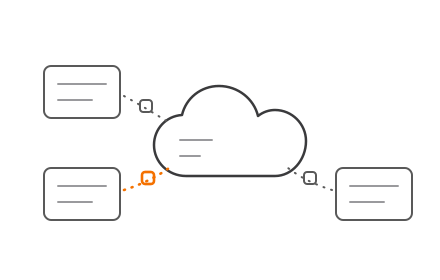
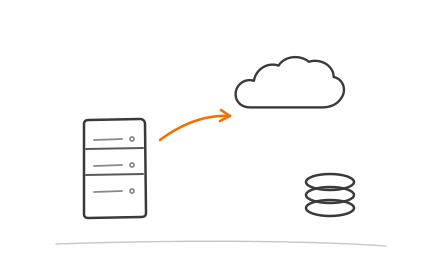
The handoff moment is where many lending operations break down. When a loan is funded in the LOS, the following data must transfer cleanly to the LMS:
- Borrower identity and contact details
- Approved loan terms and repayment schedule
- Disbursement amount and date
- Underwriting notes and conditions
- Compliance documentation
The quality of this handoff determines whether servicing runs smoothly from day one. Poor data transfer means servicing teams spend months reconciling records manually — and that inefficiency compounds quickly across a growing loan book.
How lenders architect the connection between these two systems directly shapes how reliable that handoff becomes.
Integration Approaches
Three main methods exist for connecting LOS and LMS platforms:
- Real-time API-based sync — Preferred for accuracy; loan data transfers immediately at funding with no lag or manual intervention
- Middleware/ESB connectors — Common in modular enterprise setups; adds flexibility but introduces additional failure points
- Nightly batch transfers — Widely used but lag-prone; creates a window where the two systems hold different data

MISMO's Servicing Transfer Catalog provides a standardised framework for residential mortgage loan data exchange between origination and servicing systems — and in 2025, MISMO released a dedicated Loan Boarding Dataset specifically to address costly errors occurring during servicing transfers.
For lenders evaluating architecture, McKinsey's banking technology research notes that modular, API-enabled architectures can deliver new solutions in 3–4 months, compared with 9–18 months for legacy system changes — a gap that materially affects how quickly lenders can respond to product or regulatory changes.
Some lenders opt for unified end-to-end platforms combining LOS and LMS in a single system. Others prefer best-of-breed tools connected via clean APIs. The right architecture depends on loan product complexity, team structure, and compliance requirements — but in either case, the integration layer is what protects data integrity across the loan lifecycle.
What to Consider When Building or Implementing These Systems
Fintech startups, NBFCs, and private lenders face a foundational decision: buy an off-the-shelf platform, customise an existing solution, or build a custom system tailored to specific loan products and compliance requirements.
Three evaluation criteria matter most:
- Scalability — Can the system handle 10x your current loan volume without a rebuild? India's NBFC sector reached USD 326B as of early 2024, and platforms that can't scale will require costly rebuilds at the worst possible time.
- Integration readiness — Does it connect cleanly with credit bureaus, payment gateways, eKYC providers, and regulatory reporting infrastructure?
- AI capability — LOS platforms increasingly automate credit decisions and fraud detection, while LMS platforms use AI for predictive delinquency management and portfolio risk forecasting. A 2024 FCA and Bank of England survey found 75% of UK financial services firms already using AI — a trend accelerating across financial markets globally — with credit underwriting, fraud prevention, and AML among the leading use cases.

Navigating these decisions — especially around integration depth and AI readiness — is where the right technology partner makes a measurable difference. Codiot works with fintech startups, private lenders, and financial enterprises to design and build lending technology solutions — spanning UI/UX and application workflows to data engineering and Salesforce integrations — built around specific lending models and compliance environments.
Frequently Asked Questions
What is the difference between a loan management system and a loan origination system?
An LOS manages the pre-funding process — application intake, underwriting, and approval. An LMS manages post-funding activity — payments, servicing, and collections. They cover different stages of the loan lifecycle and are designed for different teams and purposes.
What is a loan origination system?
A Loan Origination System is software that automates the front-end lending process, from borrower application through credit assessment, compliance verification, and fund disbursement. It is primarily a decision-making and compliance tool used before a loan is funded.
What is a loan management system?
A Loan Management System manages a loan after disbursement — handling payment processing, balance tracking, delinquency management, and regulatory reporting over a term that may span years or decades.
Can one system handle both loan origination and loan management?
Some unified platforms offer both functions. Many lenders still use separate specialised systems for greater depth and flexibility, with API integration ensuring clean data flow between them. The right approach depends on product complexity and scale.
How does AI improve loan origination and management systems?
AI enables automated credit decisioning, fraud detection, and faster approvals at the origination stage. On the servicing side, it supports predictive delinquency management, dunning workflows, and portfolio risk forecasting — cutting manual workload across both functions.
Do fintech startups and private lenders need both an LOS and an LMS?
Most scaling lenders benefit from both. An LOS drives faster, compliant loan creation; an LMS protects long-term portfolio performance. Even early-stage lenders should plan for both to avoid costly gaps as volume grows.