Introduction
Lending teams at banks, NBFCs, and private lenders know the pain well: applications pile up in email inboxes, credit analysts chase documents manually, compliance checks get missed, and borrowers abandon the process out of frustration. In a market where digital-first lenders can now deliver a "time to yes" in five minutes and disburse funds in under 24 hours, traditional workflows are no longer just inefficient — they're a competitive liability.
That pressure is reshaping investment priorities. The global loan origination software market stands at USD 8 billion in 2025 and is projected to reach USD 20.6 billion by 2034, growing at 11.1% CAGR. For India, the numbers are even more striking — the digital lending market is expanding at roughly 30.8% CAGR through 2030, making it one of the fastest-growing origination digitisation markets in the world.
This guide breaks down what a Loan Origination System (LOS) actually is, how the end-to-end workflow functions, which features separate capable platforms from costly ones, and how to decide whether an off-the-shelf solution or a custom-built system makes sense for your operation.
TL;DR
- A LOS automates the full loan lifecycle — from application intake to disbursement — replacing manual handoffs with rule-based workflows
- Modern platforms integrate with credit bureaus, KYC tools, core banking systems, and e-signature providers via APIs
- Key benefits: faster processing, fewer compliance errors, and lower borrower drop-off rates
- Off-the-shelf suits early-stage lenders; custom-built suits institutions with complex workflows or proprietary scoring needs
- AI/ML decisioning is now standard — 80% of credit-risk organizations plan to implement generative AI (McKinsey, 2024)
What Is a Loan Origination System?
A Loan Origination System is a digital platform that manages the complete loan lifecycle from application intake through fund disbursement. It automates workflows, centralises borrower data, enforces compliance rules, and reduces manual touchpoints at each stage of the process.
One important distinction: LOS is not the same as loan management software. LOS handles the front-end origination cycle — everything that happens before a loan is funded. Loan management (or servicing) software handles what comes after: repayment tracking, collections, account servicing, and portfolio reporting. Many modern platforms now combine both, but they remain functionally distinct.
Types of Loan Origination Systems
By deployment model:
- Cloud-based LOS: Lower upfront cost, automatic updates, and on-demand scalability. Increasingly the preferred choice for new deployments
- On-premises LOS: Greater control over data and infrastructure, but higher setup costs and longer implementation timelines
By use case:
- Mortgage LOS: Supports complex disclosure requirements (TRID, HMDA in the US; RBI guidelines in India) and long approval cycles
- Consumer/retail lending LOS: Optimised for high-volume, fast-turnaround personal and auto loans; 81% of financial institutions report online completion for credit cards
- SME/commercial LOS: Handles more complex underwriting, collateral assessment, and multi-stakeholder approvals
- Microfinance/NBFC-MFI LOS: Built for high-frequency, smaller-ticket loans with group lending workflows and alternate data sources
Banks, credit unions, NBFCs, MFIs, fintech lenders, and private lending operations all rely on a LOS — any organisation processing significant loan volumes benefits from having origination infrastructure in one place.
How Does a Loan Origination System Work?
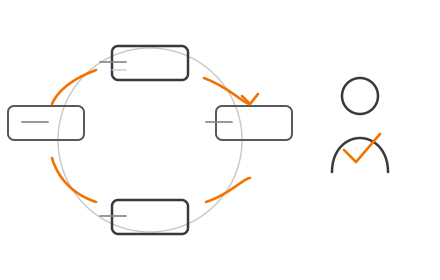
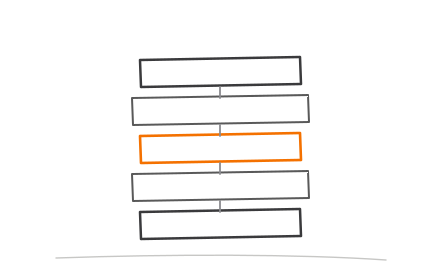
A LOS connects all origination steps into one platform, routing tasks automatically between departments, enforcing business rules at each stage, and removing manual handoffs between teams. Here's how each stage works:
Loan Application Stage
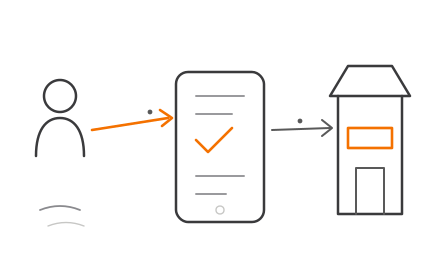
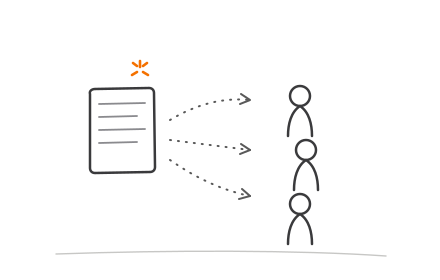
Borrowers submit applications through online portals, mobile apps, or in-branch terminals. The LOS validates completeness and accuracy in real time — flagging missing fields or inconsistencies before the application enters the processing queue. This front-end validation alone cuts downstream rework before it starts.
Data Collection and Verification Stage
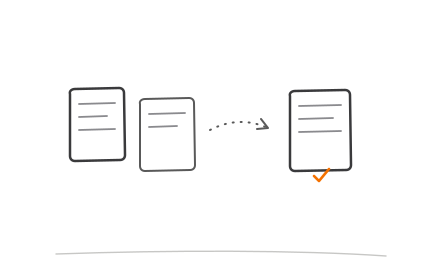
Once an application is accepted, the LOS triggers automated document collection: identity proof, income documents, address verification. It simultaneously pulls data from external sources — credit bureaus via API, government identity databases, and banking data through frameworks like India's Account Aggregator system — rather than waiting for borrowers to submit everything manually.
Credit Assessment and Underwriting Stage
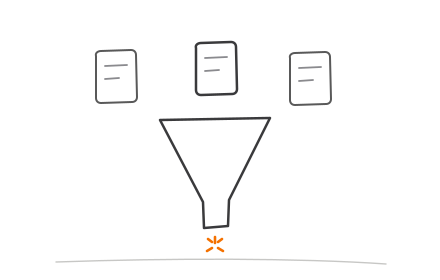
The LOS integrates with credit bureaus (such as TransUnion CIBIL in India) to retrieve credit scores and histories. It then applies predefined scoring models — increasingly powered by AI/ML algorithms — to evaluate the borrower's risk profile and recommend loan terms. McKinsey reports that sophisticated lenders can now automate 70–80% of SME credit decisions and up to 95% of retail underwriting in some institutions.
Loan Approval or Rejection Stage
Automated decision engines generate approval or rejection outcomes based on underwriting results. The LOS notifies borrowers immediately via email, SMS, or in-app messaging — no manual communication required. Approvals that once took days now complete in hours.
Disbursement Stage
For approved loans, the LOS generates loan agreements, routes them for e-signature, and integrates with core banking systems to trigger fund disbursement. From there, the account transfers to the loan management system for servicing — the origination process is complete.

Key Features of a Modern Loan Origination System
The gap between a functional LOS and a genuinely effective one comes down to specific capabilities. Here's what modern platforms include — and what legacy tools typically lack:
Workflow Automation
Rule-based task routing, automated notifications, and configurable approval workflows eliminate manual follow-ups entirely. Lenders define the rules once; the system enforces them on every application — consistently, without exceptions.
Document Management
Digital upload, classification, storage, and retrieval of borrower documents — with version control and audit trails. Integration with e-signature tools (DocuSign, Leegality, or similar) enables fully paperless processing from application to disbursement.
Integration Capabilities
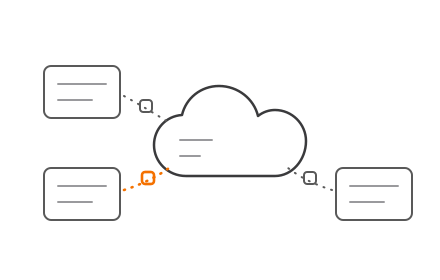
A modern LOS must connect cleanly with:
- Credit bureaus (CIBIL, Experian, Equifax)
- Core banking and accounting systems
- KYC/AML verification tools
- Government ID databases (Aadhaar, DigiLocker in India)
- Account Aggregator APIs for alternate data
- E-signature platforms
Pre-built connectors matter here — they reduce integration time from months to weeks.
Compliance Management
Built-in regulatory rule engines apply the correct compliance checks automatically, whether that's RBI Digital Lending Guidelines for Indian institutions or CFPB Regulation B and HMDA requirements for US lenders. Audit trails and automated reporting protect institutions during examinations.
This isn't optional. In 2024, Freedom Mortgage faced a $3.95 million CFPB penalty partly due to housing-data reporting errors — exactly the kind of issue a robust LOS compliance module prevents.
AI-Powered Decisioning and Analytics
80% of credit-risk organisations surveyed by McKinsey expect to implement generative AI in their workflows. Modern LOS platforms reflect this shift — using machine learning for credit risk modelling, fraud detection, and predictive analytics that go well beyond static scorecards.

Building these capabilities requires real technical depth. For lending institutions developing or modernising a custom LOS, that means working with partners who can integrate proprietary scoring models from the ground up — which is where Codiot's AI and data engineering practice focuses for finance clients.
Benefits of a Loan Origination System for Lenders
Speed and Operational Efficiency
Automation of repetitive tasks — document chasing, data entry, status updates — compresses loan processing from days or weeks to hours. One MeridianLink case study with Broadway Bank showed five to six days removed from the purchase-money loan cycle alongside a 50% reduction in mortgage closing costs. These aren't universal benchmarks, but they illustrate the scale of gain that well-implemented automation can deliver.
Accuracy and Compliance
Manual processes introduce errors. Automated data validation and built-in compliance checks catch issues before they become violations. The same Broadway Bank case study reported a 92% reduction in audit findings — from 26 to just 2 — in under two years. For institutions under regulatory scrutiny, that kind of improvement is operationally significant.

Better Borrower Experience
Digital-first lenders have a measurable conversion advantage. 68% of consumers have abandoned online financial services applications, and abandonment probability jumps to 60% or more when an application takes longer than five minutes. A well-designed LOS — with omnichannel access, real-time status updates, and minimal friction — directly reduces that drop-off rate.
Yet over 50% of organisations still struggle to deliver fast, seamless digital lending experiences, according to the State of Digital Lending 2024 report. For lenders that close that gap, the competitive upside is immediate: faster completions, lower drop-off, and borrowers who actually finish what they started.
How to Choose or Build the Right Loan Origination System
Evaluating Off-the-Shelf LOS Platforms
When assessing commercial LOS vendors, industry analysts broadly recommend evaluating platforms across four dimensions: composability, ecosystem connectivity, support for custom ML model integration, and user experience. Key criteria to assess:
- Scalability — Can it handle 10x your current loan volume without re-architecture?
- Configurability — Can business teams adjust workflows without developer involvement?
- Integration ecosystem — What pre-built connectors exist for your key third-party systems?
- Total cost of ownership — Factor licensing, implementation, maintenance, and compliance update costs together
- Compliance update frequency — How quickly does the vendor push regulatory changes?
- Vendor support quality — What SLAs and escalation paths exist post-deployment?
When a Custom-Built LOS Makes Sense
Off-the-shelf platforms cover standard workflows well. Custom development becomes the stronger choice when your requirements fall outside that standard:
- High-volume lenders with proprietary underwriting logic that standard platforms can't accommodate
- Institutions targeting underserved segments — microfinance, rural lending, informal sector — where standard credit scoring is insufficient
- Lenders needing deep AI/ML integration and custom scoring models built on their own data
- Businesses requiring tight integration with legacy core banking infrastructure

For these organisations, building in-house from scratch is rarely the fastest path. Partnering with a specialist technology firm is typically more cost-effective and faster to deploy.
Codiot has worked with lending institutions on fully tailored LOS builds — covering borrower portals, workflow engines, data engineering, and analytics — drawing on direct experience with private lending operations.
A Simple Decision Framework
| Organisation Type | Recommended Approach |
|---|---|
| Startup / early-stage lender | Configurable SaaS LOS — fastest time to market |
| Growing SME lender | Heavily customised SaaS or hybrid build |
| Enterprise / complex product portfolio | Custom-built LOS with proprietary AI models |
| NBFC / MFI with unique workflows | Custom build or specialist vertical platform |
Frequently Asked Questions
How does a loan origination system work?
A LOS automates the loan process by routing applications through sequential stages: data collection, credit assessment, underwriting, approval, and disbursement. It uses rule-based workflows and connects to external data sources like credit bureaus and KYC tools to do this.
What is the loan origination process?
Loan origination is the complete sequence from a borrower's initial application to final fund disbursement, covering document verification, credit assessment, underwriting, and approval. A LOS manages and automates each of these stages within a single platform.
What is the difference between a loan origination system and loan management software?
A LOS covers the front-end origination cycle — from application intake through disbursement. Loan management software takes over after that, handling repayment tracking, collections, and account servicing. Many modern platforms combine both functions.
What are the must-have features in a loan origination system?
Essential features include:
- Workflow automation and document management
- Credit bureau integration and compliance rule engines
- E-signature support and AI-powered decisioning
- API connectivity to core banking and KYC systems
Should I build a custom LOS or buy an off-the-shelf solution?
Off-the-shelf platforms suit lenders seeking quick deployment and standard workflows. Custom-built solutions are better for institutions with unique products, complex integrations, proprietary scoring models, or specific regulatory compliance requirements.
How long does it take to implement a loan origination system?
Cloud-based off-the-shelf LOS platforms typically deploy in 2–4 months. Custom-built or heavily customized solutions generally take 4–12 months, depending on integration complexity, required AI/ML components, and the development team's experience with lending infrastructure.