Key Loan Origination System Integrations for Lenders Lenders today face a tightening squeeze: origination costs are climbing, borrowers expect faster decisions, and regulators are raising the compliance bar. According to Freddie Mac's 2024 Cost to Originate Study, average mortgage origination costs rose 35% over three years, with personnel accounting for 67% of total production costs. The same study found that high adopters of digital tools had costs $1,500 lower per loan and cycle times 5 days shorter than low-adoption peers.

None of those efficiency gains happen without a well-integrated Loan Origination System. A standalone LOS manages workflow — but it's the integrations that supply the data, automate the decisions, and keep the institution compliant.

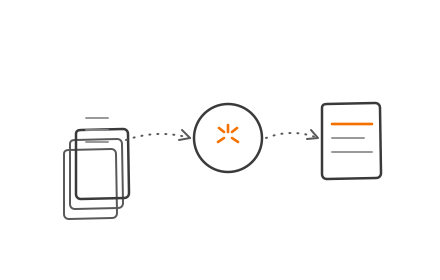
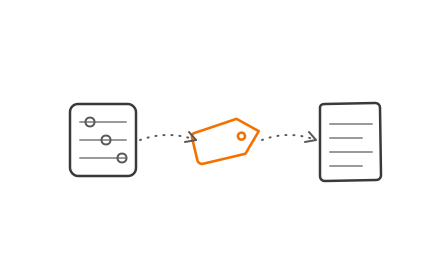
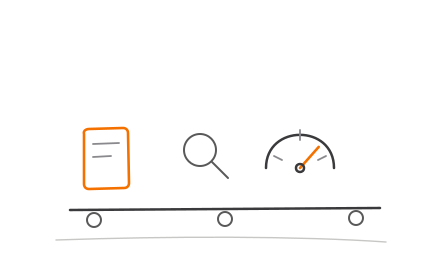
This article covers the four integration categories every lender needs to understand: credit and identity, risk and compliance, workflow and operations, and analytics with core banking. Each layer addresses a specific gap between raw LOS functionality and production-ready lending.


TL;DR

  • Credit bureau and KYC integrations are non-negotiable — they form the data foundation for every credit decision
  • Open banking and alternative data connections expand approvals for thin-file borrowers
  • AML, fraud detection, and compliance integrations shield lenders from regulatory penalties and identity fraud losses
  • CRM, e-signature, and payment integrations compress the loan lifecycle from days to hours
  • An API-first architecture prevents the fragmentation that kills scale

What Makes an LOS Integration "Essential"?

An LOS integration is a live data connection between the origination system and a third-party or internal platform — enabling real-time exchange of borrower data, credit decisions, documents, or payments without manual re-entry.

Two categories define the integration stack:

  • Essential integrations — directly affect the credit decision and regulatory compliance (credit bureaus, KYC, AML, fraud detection, automated decisioning)
  • Operational integrations — improve workflow efficiency without altering the decision itself (CRM, e-signature, payment processing, borrower portals)

Both matter. Strong decisioning without smooth workflows still costs you borrowers — slow processing is enough to push them elsewhere. And strong workflows built on weak compliance integrations are just building on a fault line; the cracks show up in audits, not applications.

The data bears this out. Blend's 2021 ROI study (vendor-reported, US mortgage context) found 11% fewer document errors, 13% fewer missing signatures, and savings of $962 per loan using integrated closing workflows — a useful benchmark even where loan sizes differ. On the compliance side, the risk is harder to quantify but harder to ignore: manual processes create exactly the gaps that regulators find.


Credit Bureau, Identity, and Open Banking Integrations

Credit Bureau Integrations

The three major bureaus — Experian, Equifax, and TransUnion — each offer APIs that pull credit reports, scores, and payment history directly into the LOS at application submission. No manual requests. No re-keying data.

Each bureau provides distinct API tooling:

  • Experian — Connect API now supports VantageScore 4.0; also offers Cashflow Score using consumer-permissioned transaction data
  • Equifax — Developer Portal includes OneView, Score Only, and OFAC Alert APIs
  • TransUnion — Client Technical Services repository covers TU4.0, TUXML, and other integration resources

For most loan types, pulling a tri-merge report through these integrations takes seconds rather than the hours or days required in manual workflows.

KYC and Identity Verification

U.S. Bank Customer Identification Program rules under 31 CFR 1020.220 require lenders to collect and verify name, date of birth, address, and an identification number for every new account, using risk-based procedures. Non-compliance carries direct regulatory exposure — making identity verification a core LOS requirement, not an afterthought.

Modern KYC integrations automate this through:

  • Document scanning (passport, driver's license)
  • Biometric checks (liveness detection)
  • Database lookups against government and commercial identity records

The same verification logic applies internationally. The UK's FCA and the EU's EBA have issued remote onboarding guidelines setting comparable requirements for their markets. Lenders operating across jurisdictions need identity integrations that can satisfy multiple regulatory frameworks from a single workflow — otherwise each new market means rebuilding the compliance layer from scratch.

Open Banking and Alternative Data

FCA research from March 2025 counted approximately 13.3 million active open banking users in the UK. The adoption trend is consistent globally, and it's changing underwriting.

Open banking integrations — connecting platforms like Plaid or similar services — allow the LOS to pull a borrower's real-time transaction history, income patterns, and cash flow data directly, reducing dependence on paper bank statements.

For thin-file borrowers, the impact is significant. The CFPB found 26 million U.S. adults — roughly 11% of the population — have no credit history with major bureaus. Alternative data integrations address this gap by incorporating:

  • Rental payment history
  • Utility and telecoms payments
  • E-commerce revenue data for small businesses
  • Cash flow analytics from bank account records

Experian's Cashflow Score, launched in 2025, claims a 25% lift in predictive performance versus conventional credit scores alone. Federal regulators have gone further, stating directly that cash flow data from bank records "may improve speed and accuracy of credit decisions and may expand access to credit" — one of the clearer regulatory signals in recent years that alternative data integrations are moving from experiment to expectation.


Alternative data types expanding credit access for 26 million thin-file borrowers infographic

Risk, Compliance, and Fraud Detection Integrations

AML Integrations

Under the FinCEN RMLO Final Rule, residential mortgage lenders and originators must maintain AML programmes and file Suspicious Activity Reports (SARs) for transactions involving $5,000 or more. SARs must be filed within 30 calendar days of initial detection, with supporting documentation retained for 5 years.

Manual AML screening against sanctions lists, PEP databases, and watchlists at that volume is not operationally viable. AML integrations automate these checks within the origination workflow — each application is screened before a decision is made, not after.

Fraud Detection

Synthetic identity fraud — where fraudsters combine real and fabricated data to create new identities — cost U.S. lenders an estimated $6 billion in 2016 and accounted for 20% of credit losses, according to a Federal Reserve white paper. The same research noted that traditional fraud models fail to flag 85–95% of potential synthetic identity applicants.

Modern fraud detection integrations address this through:

  • Behavioural analytics during the application session
  • Device fingerprinting
  • Synthetic identity detection algorithms
  • Cross-referencing against known fraud databases

These tools feed a score or flag directly into the LOS decision workflow, allowing underwriters to act on the signal before approval — not after a loss.

Automated Decisioning and Compliance Checks

Fraud scores and AML flags don't operate in isolation — they feed directly into a broader compliance layer. Regulatory compliance integrations automate checks against fair lending regulations, data privacy rules (including GDPR for applicable lenders), and jurisdiction-specific requirements. They generate structured audit trails that document every decision, every check, and every data point used.

The decisioning engine — whether internal or third-party — draws from all of the above: bureau data, fraud scores, AML flags, and compliance checks. This produces a consistent, defensible credit decision rather than one that depends on individual underwriter interpretation. That consistency matters in regulatory exams, where auditors expect documented rationale for every approval or denial.


LOS compliance and decisioning workflow from fraud detection to credit decision infographic

Workflow and Operations Integrations

CRM and Document Management

A CRM-to-LOS integration — Salesforce is the most common example — ensures loan officers access full borrower context without switching systems. Communication history, previous applications, and relationship data are visible inside the origination workflow. nCino and Salesforce extended their strategic partnership through 2031, serving more than 1,850 financial services providers, making CRM-LOS connectivity a baseline expectation in commercial lending — not a differentiator.

Document management integrations replace paper-based collection with automated digital workflows:

  • Borrowers upload documents through a secure portal
  • The LOS automatically indexes and categorizes each document
  • E-signature tools (DocuSign serves approximately 1.7 million customers) route agreements for execution without printing

Blend's 2021 study (vendor-reported) found integrated digital closing workflows shortened closing times by 2 days and saved up to 61 minutes per loan on hybrid closes.

Payment Processing and Borrower Communication

Payment integrations connect the LOS to payment gateways and processors to handle:

  • Automated disbursement upon loan approval
  • ACH repayment scheduling
  • Real-time payment tracking within the lending workflow

SMS/email notifications and self-service status portals keep applicants informed at each stage — cutting inbound support calls and recovering applications that stall mid-process.

When these workflow layers operate together, the loan lifecycle from intake to funding runs with minimal manual intervention — which is the point.


Analytics, AI, and Core Banking Integrations

Core Banking Integration

Core banking integration is the connection between the LOS and the institution's primary financial infrastructure. It enables:

  • Real-time account opening upon approval
  • Automated fund disbursement
  • Loan booking and GL reconciliation
  • Repayment tracking without duplication across systems

Without this integration, approvals and disbursements require manual handoffs between systems — creating delays and reconciliation errors at the point where speed matters most to the borrower.

BI, AI, and Machine Learning

A business intelligence layer connected to the LOS gives lenders visibility into pipeline performance, approval rates, turnaround times, and risk concentration by product or geography. These are management decisions — but only possible with structured, accessible data coming out of the origination system.

AI and machine learning integrations go further. The CFPB reported that an AI-driven underwriting model produced measurable gains over traditional models:

  • 27% more applicants approved with 16% lower average APRs
  • 95% higher approval rates for FICO 620–659 borrowers
  • 172% higher approval rates for thin-file applicants

AI underwriting model approval rate improvements versus traditional credit models comparison infographic

These results are not automatic. AI models integrated into an LOS require ongoing monitoring, fairness testing, and compliance controls. For lenders serving non-traditional or underserved segments, the data makes a compelling case for ML-enhanced underwriting — and the regulatory groundwork to support it is already in place.


Building a Scalable LOS Integration Strategy

Choosing the right integrations is only half the problem. How those integrations are built determines whether the stack holds together at scale.

API-First Architecture

The foundation of a resilient LOS is API-first architecture — where each integration connects via a standardised, documented API rather than a brittle point-to-point connection. When a third-party system updates its data format or endpoint, an API-based integration can adapt. A legacy middleware connection often breaks.

McKinsey's 2023 research on APIs in banking found that 81% of respondents view APIs as a priority for business and IT, with large banks allocating around 14% of IT budgets to API programmes. APIs now account for approximately 50% of all internal interfaces at large banks.

API-first LOS architecture showing banking integration priority and IT budget allocation infographic

Planning Your Integration Stack

Before selecting tools, lenders should answer three questions:

  1. Which integrations are must-haves for your specific loan product? A mortgage LOS needs different connections than a small business lending platform.
  2. Does your LOS support open APIs, or only vendor-managed integrations? The answer affects how much flexibility you have to connect best-in-class third-party tools.
  3. Do you have the technical resources to build and maintain custom integrations? If not, working with a technology partner — such as Codiot, which works across finance and private lending on AI-driven digital solutions — can reduce both build time and long-term maintenance risk.

Common Integration Pitfalls

Avoid these patterns that consistently undermine LOS integration projects:

  • Data fragmentation: too many disconnected point solutions producing inconsistent borrower records
  • Legacy middleware dependence: translation layers that become bottlenecks as transaction volumes grow
  • Underinvestment in testing: integrations that pass UAT but fail under production load or after vendor updates
  • Scope creep without prioritisation: adding integrations before foundational ones (bureau, KYC, AML) are stable

A well-sequenced strategy starts with the essentials — credit, identity, compliance — and builds operational and analytics layers once that core logic is stable and tested.


Frequently Asked Questions

What is a loan origination system?

A Loan Origination System (LOS) is software that automates and manages the end-to-end loan process — from application intake and credit assessment through underwriting, approval, and funding. It reduces manual work, improves accuracy, and gives lenders the compliance infrastructure needed to operate at scale.

What are the key components of a loan origination system?

Core components include application intake, identity verification, credit assessment, automated decisioning, document management, compliance checks, and loan closing and disbursement workflows. Each component typically depends on third-party integrations to function at production quality.

What are the different types of loan origination systems?

LOS platforms are typically categorized by loan type — Mortgage, Consumer/Retail, Commercial, and Small Business — and by deployment model (cloud-based, on-premises, or hybrid). Cloud-based systems are increasingly preferred for scalability and easier integration maintenance.

What are the 4 C's in lending?

The 4 C's are Capacity (ability to repay), Capital (assets held), Collateral (security offered), and Credit history. A well-integrated LOS automates evaluation of all four by pulling data from credit bureaus, bank accounts, and asset verification tools during underwriting.

What is the role of API integration in a loan origination system?

APIs are the connective layer that allows the LOS to communicate in real time with credit bureaus, fraud tools, core banking systems, and other platforms. They enable automated data exchange without manual re-entry, so lenders can trigger credit pulls, identity checks, and document requests directly from within the LOS.

How do LOS integrations improve loan processing speed?

Integrations eliminate manual steps — pulling credit reports, verifying identity, chasing documents — by automating data retrieval and routing. For straightforward applications, this can compress processing time from days to hours or even minutes.