How Data Analytics Improves Sales Performance in Business Sales teams today face more pressure than ever. Buyers arrive better informed, decision cycles have compressed, and the cost of misreading a prospect has grown considerably. In this environment, relying on instinct to manage pipelines, prioritise leads, and forecast revenue is a liability most businesses can't afford.

"Data-driven sales" gets discussed constantly — but the actual value shows up in specific, measurable outcomes: faster deal closures, fewer hours spent on low-probability leads, and revenue forecasts that hold up through the quarter. According to McKinsey research on data-driven B2B commercial growth, companies operating data-driven sales engines report 15–25% EBITDA increases compared to competitors.

This article explains three core ways data analytics creates measurable improvements in sales performance — and what organisations lose when they ignore it.


TL;DR

  • Replaces guesswork with evidence across the full sales cycle — from lead prioritisation to revenue forecasting
  • Core use cases include predictive lead scoring, segmentation-driven personalisation, and pipeline forecasting
  • Businesses without analytics face inconsistent pipelines, reactive management, and rising cost of sale
  • Value comes from consistent application tied to action, not from passively monitoring dashboards
  • Startups and SMEs benefit just as much as enterprises; the key is starting with clearly defined sales KPIs

What Is Data Analytics in Sales?

Data analytics in sales is the process of collecting, organising, and interpreting sales and customer data to inform decisions that drive revenue.

It applies across the entire sales cycle:

  • Lead generation — identifying which sources produce the most qualified prospects
  • Pipeline management — tracking deal health and progression in real time
  • Customer engagement — understanding which interactions move buyers forward
  • Deal closure — identifying patterns in won and lost deals
  • Post-sale retention — monitoring account health and upsell opportunities

The goal is higher win rates, shorter sales cycles, and more predictable revenue — the outcomes sales managers and business leaders are directly accountable for. Better-looking reports are a byproduct, not the point.

IBM defines sales analytics as gathering and analysing data points to assess progress toward goals, generate performance insights, and create actions to improve sales. The emphasis is on action — analytics that don't change behaviour don't improve revenue.


Key Advantages of Data Analytics for Sales Performance

The three advantages below focus on operational impact tied to outcomes sales teams actively track: conversion rates, deal velocity, revenue predictability, and customer lifetime value.

Advantage 1: Predictive Lead Scoring and Pipeline Visibility

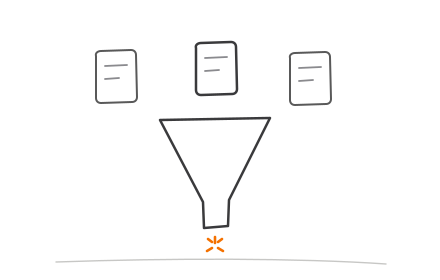
Sales teams managing high lead volumes face a consistent problem — not enough time to work every prospect thoroughly, and no reliable way to distinguish ready buyers from early-stage browsers. Predictive lead scoring solves this directly.

Analytics platforms process CRM data, email engagement, browsing behaviour, and firmographic signals to assign each lead a score. The result is a ranked view of who to contact first, built on data rather than rep intuition.

A 2025 B2B study analysing 23,154 CRM records found that a machine-learning lead scoring model achieved 98.39% accuracy in classifying leads — demonstrating that predictive models can rank B2B prospects with high reliability when built on sufficient CRM data.

The commercial impact goes beyond accuracy. According to LinkedIn's research across 2,187 B2B sellers, deep sellers — those who use sales intelligence tools to prioritise high-potential accounts — are 1.9x more likely to exceed quota than their peers. And 62% of these top performers use intelligence tools to guide account prioritisation, compared to just 15% of low performers.

Deep sellers versus average sellers quota attainment comparison infographic

KPIs this directly influences:

  • Lead-to-opportunity conversion rate
  • Average sales cycle length
  • Sales rep activity efficiency
  • Pipeline coverage ratio

When it matters most: This advantage has the highest impact for inbound-heavy SMEs, SaaS businesses, and financial services firms managing large inquiry volumes — where manual qualification is both slow and inconsistent.

Advantage 2: Customer Segmentation and Personalised Sales Outreach

Not all customers are the same. A startup evaluating software for the first time has different concerns and timelines than a large enterprise mid-way through a procurement process. Treating them identically wastes both parties' time.

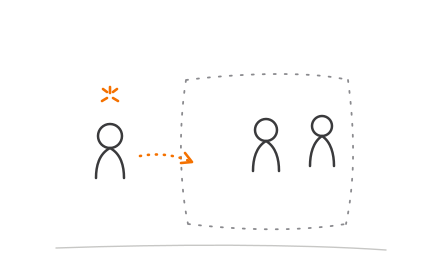
Data analytics allows businesses to divide their customer base into meaningful groups based on behaviour, purchase history, deal size, industry, or engagement pattern — then tailor messaging and offers to each.

The cost of getting this wrong is concrete. Gartner research found 73% of B2B buyers actively avoid suppliers that send irrelevant outreach — and 61% say they prefer a rep-free buying experience when engagement isn't relevant. Generic, batch-and-blast outreach doesn't just underperform; it damages supplier consideration altogether.

Personalisation at the segment level produces measurable lift. LinkedIn's Sales Leader Compass reports that B2B sellers using AI to craft personalised outreach see an average 28% increase in buyer response rates. McKinsey's B2B growth research adds a sharper finding: high-performing companies that combine AI with personalised customer experiences are 1.7x more likely to increase market share.

KPIs this directly influences:

  • Customer acquisition cost (CAC)
  • Email open and response rates
  • Average deal size by segment
  • Upsell and cross-sell revenue
  • Customer retention rate

When it matters most: Segmentation delivers the most value when a business serves diverse customer types. Selling to both startups and large enterprises, or across finance and manufacturing, means a single approach will consistently fail to resonate.

Advantage 3: Sales Performance Monitoring and Revenue Forecasting

Without visibility into deal progression and pipeline health, sales managers only discover problems after targets are missed. By then, the opportunity to course-correct mid-cycle is gone.

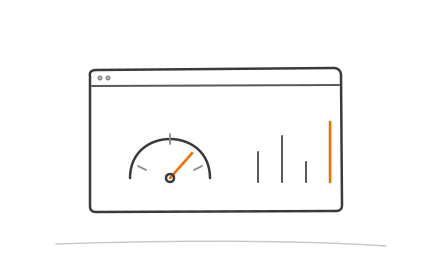
Analytics dashboards address this by tracking:

  • Deal progression and stage velocity in real time
  • Rep activity metrics and quota attainment
  • Historical win rates by segment, rep, and deal type
  • Pipeline gaps forming before they impact monthly targets

The data inputs matter as much as the outputs. Salesforce's State of Sales survey of 5,500 professionals found only 35% of sales professionals completely trust their organisation's data accuracy. Forecasts built on low-quality CRM data are unreliable regardless of the tools used — clean data hygiene is a precondition, not an afterthought.

Gartner identifies pipeline management and sales forecasting as among the areas where sales operations are least effective, meaning most organisations have real room to improve here. The payoff is worth pursuing: 83% of sales teams using AI reported revenue growth, compared to 66% of teams without AI-enabled analytics, per the same Salesforce research.

KPIs this directly influences:

  • Quota attainment rate
  • Forecast accuracy percentage
  • Pipeline velocity
  • Churn-adjusted revenue projection
  • Manager-to-rep coaching efficiency

When it matters most: This advantage becomes critical as teams scale — particularly for businesses in growth phases, investment or lending verticals where revenue predictability affects funding decisions, and organisations managing distributed or remote sales teams.


What Happens When Sales Analytics Is Missing

Without analytics embedded in the sales process, businesses default to instinct and lagging indicators. By the time problems are visible, the opportunity cost has already accumulated.

The common consequences:

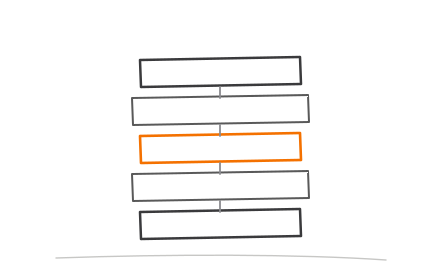
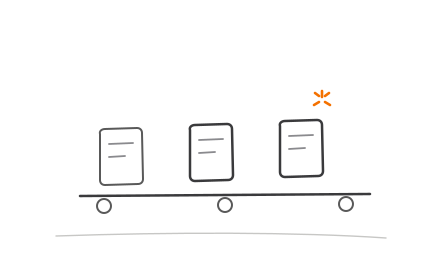
  • Reps pursue low-probability deals at the same intensity as high-value ones, skewing time allocation and revenue projections
  • Missed targets only surface after the quarter closes, leaving managers no room to redirect effort mid-cycle
  • Without lead scoring or segmentation, customer acquisition costs rise as generic outreach produces diminishing returns
  • What works for a 5-person team cannot replicate across 20 reps without data-backed playbooks; instinct doesn't transfer

Salesforce reports that sales reps spend 70% of their time on non-selling tasks. Without data identifying which activities actually drive revenue, that time continues to drain into low-impact work — and no one catches it until the damage shows up in the numbers.


Four key consequences of missing sales analytics for revenue and pipeline health

How to Get the Most Value from Sales Analytics

Sales analytics delivers compounding returns when it's embedded across the sales workflow — not treated as a quarterly reporting exercise. Three conditions determine how much value you actually extract:

  1. Consistency — apply analytics across the full sales cycle, from first lead touch to post-sale review. Data gaps at any stage distort the picture and erode forecast reliability.

  2. Scheduled review cadences — align reviews to your sales cycle: weekly pipeline checks, monthly performance audits, quarterly forecast recalibrations. Patterns caught early drive action; patterns caught late become post-mortems.

  3. Action over documentation — a dashboard that doesn't change behaviour is just a report. Tie each insight to a specific action: re-prioritising leads, adjusting pitch approach, or reallocating territory.

Startups and SMEs without in-house data engineering capacity can accelerate this by working with a partner like Codiot, which builds custom data analytics and business intelligence solutions that give growing teams the same analytical foundation larger organisations develop over years.

Conclusion

Data analytics in sales comes down to three things: knowing which leads to pursue, which customers to invest in, and whether the business is on track before the quarter ends. That visibility is what separates teams that manage pipelines proactively from those reacting to shortfalls after the quarter closes.

Businesses that build these habits early — consistent lead scoring, customer-level personalisation, and forward-looking forecasting — outpace competitors who rely on intuition as market complexity grows.

Treating analytics as an ongoing practice, not a one-time implementation, is what sustains that advantage. That requires regular attention, clearly defined KPIs, and either an internal team or a technology partner capable of translating raw data into decisions that directly drive pipeline and revenue growth.


Frequently Asked Questions

How can data analytics be used to improve sales performance?

Data analytics improves sales performance by enabling lead prioritisation through scoring, personalising outreach via customer segmentation, and improving revenue forecast accuracy. Together, these capabilities shorten sales cycles and lift win rates by replacing guesswork with evidence.

What are the 4 types of data analytics?

The four types are descriptive (what happened), diagnostic (why it happened), predictive (what will happen), and prescriptive (what action to take). In sales, descriptive analytics reviews past deal performance, while predictive and prescriptive analytics guide lead prioritisation and pipeline decisions.

What are the 5 C's of data analytics?

The 5 C's — Context, Clarity, Completeness, Coherence, and Conclusions — are a framework for evaluating how sales data is collected and interpreted. They help teams ensure data is relevant, well-structured, and tied to specific decisions rather than sitting unused in dashboards.

How can data analytics help increase sales in an online business?

Analytics helps online businesses increase sales by identifying high-converting traffic sources, personalising recommendations, reducing cart abandonment through behavioural triggers, and optimising pricing based on demand. The goal is to intervene at the exact points where buyers drop off.

What sales KPIs can data analytics help track?

Key KPIs include lead conversion rate, average deal size, sales cycle length, customer acquisition cost, pipeline velocity, and customer lifetime value. Tracking these in real time — rather than monthly — lets teams course-correct before targets are missed.

Is data analytics only useful for large enterprises?

No. For startups and SMEs, limited resources make efficient lead targeting and accurate forecasting even more critical — not less. Modern tools and technology partners make implementation accessible without requiring a large in-house data team, meaning smaller businesses can capture the same advantages at a proportionate scale.